Learn how artificial intelligence songwriting supports lyrics, melodies, and production while protecting originality, copyright, and creative control.
Artificial Intelligence Songwriting
Artificial intelligence songwriting uses machine learning systems to suggest lyrics, melodies, harmonies, arrangements, or complete musical drafts. These tools can accelerate experimentation, but compelling songs still require human judgment, emotional specificity, musical taste, and responsible rights management.
For songwriters, the practical opportunity is not replacing creativity. It is reducing the time spent confronting an empty page, testing variations, and organizing early ideas. The strongest workflow treats AI as an adjustable collaborator whose output must be questioned, edited, performed, and documented.
Quick Answer: Artificial intelligence songwriting can generate lyric concepts, chord progressions, melodies, arrangements, and production sketches from prompts. Use it to explore possibilities rather than publish untouched output. Define your creative brief, generate narrow alternatives, revise every meaningful choice, verify rights, and preserve records showing your human contribution.
What Is Artificial Intelligence Songwriting?
Artificial intelligence songwriting is the use of generative models or algorithmic tools during song creation. A system learns statistical relationships from musical or textual data, then predicts plausible continuations based on instructions, uploaded material, settings, or previous notes.
This definition matters because prediction is not intention. A model can produce a convincing rhyme or chord sequence without understanding grief, humor, cultural context, or the personal event behind a song. The writer supplies meaning and decides which musical choices deserve to survive.
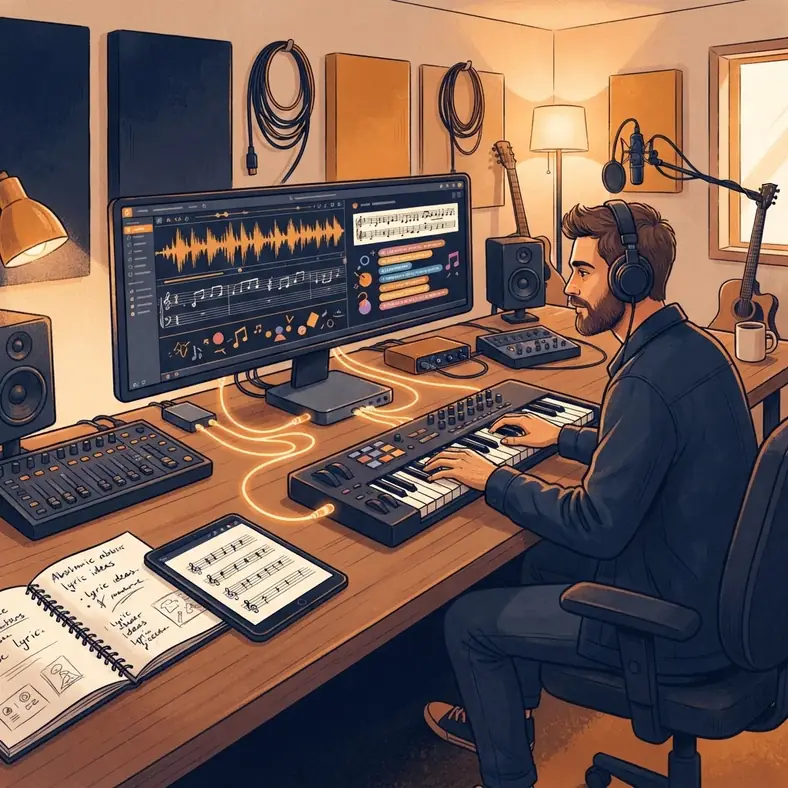
AI can contribute at several stages:
- Ideation: themes, titles, imagery, narrative perspectives, and reference lists.
- Lyrics: rhyme alternatives, structural drafts, syllable patterns, and line variations.
- Composition: chord progressions, melodies, counterpoints, and rhythmic motifs.
- Production: arrangement concepts, instrumental textures, demos, and stem experiments.
- Revision: contrast checks, repetition analysis, structural comparisons, and alternative endings.
What Can AI Songwriting Tools Actually Do?
AI tools differ significantly, so choose one according to the bottleneck you need to solve. Text models are useful for language exploration, while music generators can demonstrate melodies or arrangements. Production assistants may analyze audio, separate stems, or propose processing decisions.
| Tool category | Best use | Human responsibility | Main risk |
|---|---|---|---|
| Lyric generator | Ideas and variations | Voice, truth, and phrasing | Generic language |
| Melody generator | Motif exploration | Singability and identity | Familiar patterns |
| Music generator | Rapid demos | Arrangement and authorship | Unclear training rights |
| Production assistant | Technical refinement | Taste and final approval | Overprocessing |
| Voice model | Temporary vocal mockups | Consent and disclosure | Unauthorized imitation |
Before adopting a platform, read its terms for ownership, commercial use, training data, uploads, and deletion. A free plan may prohibit monetization even when a paid plan permits it. Save a dated copy of the applicable terms because platforms can revise policies after you create a track.
How Should You Write a Song With AI?
A controlled process produces more original work than repeatedly requesting a complete song. The following workflow keeps the writer responsible for artistic direction and creates useful evidence of human authorship.
1. Write a Specific Creative Brief
Define the listener, emotional change, point of view, tempo range, structure, and musical constraints. Replace a broad request such as "write a sad pop song" with a concrete scenario: a narrator deletes an unsent voicemail after realizing an apology would reopen an old relationship.
Specific constraints make evaluation easier. Include desired imagery and prohibited cliches, but avoid requesting imitation of a living artist. Describe observable qualities instead, such as conversational verses, a restrained pre-chorus, syncopated drums, and a chorus melody that rises before resolving downward.
2. Generate Components, Not a Finished Identity
Request ten titles, three narrative angles, or five chorus concepts rather than one complete song. Component generation makes comparison possible and prevents the first fluent response from controlling the project. Reject predictable suggestions quickly and combine only ideas that support your brief.
3. Rewrite Lyrics in Your Own Voice
AI lyrics often sound polished while remaining emotionally interchangeable. Replace abstract declarations with sensory evidence, consequential actions, and language the narrator would naturally use. Read every line aloud to identify awkward stress, excess syllables, accidental ambiguity, and rhymes that sound written rather than spoken.
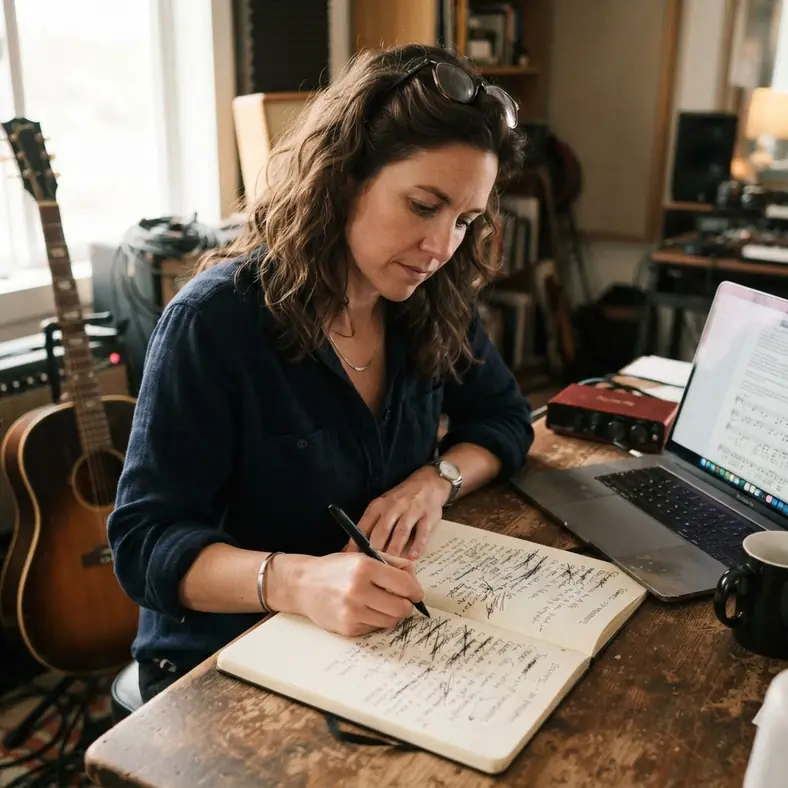
A useful editing test asks four questions:
- Could this line belong to hundreds of unrelated songs?
- Does it reveal new information or merely repeat an emotion?
- Does the natural word stress fit the melody?
- Can the image be observed, heard, touched, or remembered?
If a line fails two questions, replace it instead of polishing it.
4. Test Melodies With Your Actual Voice or Instrument
A generated melody may look coherent in a piano roll yet feel unnatural when sung. Check its range, breathing points, repeated notes, interval difficulty, and relationship with important syllables. Record several human performances because phrasing frequently exposes stronger rhythmic options than visual editing.
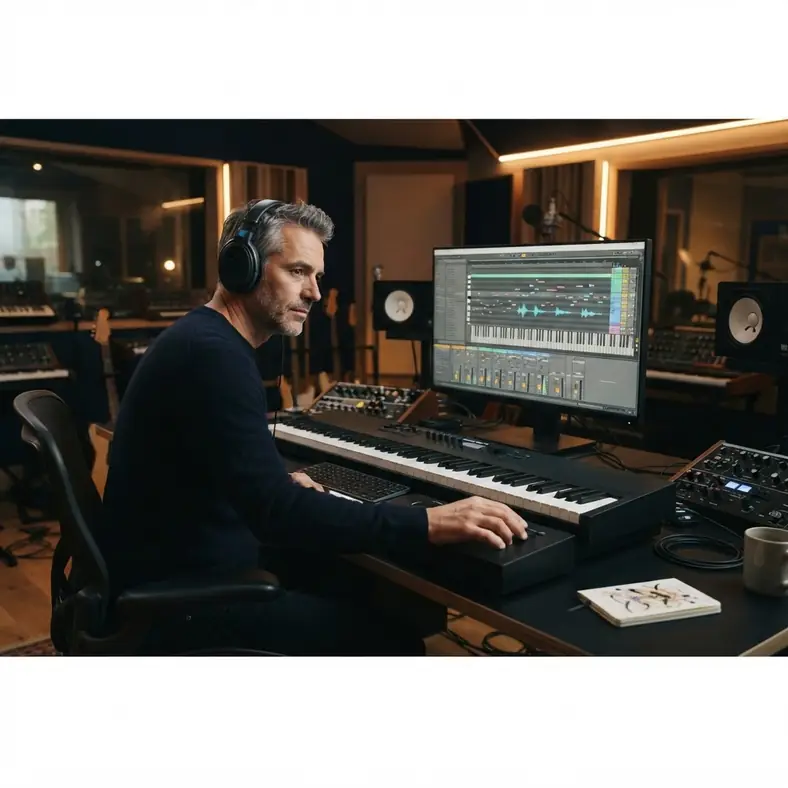
Preserve one memorable motif and vary its rhythm, register, or ending across sections. This creates coherence without making every phrase identical. If the chorus does not feel distinct, compare note range, phrase length, harmonic rhythm, and lyrical density instead of simply making it louder.
5. Arrange for Emotional Progression
Arrangement should explain how the listener is meant to feel over time. Map each section by intensity, instrumentation, register, and density. Remove elements before adding more; a brief drop in drums or harmony can make the next entrance more powerful than another layered instrument.
Use AI-generated demos as sketches, then rebuild important parts with deliberate performances, sound choices, and transitions. This improves originality and gives collaborators editable material rather than a flattened result that conceals how decisions were made.
How Do You Preserve Originality?
Originality comes from a traceable sequence of personal decisions, not merely an unusual prompt. Supply lived details, write core hooks yourself, alter generated harmony, perform distinctive parts, and retain rejected versions. The creative record should reveal selection, transformation, and musical judgment.
Teams at ZoneTechify and WebPeak approach generative work most effectively when automation supports a defined human objective. For projects requiring a structured AI workflow, relevant artificial intelligence services can help establish governance, evaluation criteria, and repeatable production processes without surrendering editorial control.
Keep a project folder containing:
- The original brief and dated prompt history.
- Handwritten notes, voice memos, and MIDI drafts.
- Generated candidates and documented rejections.
- Revised lyric sheets with tracked changes.
- Performer, producer, model, and dataset disclosures.
- Licenses and terms applying on the creation date.
These records support collaboration, split discussions, release reviews, and potential copyright questions.
What Are the Copyright and Ethical Risks?
Copyright treatment varies by country, and platform ownership terms do not automatically create copyright protection. In its January 2025 report on copyrightability, the United States Copyright Office concluded that prompts alone generally do not provide sufficient human control, while human-authored expression and perceptible creative modifications may be protected.
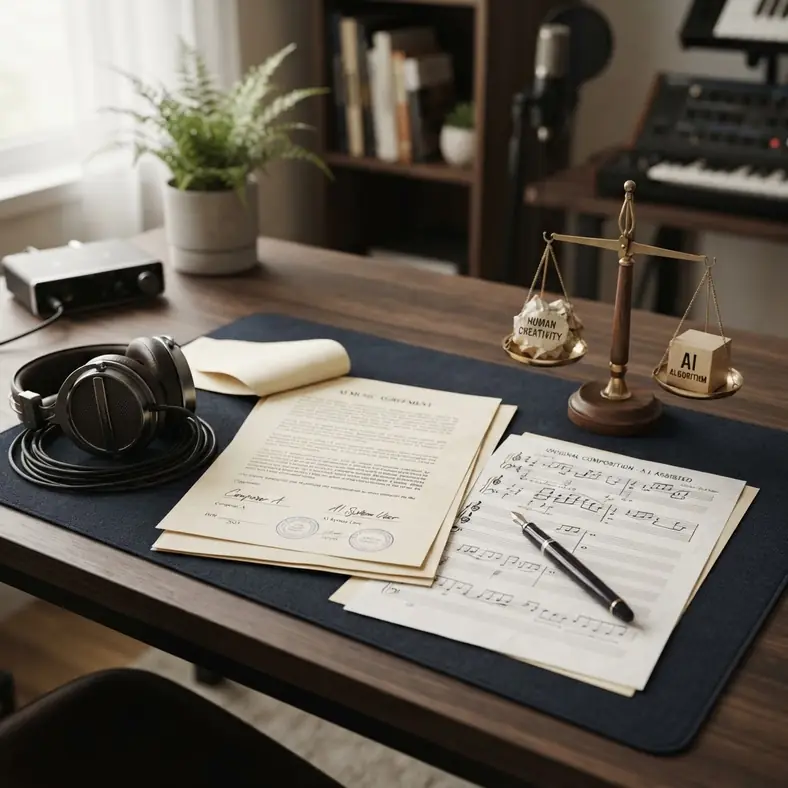
Consent is equally important. IFPI reported in its 2023 global music engagement study that 74% of surveyed music fans agreed AI should not clone or impersonate artists without authorization. Never clone a recognizable voice, likeness, or signature performance style without explicit permission covering the intended distribution.
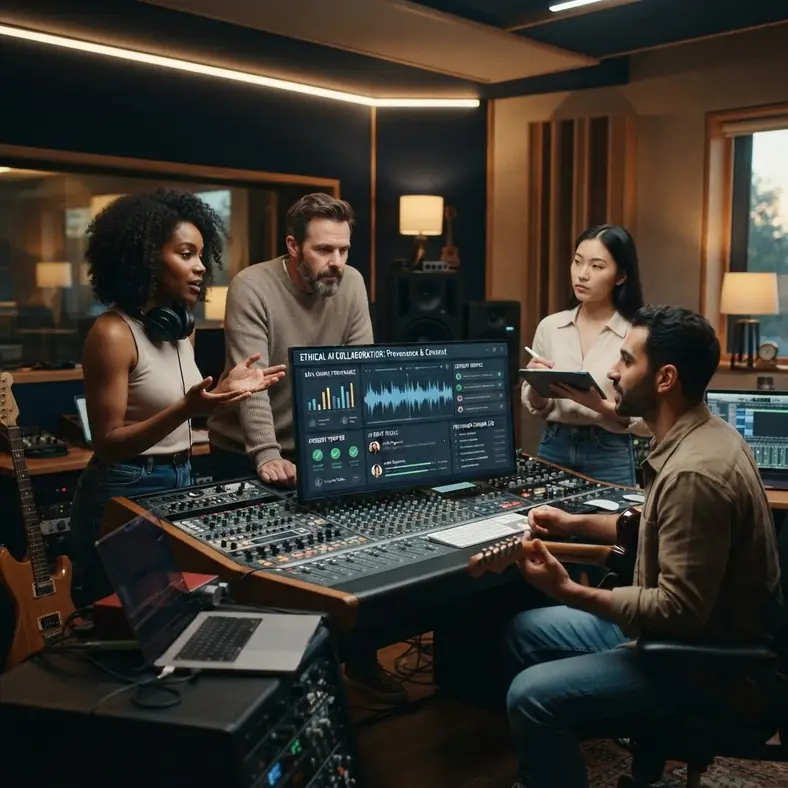
Before release, confirm:
- The tool permits commercial use under your plan.
- Every uploaded sample, lyric, recording, and voice is authorized.
- Collaborator splits reflect actual contributions.
- Generated material has been checked for suspicious similarity.
- Disclosures meet distributor, label, platform, and jurisdictional requirements.
- A qualified lawyer reviews high-value or disputed releases.
This checklist is practical risk management, not legal advice.
How Can You Evaluate an AI-Assisted Song?
Evaluate the song without mentioning the technology. Ask target listeners what they remember, where attention drops, what emotion changes, and which lines feel unbelievable. Unprompted recall is more informative than asking whether respondents "like" the track.
Score each draft from one to five for hook recall, lyrical specificity, melodic singability, structural momentum, production clarity, and artist fit. Compare versions using the same speakers and listening level. Change one major variable at a time so you can identify why a revision performs better.
Key Takeaways
- Artificial intelligence songwriting is most valuable for exploration, variation, and rapid prototyping.
- Human authors must provide intention, emotional truth, selection, revision, and accountable final approval.
- The US Copyright Office distinguishes protected human expression from material controlled primarily through prompts.
- IFPI found that 74% of surveyed fans opposed unauthorized AI impersonation of artists.
- Commercial releases require documented licenses, contributor consent, originality checks, and retained creation records.
- Narrow prompts and component-level generation usually produce more controllable results than requesting complete songs.
Frequently Asked Questions (FAQ)
Can AI write an entire song for me?
Yes, some tools can generate lyrics, vocals, melodies, and arrangements from one prompt. However, a technically complete output may lack personal meaning, originality, or reliable commercial rights. Treat it as a demo, then rewrite, perform, document, and legally review the elements you intend to release.
Is AI-generated music copyright free?
No. AI-generated music is not automatically copyright free. Protection and ownership depend on jurisdiction, human contribution, source material, and platform terms. The output could also resemble protected work. Review the license, preserve evidence of your authorship, and obtain legal advice before commercially exploiting valuable material.
What is the best way to prompt an AI songwriting tool?
Provide a concrete situation, narrator, emotional turn, structure, tempo range, and musical constraints. Ask for several narrow alternatives rather than a finished song. Describe musical characteristics instead of naming living artists, then evaluate each suggestion against your brief and substantially revise anything you keep.
Will AI replace professional songwriters?
AI will likely automate parts of brainstorming, demo creation, and variation, but professional songwriting depends on taste, relationships, cultural judgment, performance awareness, and lived experience. Writers who direct tools responsibly may work faster, while distinctive perspective and trusted collaboration remain difficult to automate convincingly.
How do I make AI lyrics sound human?
Replace general emotions with specific actions, objects, places, and consequences. Match vocabulary to the narrator, read lines aloud, correct unnatural stress, and remove predictable rhymes. A strong lyric reveals information progressively; each section should change what the listener understands rather than restating the same feeling.
Can I release an AI-assisted song commercially?
Possibly, provided the platform license allows commercial use and every sample, voice, upload, and collaborator contribution is authorized. Check distributor rules, document human revisions, test for similarity, disclose AI involvement when required, and consult qualified counsel when the song has substantial financial or reputational value.