
A practical, expert breakdown of how cryptographic hashing secures blockchain networks through chain linking, Merkle trees, proof of work, and tamper detection.
How Does a Hash Help Secure Blockchain Technology
Every blockchain on earth rests on one deceptively simple mathematical tool: the cryptographic hash function. Remove hashing and Bitcoin, Ethereum, and every enterprise ledger built after them collapse into ordinary, editable databases. Hashing is what turns a shared spreadsheet into a tamper-evident historical record that thousands of mutually distrustful computers can agree on.
This guide explains exactly how a hash secures blockchain technology, based on how production networks actually behave, not on abstract theory. You will learn what a hash is, how hashes chain blocks together, why changing one character breaks everything downstream, and where hashing stops being enough.

Quick Answer: A hash secures blockchain technology by converting each block's data into a unique fixed-length fingerprint that is stored inside the next block. Altering any past transaction changes that fingerprint, breaking every subsequent link, so the entire network instantly detects tampering and rejects the modified chain.
What Is a Cryptographic Hash, Exactly?
A cryptographic hash function is a one-way mathematical process that takes input of any size and returns a fixed-length output called a hash, digest, or fingerprint. Bitcoin uses SHA-256, which always returns 256 bits, written as 64 hexadecimal characters, whether the input is a single letter or a 500-page book.
Four properties make hashing suitable for security work:
- Deterministic - the same input always produces the same output, so any node can independently verify a block.
- One-way (preimage resistant) - you cannot reverse a hash to recover the original data.
- Collision resistant - it is computationally infeasible to find two different inputs producing the same hash.
- Avalanche effect - a one-bit change in input produces a completely unrelated output.

That fourth property is where blockchain security truly begins. It means a hash is not a summary of data. It is a proof of data. If the hash matches, the data is byte-for-byte identical to what was originally recorded.
Hashing Is Not Encryption
This distinction matters and is frequently confused. Encryption is two-way and designed to be reversed with a key. Hashing is one-way and designed never to be reversed. Blockchains use both: hashing to prove integrity, and public-key cryptography with digital signatures to prove ownership. A hash alone never hides data, it only fixes it in place.
How Hashes Chain Blocks Together
The core security mechanism is structural. Each block header contains the hash of the previous block's header. That single field is what makes a chain a chain rather than a pile of blocks.
A typical block header contains:
- The previous block's hash
- The Merkle root of all transactions in the block
- A timestamp
- The difficulty target
- A nonce

Because the previous hash is an input to the current block's hash, the hashes form a dependency chain stretching back to the genesis block. Block 900,000's hash mathematically depends on block 899,999, which depends on 899,998, and so on. Every block silently certifies the entire history before it.
This is why blockchain records are described as immutable. They are not physically unchangeable. They are change-evident. Anyone with a copy of the chain can recompute every hash in minutes and detect a single altered byte.
Why One Small Change Breaks the Whole Chain
Suppose an attacker edits a transaction in block 500 to redirect funds to themselves. Here is what happens, step by step:
- The transaction data changes, so the Merkle root of block 500 changes.
- A changed Merkle root changes block 500's header, so its hash changes completely.
- Block 501 still stores the old hash of block 500, so the link no longer validates.
- To repair the break, the attacker must recompute valid proof of work for block 501, then 502, then every block up to the chain tip.
- Meanwhile honest miners keep extending the real chain, so the attacker must out-compute the entire rest of the network simultaneously.

The avalanche effect is what makes step two so brutal. Changing an amount from 1.0 to 1.00000001 does not produce a slightly different hash. It produces an entirely unrelated 64-character string, with no gradient an attacker could follow toward a useful result.
Merkle Trees: Hashing at Scale
A Merkle tree is a structure in which transactions are hashed in pairs, then those hashes are hashed in pairs, repeatedly, until a single hash remains: the Merkle root. That root is stored in the block header.
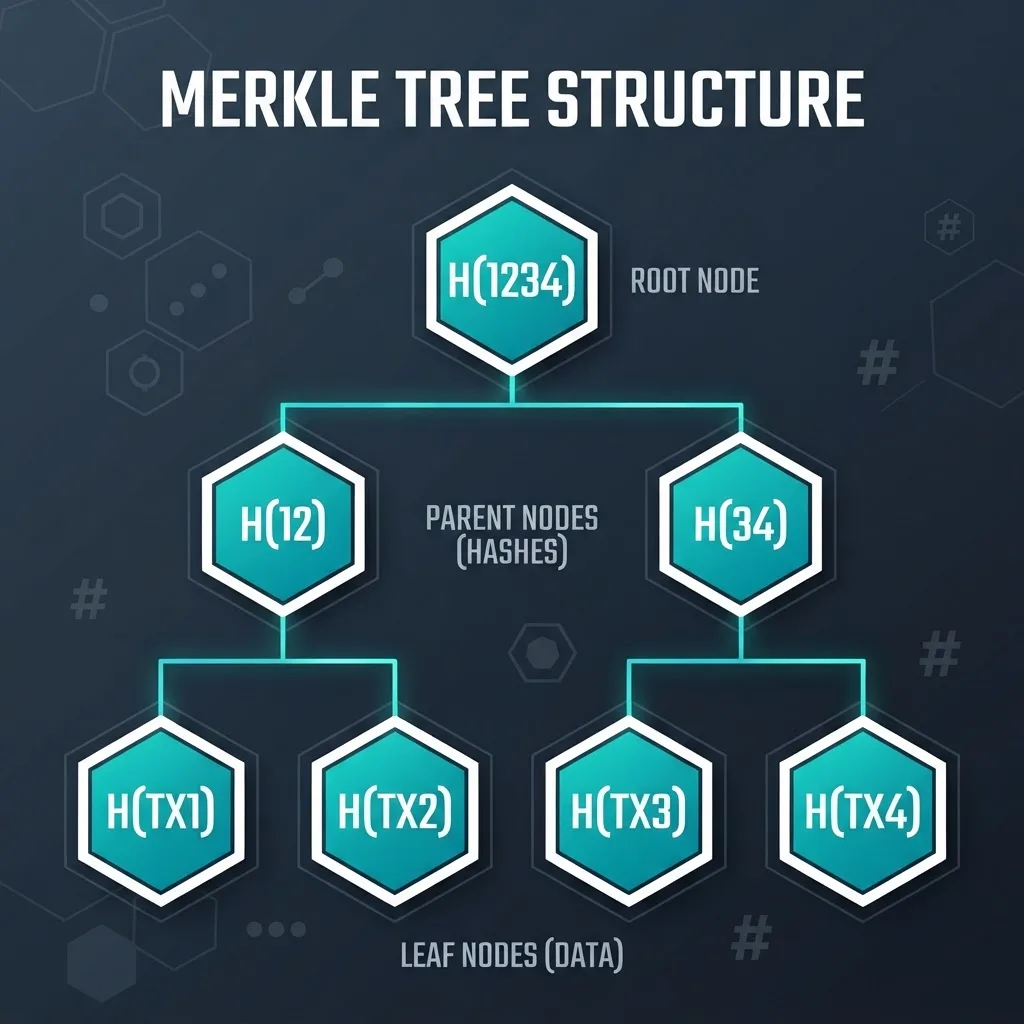
Merkle trees deliver two practical benefits real networks depend on:
- Compact integrity - one 32-byte root commits to thousands of transactions. Bitcoin blocks routinely contain over 2,000 transactions, all secured by a single header field.
- Efficient proofs - a light wallet can prove a transaction is in a block by downloading roughly log2(n) hashes instead of the whole block. For 1,024 transactions that is about 10 hashes rather than all 1,024.
This is the mechanism behind Simplified Payment Verification, which lets mobile wallets verify payments without storing hundreds of gigabytes of chain data. It is a genuine engineering achievement built entirely from repeated hashing.
Hashing in Proof of Work Consensus
Proof of work is a hashing competition. Miners repeatedly change the nonce in a block header and rehash it, searching for an output below a target value, meaning a hash beginning with a required number of zeros. There is no shortcut. The only strategy is brute-force guessing.

According to public network data published by Blockchain.com, the Bitcoin network's hash rate has exceeded 600 exahashes per second, meaning miners collectively compute more than 600 quintillion hash attempts every second. Bitcoin's protocol retargets difficulty every 2,016 blocks so that a valid hash is found roughly every 10 minutes regardless of how much hardware joins.
That enormous expenditure converts electricity into history that is economically irrational to rewrite. Rewriting six confirmed blocks means redoing all of their proof of work faster than the entire honest network produces new blocks. The security is not merely mathematical, it is financial.
Hashing Still Matters in Proof of Stake
Ethereum's move to proof of stake in 2022, an upgrade that the Ethereum Foundation reports reduced network energy use by roughly 99.95 percent, removed mining but not hashing. Blocks are still linked by hashes, state is still committed via hash-based tries, and validator attestations still sign hashes. Consensus changed. Integrity mechanics did not.
Comparison: What Hashing Protects and What It Does Not
| Security Concern | Does Hashing Solve It | How or Why Not |
|---|---|---|
| Detecting altered past records | Yes | Any edit changes the block hash and breaks all downstream links |
| Proving a transaction is included in a block | Yes | Merkle proofs verify inclusion with a handful of hashes |
| Making rewriting history expensive | Yes | Proof of work requires redoing brute-force hashing for every later block |
| Keeping transaction contents private | No | Hashes prove integrity, they do not conceal on-chain data |
| Proving who owns funds | No | Requires digital signatures and private keys, not hashing |
| Stolen private keys | No | A valid signature looks legitimate regardless of hashing |
| Bugs in smart contract logic | No | Flawed code is hashed and executed faithfully |
The honest takeaway from years of building on these systems: nearly every major crypto loss has come from the right column, not the left. Hashing rarely fails. Key management, bridges, and contract logic do.

Hashing Beyond Blocks: Addresses and Identifiers
Hashing appears throughout blockchain systems in places most users never notice.
- Wallet addresses are derived by hashing public keys. Bitcoin applies SHA-256 then RIPEMD-160, shortening a long key into a compact address while adding a protective layer, since the raw public key stays hidden until the funds are spent.
- Transaction IDs are hashes of transaction data, which is why every explorer lookup uses a 64-character string.
- Checksums in address formats are hash-derived, so a mistyped address is rejected rather than sending funds into the void.
- File anchoring lets organizations store only a document's hash on-chain, proving a file existed unchanged at a point in time without publishing its contents.

That last pattern is the most commercially useful for ordinary businesses. Supply chain records, audit logs, medical consent forms, and certificates can all be hash-anchored for verifiable integrity while the underlying data stays private in existing systems. Teams exploring this kind of architecture often start with focused technical guidance from partners such as ZoneTechify or WebPeak before committing to a full ledger deployment.
Practical Guidance for Builders and Evaluators
If you are assessing or building a blockchain system, these checks separate real security from marketing language:
- Confirm the hash algorithm. SHA-256, SHA-3, Keccak-256, and BLAKE2 are appropriate. MD5 and SHA-1 are broken for collision resistance and must never secure a ledger.
- Verify chain linking is enforced by nodes. A database with a hash column that nothing validates provides zero protection.
- Check how many independent parties hold copies. Tamper evidence only matters if someone else has the correct version to compare against.
- Treat private keys as the real attack surface. Use hardware wallets, multisig, and clear recovery procedures.
- Never hash passwords with blockchain hash functions. SHA-256 is deliberately fast. Use bcrypt, scrypt, or Argon2 for credentials.
Key Takeaways
- A cryptographic hash is a fixed-length fingerprint of data; SHA-256 always outputs 64 hexadecimal characters regardless of input size.
- Each block stores the previous block's hash, so altering old data invalidates every block that follows.
- The avalanche effect means a one-bit change produces a completely unrelated hash, leaving attackers no shortcut.
- Merkle trees compress thousands of transactions into one root hash and enable inclusion proofs using roughly log2(n) hashes.
- Bitcoin's network hash rate has surpassed 600 exahashes per second, making historical rewrites economically irrational.
- Ethereum's 2022 proof of stake transition cut energy use by about 99.95 percent while keeping hash-based integrity intact.
- Hashing proves integrity but does not provide privacy, ownership proof, or protection from stolen keys and buggy contracts.
Frequently Asked Questions (FAQ)
What is a hash in blockchain in simple terms?
A hash is a unique fixed-length fingerprint generated from a block's data. If even one character of that data changes, the fingerprint changes entirely. Blockchains store each block's hash inside the next block, so the network can instantly detect whether any past record has been altered.
Can a blockchain hash be reversed or decrypted?
No. Cryptographic hash functions are one-way, so there is no key or algorithm that recovers the original input from a hash. Attackers can only guess inputs and compare outputs, which is infeasible for realistic data. This is why hashing proves integrity but never provides confidentiality.
What happens if someone changes data in an old block?
The altered block's hash changes immediately, so the next block's stored previous-hash no longer matches. That break cascades through every later block. To hide it, the attacker must redo proof of work for all subsequent blocks faster than the entire honest network, which is practically impossible.
Is SHA-256 still secure for blockchain in 2026?
Yes. SHA-256 has no known practical collision or preimage attacks and remains a NIST-approved standard securing Bitcoin. Large-scale quantum computers would threaten signature schemes before hash functions, and SHA-3 plus larger digests provide migration paths if the threat landscape shifts.
Do hashes make blockchain completely unhackable?
No. Hashing makes stored history tamper-evident, but it cannot stop stolen private keys, phishing, flawed smart contract code, or compromised exchanges. Most real-world crypto losses occur at these layers, not in the hashing itself. Strong key management matters as much as strong cryptography.
Why do different blockchains use different hash algorithms?
Algorithm choice reflects design goals. Bitcoin uses SHA-256 for proven stability, Ethereum uses Keccak-256 for its ecosystem tooling, and Litecoin uses Scrypt to resist specialized mining hardware. All provide strong collision resistance while optimizing for different hardware, speed, and decentralization trade-offs.
Final Thoughts
Hashing is the quiet foundation that makes distributed trust possible. It does not encrypt, it does not authorize, and it does not fix bad code. What it does is far more fundamental: it makes the past verifiable by anyone, at any time, at almost no cost. Understanding that boundary, what hashing guarantees and what it deliberately leaves to signatures, consensus, and operational discipline, is what separates informed blockchain decisions from expensive assumptions.