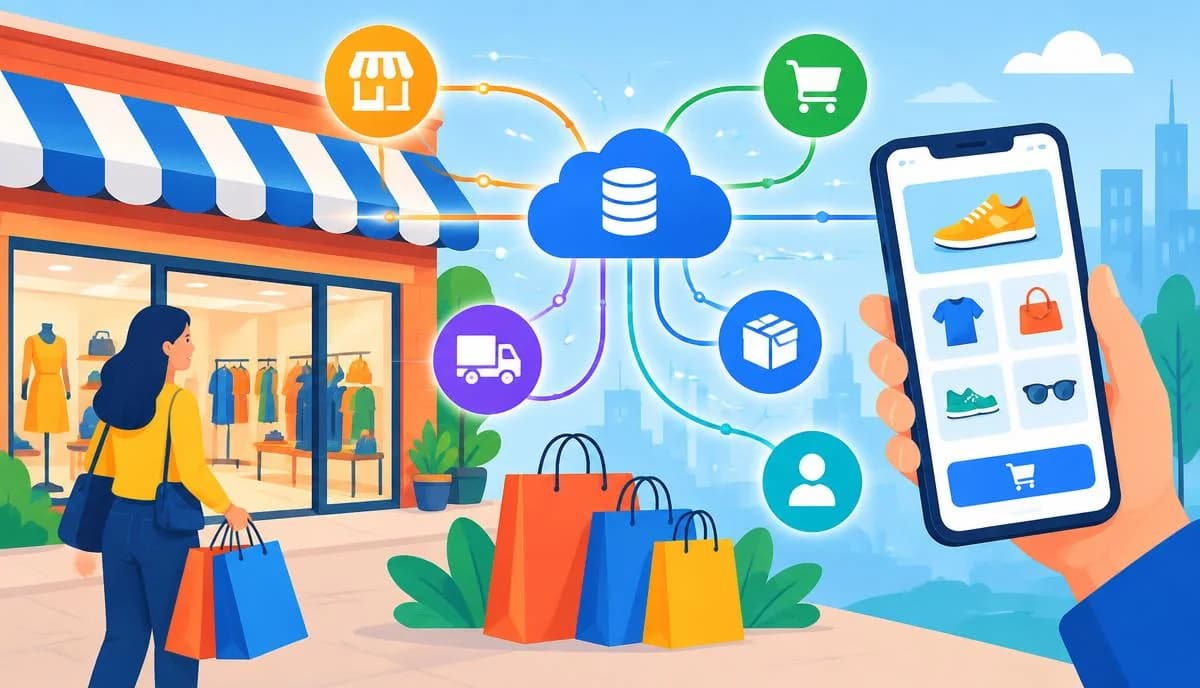
A complete guide to retail digital marketing, covering SEO, paid social, email lifecycle campaigns, retail media networks, and data-driven personalization strategies.
Retail Digital Marketing
Retail has changed more in the last decade than in the previous fifty years combined. Shoppers now bounce between mobile apps, social feeds, marketplaces, and physical stores within a single purchase journey, forcing retail marketers to build strategies that work seamlessly across every touchpoint rather than treating channels as separate silos.
The retailers winning today are the ones that treat digital marketing as a connected ecosystem, not a checklist of tactics. From personalized email flows to influencer partnerships and in-store pickup promotions, every channel now feeds data into a single customer view, and the brands that master this integration consistently outperform competitors that still operate in channel silos.
Quick Answer: Retail digital marketing combines SEO, paid social, email, influencer partnerships, and marketplace optimization to drive both online and in-store sales. Success depends on unified customer data, mobile-first experiences, and fast iteration based on real-time performance metrics across every touchpoint in the shopper journey.
The Modern Retail Customer Journey
Today's shoppers rarely follow a linear path from awareness to purchase. A customer might discover a product through a short-form video, compare prices on a marketplace app, read reviews on a third-party site, and finally complete the purchase in a physical store using a mobile coupon. Practitioners tracking retail attribution consistently observe that a large share of in-store purchases are influenced by digital research beforehand, even when the final transaction never touches an online checkout page.
This reality means retail marketers must stop measuring channels in isolation. A social ad that never generates a direct online sale may still be responsible for driving significant foot traffic, and ignoring that influence leads to chronically undervaluing upper-funnel channels.
Core Pillars of Retail Digital Marketing
1. Search Engine Optimization and Marketplace Visibility
Product discovery increasingly starts on search engines and marketplaces like Amazon rather than a retailer's own homepage. Optimizing product titles, descriptions, structured data, and category pages for search intent remains one of the highest-ROI investments a retail brand can make, since organic visibility compounds over time without ongoing ad spend.
2. Paid Social and Shoppable Content
Platforms like Instagram, TikTok, and Pinterest have turned browsing into buying with native checkout features. Retailers that invest in short-form video content showcasing real product use tend to see stronger engagement than static catalog imagery, particularly among younger shoppers who treat social discovery as their primary shopping channel.
3. Email and Lifecycle Marketing
Despite the rise of newer channels, email remains one of the most cost-effective retail marketing tools because it targets an owned audience rather than renting attention from a platform algorithm. Segmented lifecycle campaigns, including cart abandonment flows and post-purchase win-back sequences, consistently deliver some of the highest returns of any retail marketing channel when properly maintained.
4. Influencer and Affiliate Partnerships
Micro and mid-tier influencers often drive better conversion rates for retail brands than mega-celebrities, since their audiences perceive recommendations as more authentic. Affiliate programs extend this further, letting retailers pay only for performance rather than upfront media spend, which is especially attractive for brands with tighter marketing budgets.
5. Retail Media Networks
Many large retailers now operate their own advertising networks, selling placement on their websites and apps to brands wanting visibility at the point of purchase. This has become one of the fastest-growing segments of digital advertising, as it captures high-intent shoppers already in a buying mindset rather than competing for attention earlier in the funnel.
Building a Data-Driven Retail Strategy
Retailers that succeed digitally treat data as a strategic asset rather than a reporting afterthought. Unifying point-of-sale data, ecommerce behavior, loyalty program activity, and marketing engagement into a single customer profile allows for far more precise targeting and personalization than any single data source could provide alone.
Working with a KPI-driven web agency helps retail brands translate this data into action, since these partners typically build dashboards and testing frameworks around specific revenue and conversion goals rather than vanity metrics that look good in a report but do not move the business forward.
Key Metrics Retail Marketers Should Track
| Metric | What It Reveals | Typical Use |
|---|---|---|
| Conversion rate by channel | Which touchpoints actually drive purchases | Budget reallocation |
| Customer lifetime value | Long-term profitability of acquired customers | Justifying acquisition spend |
| Cart abandonment rate | Friction points in checkout | Email and UX optimization |
| Return on ad spend (ROAS) | Efficiency of paid media investment | Campaign scaling decisions |
| Organic search share | Brand visibility without paid support | Long-term SEO strategy |
Mobile Commerce Cannot Be an Afterthought
Mobile devices now account for the majority of retail website traffic in most markets, and shoppers abandon slow or clunky mobile experiences within seconds. Site speed, simplified checkout flows, and mobile wallet integrations like Apple Pay and Google Pay directly affect conversion rates, and retailers that neglect mobile optimization consistently see higher bounce rates than those who prioritize it.
The Role of Search Engine Optimization in Retail Growth
Strong organic visibility reduces a retailer's dependence on paid advertising over time, which becomes increasingly important as ad costs on major platforms continue to rise. Structured data markup for products, reviews, and pricing helps retail pages appear in rich search results, increasing click-through rates without any additional ad spend. Many growing retail brands invest in dedicated search engine optimization programs specifically because organic traffic tends to convert at a healthier margin than paid traffic once acquisition costs are factored in, and working with specialists in search engine optimization ensures technical and content strategies stay aligned with evolving search algorithm updates.
Common Mistakes Retail Marketers Make
- Treating each marketing channel as an independent silo instead of part of one customer journey
- Underinvesting in mobile experience despite it driving the majority of traffic
- Focusing only on new customer acquisition while neglecting retention and lifetime value
- Ignoring marketplace optimization even when a large share of product searches start there
- Failing to test creative and messaging regularly, leading to ad fatigue and declining returns
Key Takeaways
- Retail digital marketing succeeds when channels are treated as one connected customer journey rather than isolated tactics.
- SEO and marketplace optimization remain foundational because most shopping journeys begin with a search.
- Retail media networks and influencer partnerships are increasingly important for reaching high-intent shoppers.
- Unified customer data enables personalization that drives both conversion and long-term loyalty.
- Mobile experience and site speed directly influence conversion rates and cannot be deprioritized.
Frequently Asked Questions (FAQ)
What is the most important channel for retail digital marketing?
There is no single most important channel, since retail success depends on how well channels work together. That said, SEO and marketplace optimization tend to have outsized long-term impact because they capture high-intent shoppers actively searching for products without ongoing ad spend required.
How can small retail brands compete with larger competitors online?
Small retailers can compete by focusing on niche SEO keywords larger brands ignore, building genuine relationships with micro-influencers, and using email marketing to nurture an owned audience. Personalized, authentic content often outperforms big-budget campaigns when it resonates more directly with a specific target audience.
Does social media actually drive retail sales?
Yes, though often indirectly. Social platforms increasingly offer native checkout features, but even when a sale is not completed on the platform itself, social content frequently influences purchase decisions made later online or in physical stores, making it an important part of the overall retail funnel.
How important is mobile optimization for retail websites?
Extremely important, since mobile devices generate the majority of retail traffic in most markets today. Slow load times or complicated checkout flows on mobile lead to high abandonment rates, so retailers prioritizing mobile speed and simplified payment options typically see stronger conversion performance than those who do not.
What is a retail media network?
A retail media network is an advertising platform operated by a retailer, allowing brands to pay for visibility directly on the retailer's website or app. These networks have grown rapidly because they place ads in front of shoppers who already have strong purchase intent, often outperforming traditional display advertising.
How often should retail brands update their digital marketing strategy?
Retail marketing strategies should be reviewed continuously rather than on a fixed annual schedule, since consumer behavior, platform algorithms, and competitive activity shift quickly. Most successful retail teams review key metrics monthly and adjust campaigns in near real time based on performance data.
Personalization at Scale
Modern retail personalization goes far beyond addressing a customer by first name in an email subject line. Leading retailers use browsing history, past purchases, and even loyalty tier status to dynamically adjust product recommendations, homepage merchandising, and promotional offers for each individual shopper. Practitioners working with large retail datasets consistently find that personalized product recommendations generate meaningfully higher conversion rates than generic best-seller displays, since shoppers respond better to relevance than to popularity alone.
Achieving this level of personalization requires clean, unified data infrastructure. Many retailers struggle because customer information is scattered across separate systems for ecommerce, point-of-sale, loyalty programs, and customer service, making a single coherent view difficult to assemble. Investing in a customer data platform, even a modest one, often pays for itself by enabling far more targeted campaigns than a fragmented data approach ever could.
Seasonal and Event-Driven Campaign Planning
Retail marketing calendars revolve heavily around seasonal peaks, from holiday shopping periods to back-to-school and major sales events. Planning these campaigns months in advance, securing inventory alignment with marketing promises, and building flexible creative that can adapt to real-time demand shifts are all essential skills for retail marketing teams. Brands that treat these peak periods as isolated sprints, rather than connected moments within a broader annual strategy, often see inconsistent year-over-year growth compared to those who build cumulative momentum through consistent lower-funnel nurturing between major events.
Looking Ahead
As commerce continues shifting toward mobile, social, and voice-driven discovery, retail brands that invest early in unified data, mobile experience, and authentic content will be better positioned to adapt as new channels emerge, rather than scrambling to catch up after competitors have already claimed shopper attention.