Learn how artificial intelligence microcontrollers run TinyML at the edge, compare hardware, deploy models, optimize power, and choose the right AI MCU.
Artificial Intelligence Microcontroller
Artificial intelligence is moving from cloud data centers into tiny, inexpensive devices. An artificial intelligence microcontroller combines low-power embedded computing with hardware and software optimized for machine-learning inference. It can recognize sounds, classify images, detect vibration anomalies, or interpret gestures without continuously sending raw sensor data online. This guide explains how these devices work, where they outperform conventional processors, and how to select, train, deploy, and validate one responsibly.
Quick Answer: An artificial intelligence microcontroller is a compact, energy-efficient chip that runs trained machine-learning models directly on an embedded device. It processes sensor data locally, reducing latency, bandwidth, power use, and privacy exposure. Choose one by matching model size, memory, supported operators, power budget, peripherals, and development tools to a measurable application requirement.
What Is an Artificial Intelligence Microcontroller?
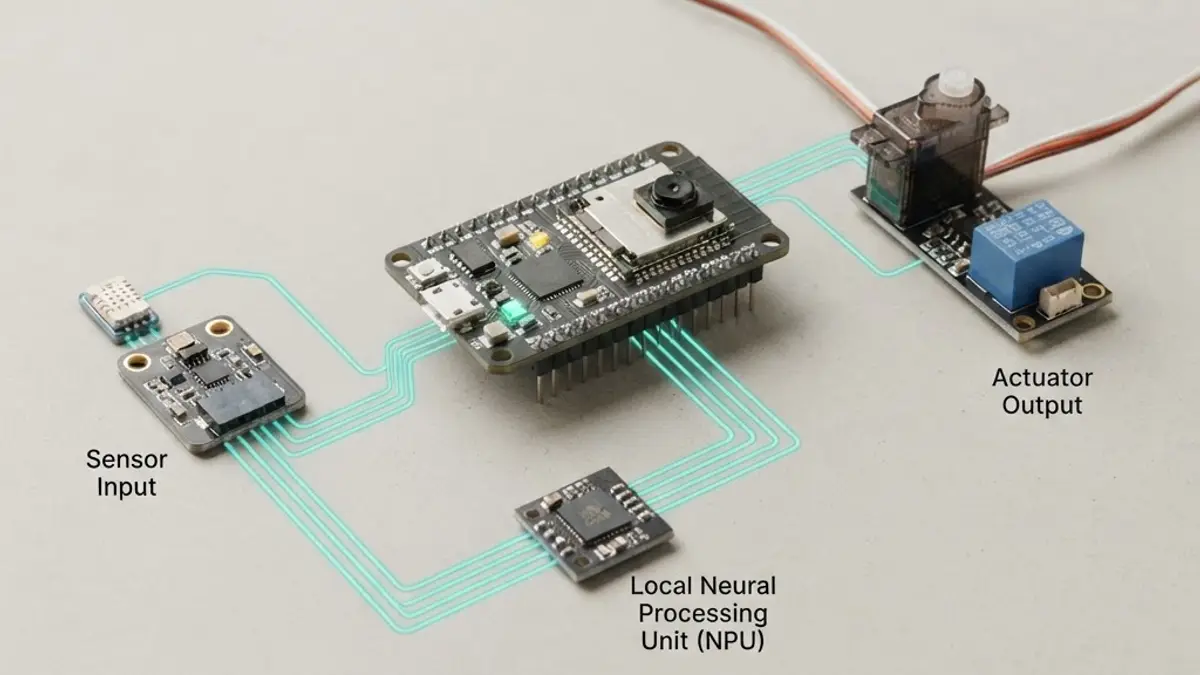
An artificial intelligence microcontroller, often called an AI MCU, is a microcontroller unit designed or configured to execute inference efficiently. Inference means applying a trained model to new input, such as deciding whether an audio sample contains a wake word. Training usually happens on a workstation or cloud platform because it requires considerably more memory and computation.
This field overlaps with TinyML, the practice of running machine learning on constrained, low-power devices. The MLCommons Tiny benchmark suite measures embedded inference workloads including keyword spotting, visual wake words, image classification, and anomaly detection. Those categories offer realistic starting points because they reflect common sensor-to-decision tasks rather than synthetic arithmetic alone.
How Does Edge AI Inference Work?
Edge inference follows a repeatable pipeline: capture data, prepare features, execute the model, interpret confidence, and trigger an action. Every stage consumes memory, time, and energy. Treating preprocessing as free is a common engineering mistake; a Fourier transform, image resize, or audio filter can cost more than a highly optimized neural network.
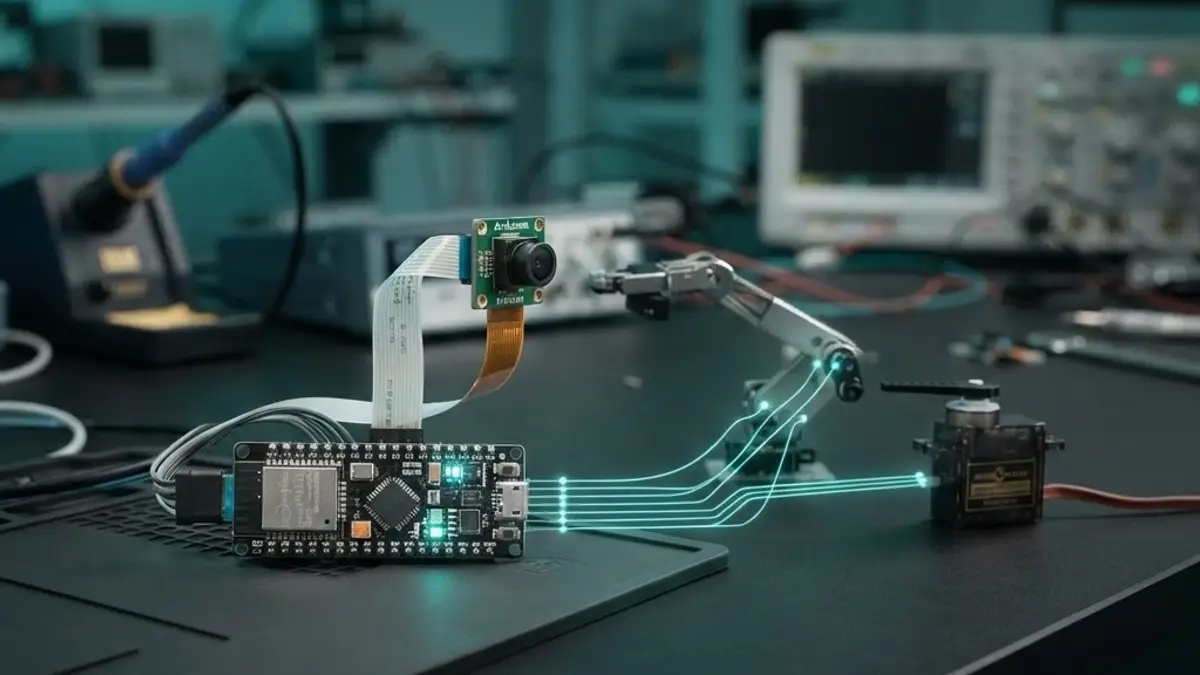
- Capture representative input. Sample the production sensor at the intended resolution and frequency.
- Apply identical preprocessing. Reproduce normalization, windowing, resizing, or feature extraction used during training.
- Run quantized inference. Execute the compiled model using optimized kernels or an accelerator.
- Calibrate thresholds. Convert model scores into decisions using validation data, not intuition.
- Handle uncertainty. Reject ambiguous inputs, retry, or escalate instead of forcing every prediction.
- Record operational metrics. Track latency, energy, memory peaks, confidence distributions, and failures.
AI Microcontroller vs Microprocessor: Which Should You Use?
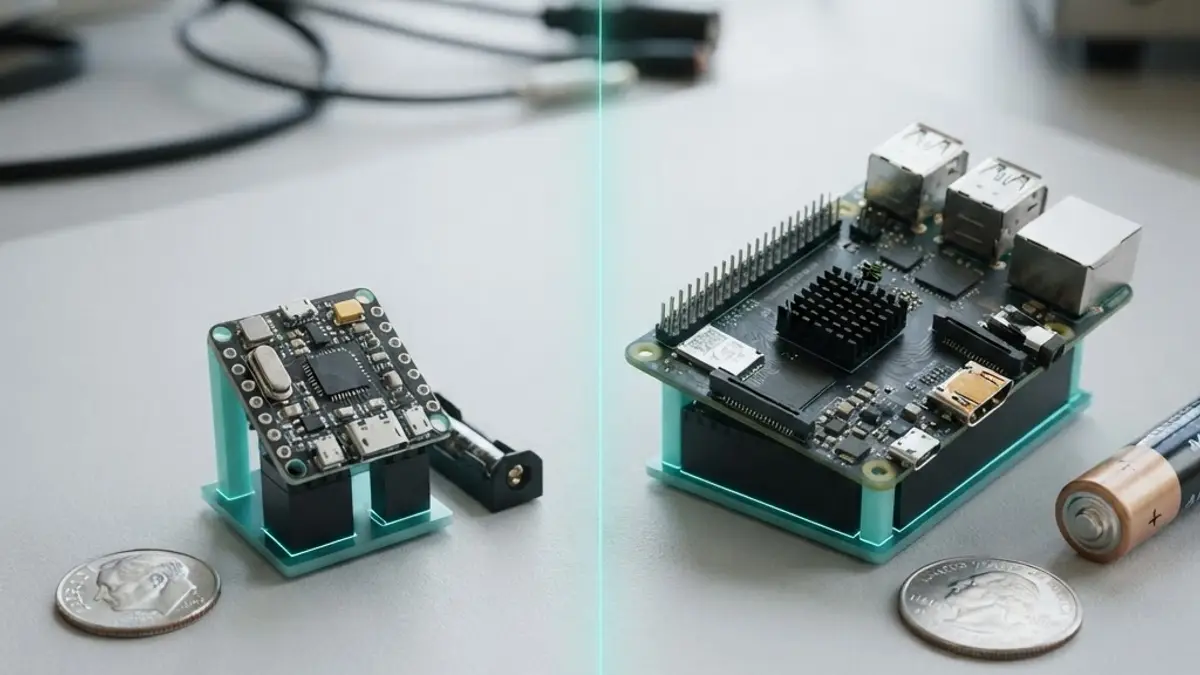
| Decision factor | AI microcontroller | Microprocessor or edge computer |
|---|---|---|
| Typical software | Firmware or real-time OS | Linux or full operating system |
| Memory | Kilobytes to several megabytes | Hundreds of megabytes to gigabytes |
| Power profile | Very low, sleep-friendly | Higher baseline consumption |
| Startup | Near-instant | Usually slower boot process |
| Best model type | Small, quantized, fixed task | Larger or frequently updated models |
| Connectivity | Optional and constrained | Broad networking support |
| Control timing | Predictable | Less deterministic without tuning |
Do not select by tera-operations-per-second alone. Vendor figures may assume sparse data, low precision, ideal operators, or maximum clock rates. Compare measured end-to-end latency and energy on your exact model, including preprocessing and memory transfers. A slower accelerator with supported operators can beat a faster one that repeatedly falls back to the CPU.
Where Are AI Microcontrollers Most Useful?
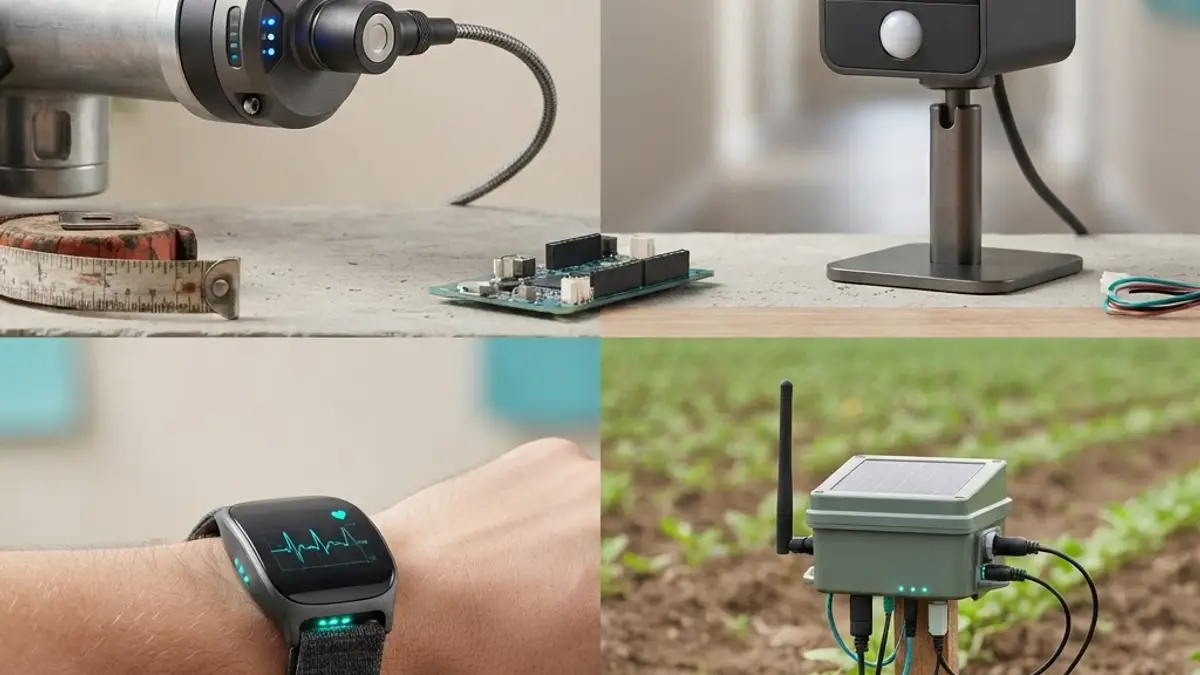
- Predictive maintenance: Classify vibration or acoustic signatures near motors, pumps, and bearings, then transmit only alerts or compressed summaries.
- Wearables: Detect gestures, activities, falls, or physiological patterns while preserving battery life and limiting raw-data transmission.
- Smart buildings: Recognize occupancy, glass breaks, equipment faults, or unusual energy behavior without permanent cloud streaming.
- Agriculture: Identify irrigation conditions, animal activity, or machinery anomalies where connectivity is intermittent.
- Consumer devices: Enable wake words, adaptive controls, and contextual automation with fast offline responses.
According to the Bluetooth SIG, Bluetooth Low Energy was designed for devices with lower power consumption and cost than classic Bluetooth, making it a frequent companion for sensor nodes. Yet wireless transmission can dominate an embedded energy budget. Running inference locally and sending a short event may extend battery life compared with continuously uploading raw samples; measure the difference with actual duty cycles.
How Do You Choose the Right AI Microcontroller?
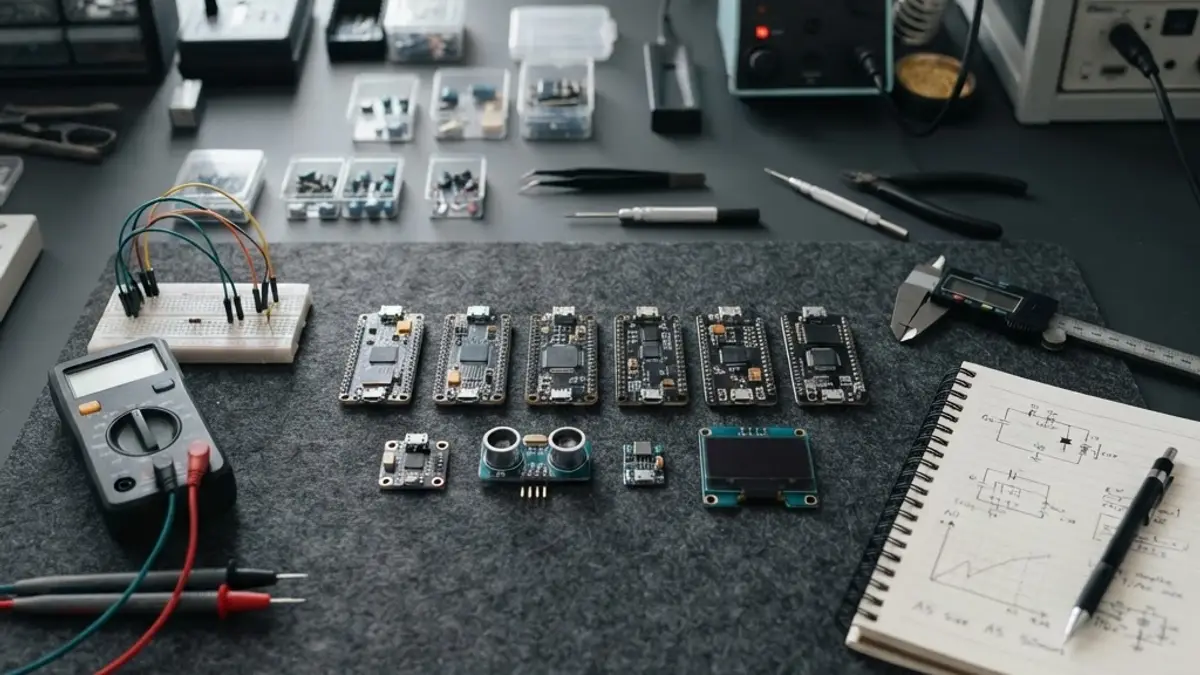
Evaluate Memory Before Compute
Model weights are only part of memory demand. SRAM must hold input buffers, intermediate activations, runtime workspaces, application state, communication stacks, and safety margins. Inspect the compiler's memory plan and test worst-case execution. External memory may increase capacity but adds energy, latency, board area, cost, and attack surface.
Verify Operator and Toolchain Support
Export the actual model early and compile it with the vendor toolchain. Confirm every operator runs on the intended accelerator. Review quantization behavior, debugging visibility, license terms, long-term support, and continuous-integration options. A mature profiler and reproducible build pipeline are often more valuable than a headline benchmark.
Measure Power Correctly
Average current depends on active inference, sensor operation, radio bursts, sleep leakage, regulator efficiency, and wake frequency. Measure at the battery input across realistic scenarios. A model that finishes quickly may use less total energy despite a higher instantaneous current. Report joules per decision alongside milliseconds per inference.
Plan Security and Updates
Require secure boot, signed firmware, protected debug access, unique device credentials, rollback protection, and a recoverable update path. Model files can reveal intellectual property or permit adversarial analysis. Threat-model physical access as well as network attacks, especially for unattended industrial, automotive, medical, or building devices.
For teams developing connected intelligent products, ZoneTechify's artificial intelligence services can support feasibility analysis and implementation. Educational resources from ZoneTechify and WebPeak can also help stakeholders understand how embedded AI fits broader software and digital strategies.
How Do You Deploy a TinyML Model?
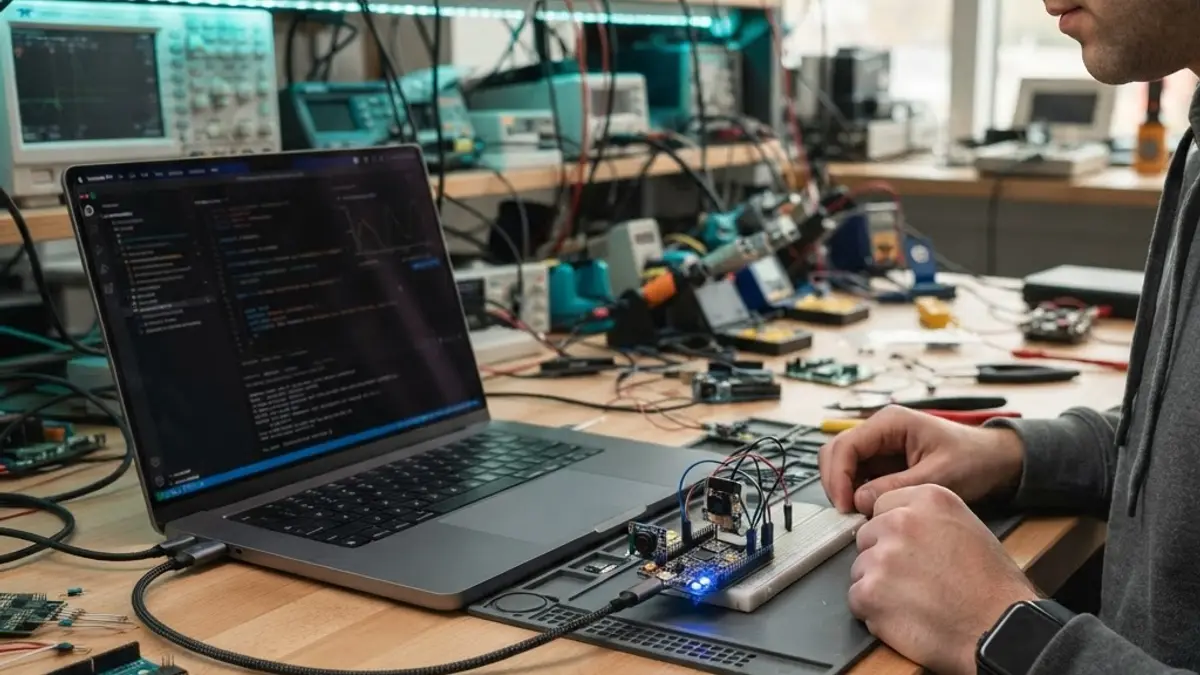
- Collect labeled examples from production-like sensors and environments.
- Split data by person, machine, location, or session to prevent leakage.
- Train a simple baseline and document accuracy, recall, and costly error types.
- Quantize the model, commonly to 8-bit integers, using representative calibration samples.
- Convert and compile it for the target runtime and accelerator.
- Flash firmware containing identical preprocessing and class mapping.
- Compare device outputs against desktop reference outputs using fixed test vectors.
- Run field trials, inspect failures, improve data, and repeat.
Quantization reduces model storage and can accelerate supported integer arithmetic, but accuracy may change. Post-training quantization is convenient; quantization-aware training can recover performance when simulated low-precision effects are included during training. Keep a versioned artifact bundle containing dataset identifiers, preprocessing code, model, converter settings, compiler version, firmware commit, and test results.
How Should You Test and Optimize Performance?
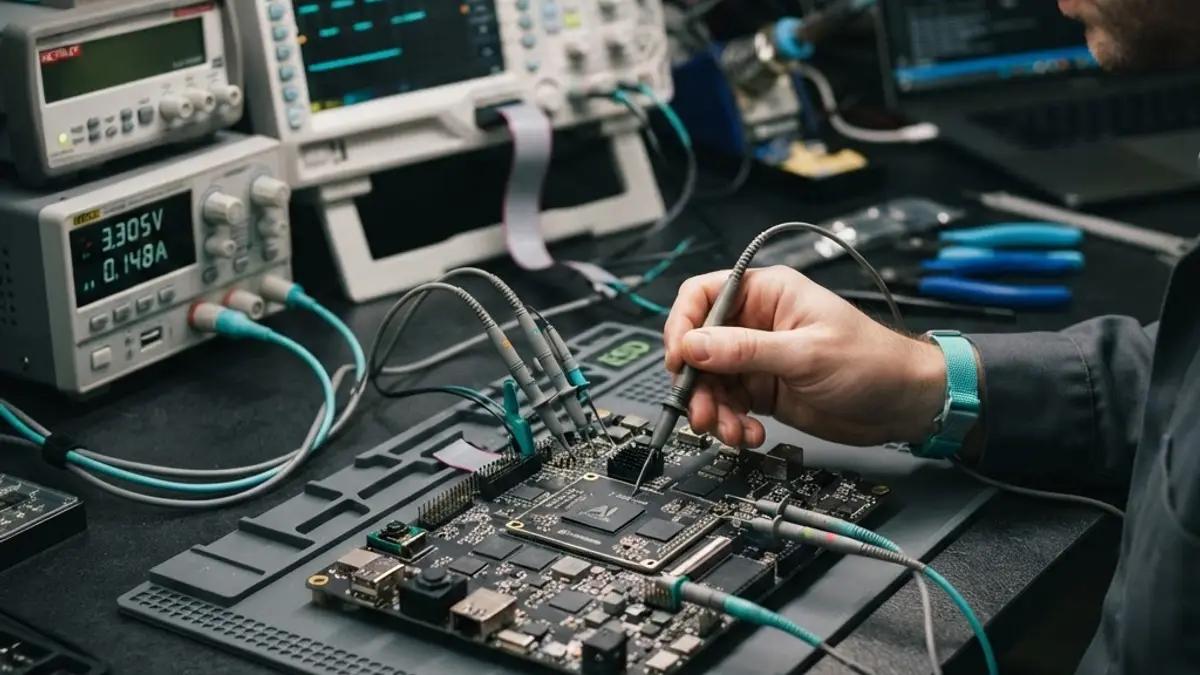
Use confusion matrices to reveal which classes fail, then evaluate performance at the operating threshold. Accuracy alone can hide dangerous behavior in imbalanced data. For rare fault detection, precision and recall are usually more informative. Test unknown, corrupted, silent, saturated, and out-of-distribution inputs, then define a safe response for each.
Common Mistakes to Avoid
- Training on clean laboratory data while deploying in noisy, changing environments.
- Randomly splitting adjacent time samples, which leaks near-duplicates into validation.
- Quoting desktop accuracy without verifying the converted model on target hardware.
- Ignoring sensor tolerances, mounting differences, aging, and calibration drift.
- Designing an update mechanism after hardware and flash layouts are fixed.
- Collecting personal data without consent, minimization, retention, and deletion policies.
- Automating high-impact decisions without human review, explanations, or safe fallback behavior.
Document intended use and known limits. An embedded model is a probabilistic component inside a deterministic product. Safety comes from architecture: confidence thresholds, redundancy, watchdogs, rule-based checks, graceful degradation, and monitoring should constrain what a mistaken prediction can cause.
Frequently Asked Questions (FAQ)
Can a microcontroller really run artificial intelligence?
Yes. A microcontroller can run compact, trained models for classification, detection, regression, and anomaly recognition. It usually performs inference rather than training. Success depends on fitting weights and activations into memory, supporting required operators, matching preprocessing exactly, and meeting measured latency and energy targets on real hardware.
What programming language is used for AI microcontrollers?
C and C++ are most common for production firmware because they provide predictable performance and direct hardware access. Python may be used for data preparation, training, conversion, and board experimentation. Some platforms support MicroPython, Rust, or generated code, but confirm accelerator bindings, memory overhead, debugging tools, and production support first.
Is TinyML the same as an AI microcontroller?
No. TinyML is the broader discipline of deploying machine learning on highly constrained, low-power systems. An AI microcontroller is hardware that can enable TinyML. TinyML also includes dataset design, training, compression, runtimes, testing, power measurement, security, and lifecycle practices needed to make an embedded model reliable.
How much memory does an AI microcontroller need?
There is no universal amount. Add model weights, peak intermediate activations, input buffers, runtime workspace, firmware, communication stacks, and a safety margin. Use the target compiler's memory report rather than model-file size. Prototype with production preprocessing because image, audio, and sensor buffers can exceed the model itself.
Do AI microcontrollers need an internet connection?
No. They can sample sensors and run inference completely offline, which supports low latency, resilience, and data minimization. Connectivity may still be useful for signed updates, aggregated telemetry, or uncertain cases. Products should remain safe during outages and authenticate, encrypt, and minimize any information they transmit.
Which AI microcontroller should a beginner choose?
Choose a well-documented development board with built-in sensors, examples for your intended workload, an actively maintained runtime, clear memory profiling, and accessible power measurement points. First compile a representative model and confirm operator support. Community size helps, but reproducible tools and target-specific examples matter more than popularity.
Key Takeaways
- An AI microcontroller runs compact inference locally, while model training usually occurs elsewhere.
- End-to-end results depend on preprocessing, supported operators, memory movement, and thresholds, not accelerator speed alone.
- Choose hardware from measurable latency, energy, memory, security, lifecycle, and cost requirements.
- Quantization can reduce storage and improve speed, but converted accuracy must be verified on the target.
- Representative field data, leakage-resistant splits, safe uncertainty handling, and signed updates determine production reliability.
- Benchmark the complete sensor-to-action pipeline and report joules per decision, tail latency, and task-specific error rates.
Field measurements should guide every decision. Artificial intelligence microcontrollers are most effective when they solve a narrow problem with accountable measurements. Begin with representative data and a simple baseline, prove the full pipeline on a development board, and profile every resource. Then design hardware around verified constraints. That sequence reduces technical risk while producing responsive, private, efficient devices users can trust.