Customized application software explained: what it is, when it beats off-the-shelf tools, how it is built, what it costs, and how to measure real ROI.
Customized Application Software
Every growing company hits the same wall. The tools that worked at ten employees start cracking at fifty. A spreadsheet quietly becomes the system of record, three overlapping subscriptions each do half a job, and somebody burns four hours a week retyping data between them. Customized application software exists to remove that wall permanently rather than papering over it with another subscription.
This guide covers what customized application software actually is, how it differs from configuration, when it pays for itself, what it realistically costs, and how to tell whether a vendor is building you an asset or handing you a liability. It is written from the perspective of teams who ship these systems and then maintain them for years, which is a very different view from a product brochure.
Quick Answer: Customized application software is a business application built or substantially modified for one organization's specific workflows, data, and rules. It is the right choice when your process is a competitive advantage, when packaged tools force expensive manual workarounds, or when integration, compliance, and data ownership requirements exceed what off-the-shelf software allows.
What Is Customized Application Software?
Customized application software is software shaped around an existing business process instead of forcing the business to adopt someone else's process. The defining test is simple: if the vendor cannot ship your requirement to every other customer, and you still need it, you are in custom territory.
That covers a wide range in practice. It includes an internal quoting tool that encodes pricing rules no generic CPQ product understands, a logistics dashboard that merges warehouse scanner data with courier APIs, a patient intake portal built to satisfy a specific regulator, and a customer portal that exposes exactly the four things your clients call about.
Key Terms Defined
- Bespoke software: built from scratch for one organization, which owns the source code and the roadmap.
- Customized software: a commercial product extended with organization-specific modules, fields, or integrations that live outside the vendor's core product.
- Configured software: an off-the-shelf product adjusted only through supported settings, with no new code. Cheapest and safest, but capped by the vendor's imagination.
- Technical debt: the future cost created by shortcuts taken today, paid back in slower releases and higher bug rates.

Customized Application Software vs Off-the-Shelf Software
The honest comparison is not custom versus packaged. It is total cost of ownership over five years versus the fit you get for that money.
| Factor | Customized Application Software | Off-the-Shelf Software |
|---|---|---|
| Upfront cost | High, paid once as a project | Low, often free to trial |
| Time to first use | Weeks to months | Same day |
| Fit to your process | Exact, by definition | Partial, workarounds required |
| Cost curve at scale | Flat, hosting plus maintenance | Rises with every seat added |
| Integration depth | Unlimited, you control the data layer | Limited to published APIs |
| Data and IP ownership | Yours | Vendor controlled |
| Roadmap control | You set priorities | Vendor sets priorities |
| Maintenance burden | Yours or your partner's | Included in subscription |
| Lock-in risk | Low if code and data are portable | High once workflows depend on it |
The crossover point matters more than the philosophy. Per-seat pricing is excellent when a team is small and punishing when it is not. A tool at 40 dollars per user per month costs 48,000 dollars a year at 100 seats and 240,000 dollars at 500. Custom software inverts that curve: most of the cost lands in year one, then flattens into hosting and maintenance regardless of headcount.
When Custom Software Is the Right Call and When It Is Not
Build custom when at least two of these are true:
- The workflow is a differentiator, not a commodity. Nobody should build a custom payroll system. Plenty of companies should build a custom underwriting or dispatch engine.
- Staff maintain shadow spreadsheets to compensate for the tool you already pay for.
- Three or more systems must share a single source of truth in near real time.
- Licence costs are growing faster than the value the tool delivers.
- Compliance or audit requirements demand control over data location, retention, and access logs.
Do not build custom when:
- A mature category product already covers 90 percent of the need. Accounting, email, and payroll are solved.
- You cannot name the person who owns the system after launch.
- Requirements change weekly because the underlying process is not settled yet. Stabilise the process first, then encode it.
- The only stated benefit is that the team dislikes the current interface.

How Customized Application Software Gets Built
Delivery quality depends far more on sequence than on stack. A reliable process looks like this:
- Discovery. Map the current process as it truly runs, including the exceptions people handle by memory.
- Scoping and prioritisation. Split the backlog into what must exist at launch and what can wait. Ruthless cutting here is what keeps a project solvent.
- Design and prototyping. Clickable prototypes of the three most-used screens, tested with the people who will live in them daily.
- Iterative build. Two-week increments, each ending in something demonstrable in a staging environment.
- Testing and hardening. Automated tests on business rules, plus load, permission, and recovery testing.
- Launch and handover. Data migration, training, documentation, monitoring, and an agreed support model.
Small senior teams consistently outperform large mixed ones on this kind of work because custom business logic requires context, and context does not parallelise well. Agencies structured this way, such as ZoneTechify, tend to keep the same engineers on a system from discovery through maintenance so the reasoning behind each rule is never lost.

Requirements Discovery Decides the Outcome
Most custom software failures are requirements failures wearing an engineering costume. Research by the Standish Group's long-running CHAOS studies has repeatedly found only around a third of software projects fully successful, with unclear or shifting requirements among the leading causes. A joint McKinsey and University of Oxford study of large IT projects found average overruns of 45 percent on budget and 7 percent on schedule, while delivering 56 percent less value than predicted.
Four discovery tactics that measurably reduce that risk:
- Sit with the end user for a full working day and count clicks on the tasks they repeat most. Those counts become your success metrics.
- Collect real artefacts: actual invoices, actual rejected orders, actual edge cases. Hypothetical examples hide the hard rules.
- Write the acceptance scenarios before the build starts, in plain business language.
- Name every integration and confirm API access exists before scoping. Assumed API access is the single most common cause of mid-project rework.
Architecture Choices That Age Well
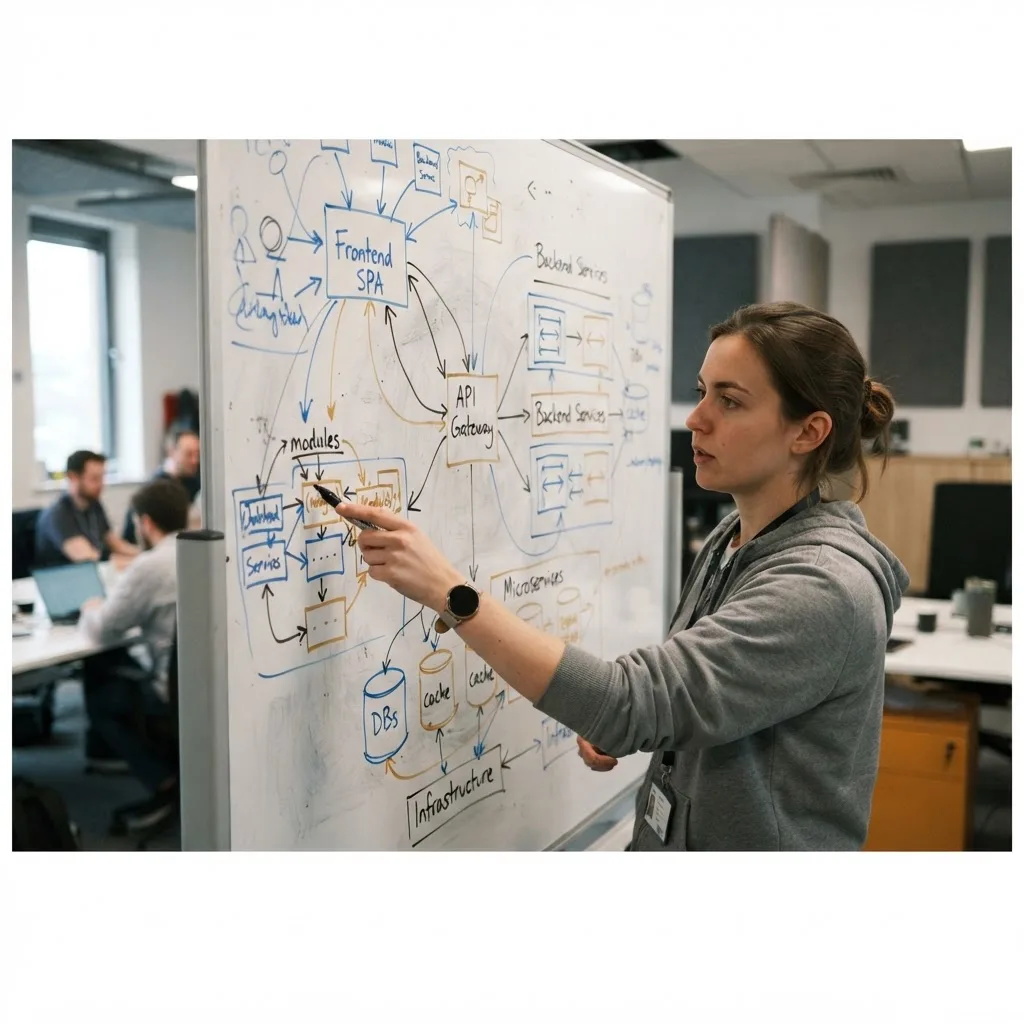
Architecture is the part you cannot cheaply change later, so bias toward boring and reversible.
- Start with a modular monolith. Clear internal boundaries give you the option to split services later. Premature microservices add operational cost long before they add value.
- Choose a mainstream stack. A conventional relational database and a widely used framework mean you can hire for it in five years.
- Keep one source of truth per entity. Duplicated customer records are how reporting quietly becomes untrustworthy.
- Log state changes from day one. Append-only audit records cost little upfront and are impossible to reconstruct retroactively.
- Ship behind feature flags. Releasing and enabling should be separate events so a bad rule can be switched off in seconds.
A well-scoped web application agency engagement should document each of these decisions and the tradeoff behind it, because that record is what lets a future team change direction safely.

What Customized Application Software Actually Costs
Costs scale with the number of distinct user roles, integrations, and business rules, not with page count.
| Project tier | Typical scope | Indicative build range |
|---|---|---|
| Single-purpose internal tool | One role, one workflow, no integrations | 8,000 to 25,000 dollars |
| Departmental application | Two or three roles, reporting, one or two integrations | 25,000 to 90,000 dollars |
| Core business platform | Multiple roles, permissions, several integrations, audit trail | 90,000 to 400,000 dollars and up |
Budget 15 to 20 percent of the build cost annually for maintenance, covering dependency updates, security patches, hosting, and small improvements. Treating maintenance as optional is the most expensive decision available, because deferred patching turns into an emergency rebuild. Teams that publish clear scoping models, including scalable web solutions specialists, make this line item explicit in the proposal instead of discovering it after launch.

Integration Is the Real Reason Companies Go Custom
Ask why a company finally commissions custom software and the answer is rarely a missing feature. It is that nothing talks to anything else. Custom applications win here because they can sit at the centre and own the data contract between systems.
Practical rules for integration work:
- Sync in one direction per field. Bidirectional sync without a designated owner produces conflicts nobody can resolve.
- Use webhooks where available and scheduled reconciliation as a safety net. Webhooks get missed.
- Store the raw payload of every inbound message. When a mismatch appears three months later, the payload is your only evidence.
- Make every write idempotent so a retry cannot duplicate an order or an invoice.

How to Measure ROI Honestly
Decide the metrics before the build, then measure the same way afterwards. Three that hold up:
- Labour recovered. Annual hours saved multiplied by fully loaded hourly cost. Measure the baseline before launch or the number is unprovable.
- Error cost avoided. Rework rate before and after, multiplied by the average cost of one correction.
- Cycle time. Hours from request received to request fulfilled. This is usually the metric customers actually feel.
A quoting tool that saves each of eight sales staff five hours weekly at 45 dollars per hour recovers roughly 93,000 dollars a year in capacity. Against a 60,000 dollar build and 10,000 dollar annual maintenance, that pays back inside the first year and keeps compounding.
Key Takeaways
- Customized application software is built around your process; off-the-shelf software requires your process to bend to it.
- Per-seat licensing rises with headcount while custom software costs flatten after launch, which is why the crossover often lands somewhere between 50 and 150 seats.
- CHAOS research places full project success near a third, and the McKinsey and Oxford study found 45 percent average budget overruns on large IT projects, both driven largely by weak requirements.
- Plan 15 to 20 percent of build cost per year for maintenance.
- Confirm API access during discovery, not during the build.
- Define ROI metrics and capture the baseline before writing code.
Frequently Asked Questions (FAQ)
What is customized application software in simple terms?
It is software written or heavily modified for one specific organisation so it matches how that business already works. Instead of adapting your process to a generic product, the application encodes your rules, your data model, and your integrations, and you control what gets built next.
How long does it take to build custom application software?
A focused internal tool typically takes four to eight weeks. A departmental application with reporting and integrations usually runs three to five months. Core business platforms take six months or longer. Timelines stretch most often because integration access or decision-making authority was not settled before development started.
Is custom software cheaper than SaaS subscriptions?
Not at first. Custom software costs more in year one and less in later years because it has no per-seat fee. The break-even point depends on headcount and licence price, and it commonly arrives between years two and three for teams above roughly 50 users.
Who owns the code in a custom software project?
You should, and the contract must say so explicitly. Ask for full source code ownership, repository access from day one, documented deployment steps, and exported credentials. Without those four things you have bought a dependency on your vendor rather than a business asset.
What happens if my development partner disappears?
You stay operational if you already hold the code, the infrastructure accounts, and the documentation. That is why mainstream technology choices matter: a conventional stack lets another team read the codebase and continue. Request a handover package at launch, not when a problem appears.
Can custom software work alongside tools we already use?
Yes, and that is usually the best design. Keep proven products for commodity functions such as accounting and email, then build custom software only for the workflow that differentiates you, connecting the two through APIs so each system owns the data it is best placed to hold.
Customized application software is not a status purchase or a technology preference. It is a decision to convert a repeated operational cost into an owned asset. Made with clear requirements, an honest budget including maintenance, and metrics agreed in advance, it is one of the highest-return investments an operations-heavy business can make.