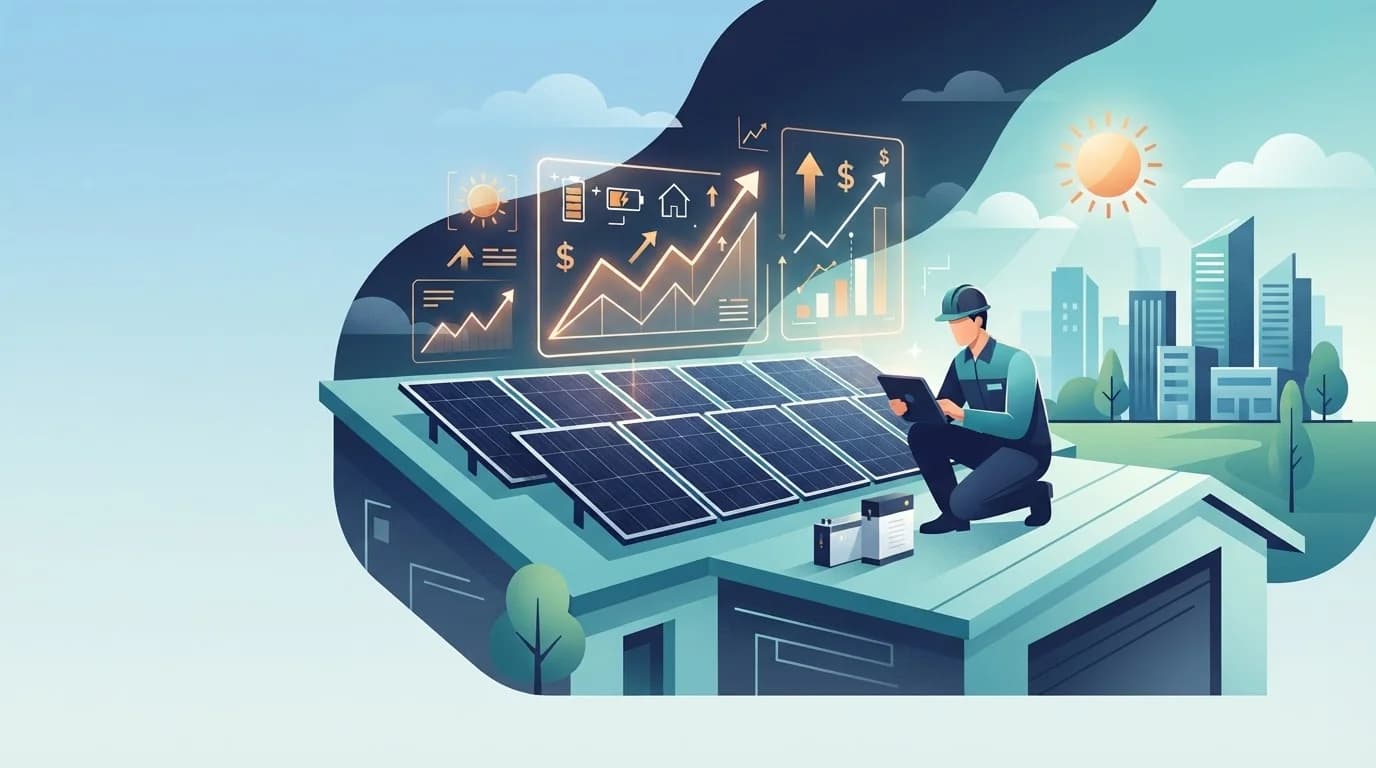
Capture residential and commercial installations with digital marketing for solar companies. Lower customer acquisition costs via SEO and paid ad funnels.
Digital Marketing for Solar Companies
The residential and commercial solar energy sectors are experiencing rapid market shifts. As electric utility rates climb and clean energy policies adjust, property owners actively evaluate renewable alternatives. However, solar installation businesses face severe competition where traditional canvassing and purchased third-party leads produce diminishing returns.
Modern solar buyers perform extensive research across digital touchpoints before speaking with an energy professional. They evaluate payback timelines, review equipment ratings, analyze net metering guidelines, and scrutinize customer testimonials across independent platforms. Solar companies must build durable inbound acquisition engines that establish authority and capture intent early.
Winning this market requires uniting web performance, search visibility, paid campaigns, and automated qualification workflows. This blueprint outlines proven digital marketing methods designed to lower acquisition expenditures, expand commercial pipelines, and secure qualified solar contracts across regional territories.
Quick Answer: Digital marketing for solar companies is an inbound acquisition framework integrating search engine optimization, paid search, localized map visibility, performance-driven web engineering, and automated nurturing. It positions installers directly before residential and commercial property owners actively researching energy savings, reducing customer acquisition costs while building long-term local market dominance.
Understanding Solar Customer Acquisition Economics
Profitable growth in the solar sector requires strict command over client acquisition costs relative to gross margins. Clean energy leadership must monitor two foundational metrics:
Customer Acquisition Cost (CAC) represents the total financial investment required to convert a prospect into a signed solar contract, incorporating ad spend, marketing software, and sales overhead.
Soft Costs refer to non-hardware expenses in solar projects, including permitting, inspection, administrative labor, and customer acquisition.
Data from the National Renewable Energy Laboratory and the Solar Energy Industries Association indicates that soft costs comprise over sixty percent of total residential installation expenses in the United States. Within those soft costs, customer acquisition routinely accounts for three thousand to four thousand dollars per residential project based on industry benchmarks. Relying on cold outreach or shared lead brokers compounds these expenses because multiple contractors bid on identical prospects.
Transitioning capital into owned digital channels allows solar businesses to generate exclusive consultations from property owners actively requesting site assessments, systematically reducing acquisition expenses over time. In an industry characterized by tightening financing options and regulatory adjustments, owning your customer acquisition mechanism protects your operating margins against external market volatility.
High-Performance Solar Web Infrastructure
A solar company website functions as the primary conversion hub for every marketing channel. Solar installations involve substantial financial commitments, requiring digital platforms that communicate reliability and technical authority. When prospective residential clients or commercial facility managers encounter site delays or broken layouts, credibility collapses immediately.
Core Web Vitals represent Google standardized metrics evaluating real-world user experience, measuring loading speed, visual stability, and interaction responsiveness.
Interactive solar calculators, irradiance maps, and estimate engines require rapid processing. Static site architectures deliver exceptional load speeds, ensuring dynamic financing tables render smoothly on mobile devices. Partnering with a specialized Next.js development agency allows solar organizations to deploy enterprise headless platforms with sub-second page loads, utility bill upload capabilities, and direct API connections to solar design software like Aurora Solar. A fast, interactive experience captures prospect interest before bounce rates erode campaign returns. Investing in modern, scalable web architecture prevents costly platform rebuilds as service areas and installation volume expand.
Search Engine Optimization for Solar Installers
Search engine optimization captures high-intent property owners when they actively seek renewable power solutions. Inbound organic prospects carry no incremental media costs per click, preserving profit margins.
Local SEO and Map Pack Dominance
Solar installation is inherently regional because homeowners select contractors operating within their local utility territory. Capturing local search share requires optimizing your Google Business Profile with precise service classifications, project photos, and consistent contact details across web directories. Generating authentic client reviews that cite specific cities, equipment brands, and battery storage solutions strengthens local signals, elevating your business into the regional map three-pack.
Technical and Structural SEO Execution
Search engines reward websites with logical architectural hierarchy and structured data. Solar contractors should build dedicated service pages for every targeted county or municipality. Each page must present unique content regarding municipal permitting guidelines, regional utility incentives, and local case studies. Enlisting professional technical SEO services ensures your platform utilizes valid Schema.org markup, eliminates crawl waste, and maintains a mobile framework search engines index smoothly.
Digital Marketing Channels Comparison for Solar Companies
Allocating marketing budgets effectively requires evaluating conversion timelines, acquisition costs, and prospect intent across available channels. The following matrix details performance benchmarks derived from industry deployment data.
| Acquisition Channel | Average CAC | Lead Quality | Conversion Velocity | Scalability |
|---|---|---|---|---|
| Organic Search (SEO) | Low ($800 - $1,500) | High | Slow (3 to 6 Months) | High |
| Google Search Ads (PPC) | Medium ($1,800 - $3,200) | High | Fast (Immediate) | Medium |
| Local Services Ads (LSA) | Medium ($1,500 - $2,800) | High | Fast (Immediate) | Moderate |
| Paid Social (Meta Ads) | High ($2,200 - $4,000) | Moderate | Moderate (1 to 3 Weeks) | High |
| Third-Party Aggregators | Very High ($3,500 - $5,000+) | Low | Immediate | Low |
These operational metrics indicate that relying exclusively on lead brokers yields escalating costs and weak closing percentages. Balancing paid search for rapid consultation volume with ongoing organic optimization establishes a durable pipeline that stabilizes cash flow while reducing overall customer acquisition expenses.
High-Intent Paid Advertising Strategies
Paid advertising produces immediate visibility for solar contractors seeking predictable monthly consultation volume. Managing profitable pay-per-click campaigns requires precise targeting to prevent wasted spend on informational queries.
Google Search and Local Services Ads
Search advertising must target users with commercial purchasing intent. Focus on exact match terms like solar installer near me, commercial solar financing, and battery storage installation. Apply rigorous negative keyword lists to exclude unproductive terms like DIY solar panels, free solar panels scam, and solar toy kits. Additionally, Google Local Services Ads provide a verified Google Guaranteed badge, operating on a pay-per-lead model that protects budgets while securing top-of-page mobile real estate.
Meta Retargeting and Video Demonstrations
Cold social advertising often yields unqualified inquiries through frictionless forms. Instead of broad prospecting, use Meta platforms primarily to retarget previous site visitors, calculator users, and abandoned quote requests. Feature video testimonials, completed regional installations, and utility rate increases. This retargeting strategy reinforces brand trust and keeps your company top of mind until homeowners schedule a formal site audit.
Answer Engine Optimization and Generative Search
The rise of artificial intelligence discovery requires solar companies to adapt content for generative platforms. Property owners increasingly consult AI engines to research solar equipment, incentives, and payback periods.
Answer Engine Optimization (AEO) is the practice of structuring content so AI assistants and answer boxes extract your information as direct solutions.
Generative Engine Optimization (GEO) involves formatting digital content so generative AI models like Google Gemini, Perplexity, and ChatGPT cite your brand as an authority during synthesized searches.
To gain prominence in generative results, publish detailed guides addressing complex consumer questions. Detail net metering tariffs, inverter degradation, and local tax rebates using clear declarative statements beneath subheadings. Incorporate data tables, technical specifications, and structured schema throughout articles. When AI engines aggregate sources for solar inquiries, clean structural formatting ensures your brand is referenced directly.
Lead Qualification and Conversion Optimization
Inbound traffic produces revenue only when supported by automated systems that filter prospective projects. Unqualified consultations exhaust sales capacity and inflate operating costs.
Interactive Qualification Tools
Integrate dynamic qualification forms on key landing pages. Prompt visitors to submit average utility bills, homeownership status, and roof conditions. Property owners spending under one hundred dollars monthly rarely realize favorable solar economics, making automated screening crucial. Instant preliminary estimates based on aerial satellite mapping engage serious prospects while filtering out renters and shaded roofs.
Automated Pipeline Velocity Workflows
Automation must engage qualified prospects instantly upon submission. Connect forms to CRM platforms like HubSpot. Trigger automated SMS and email confirmations within sixty seconds, providing self-scheduling links for virtual or on-site energy audits. Automated sequences explaining what to prepare for the consultation maintain engagement. Rapid response prevents prospects from contacting competitors, directly boosting consultation attendance and contract closing rates.
Key Takeaways
Implementing an effective solar digital marketing strategy requires focusing on measurable performance indicators and sustainable assets:
- Customer acquisition accounts for over three thousand dollars per residential installation, making digital channel efficiency vital for installer solvency.
- Soft costs represent more than sixty percent of total residential solar project expenses in the United States.
- Proprietary digital assets generate exclusive leads that reduce reliance on costly, low-converting shared lead portals.
- Sub-second website load performance and interactive calculators substantially increase conversion rates for online energy evaluations.
- Structured content answering granular equipment and utility policy questions secures organic visibility across AI answer engines.
- Automated lead qualification and immediate appointment self-scheduling significantly lower cancellation rates for site assessments.
Frequently Asked Questions (FAQ)
How much should a solar company spend on digital marketing?
A growing solar company should typically allocate six to ten percent of projected gross revenue toward digital marketing. For residential installers, this investment usually translates to roughly one thousand five hundred to two thousand five hundred dollars per anticipated installation, balancing paid search campaigns for rapid lead volume with organic asset optimization.
Why do shared third-party solar leads convert at such low rates?
Shared solar leads convert poorly because lead brokers distribute identical contact details to four or five competing contractors simultaneously. This triggers aggressive phone calls from multiple companies, overwhelming the prospective homeowner. Consequently, contact rates drop dramatically, price competition intensifies, and customer acquisition costs rise compared to exclusive inbound digital marketing.
How long does it take for solar SEO to generate qualified leads?
Solar SEO generally requires three to six months to produce consistent, high-quality consultation inquiries. The timeline depends on existing domain authority, technical site health, local competition density, and content depth. Once established, however, organic search delivers an enduring inbound lead pipeline with substantially lower customer acquisition costs than continuous pay-per-click campaigns.
Is Google Ads or Meta advertising better for generating solar sales?
Google Ads is superior for capturing immediate demand because prospects actively search for solar installation solutions using high-intent keywords. Meta advertising functions best as a middle-funnel retargeting tool. Displaying customer case studies, local drone installations, and financing explanations to past website visitors effectively converts undecided prospects who researched your brand earlier.
What digital tools are essential for qualifying inbound solar leads?
Essential qualification tools include interactive solar savings calculators, aerial roof analysis software, and custom intake forms capturing monthly electric bills and homeownership status. Coupling these front-end assessment tools with automated CRM workflows ensures only qualified homeowners with suitable roofs and sufficient utility expenditures reach your sales team for formal consultations.
Conclusion
A modern digital marketing system empowers solar contractors to move beyond volatile lead vendors and build predictable enterprise value. By upgrading web performance, establishing local search authority, managing disciplined paid campaigns, and automating qualification, clean energy companies can steadily lower soft costs, increase pipeline velocity, and dominate their regional markets with high-margin installations.