
A practical, interview-tested guide to MongoDB interview questions covering the document model, indexing, aggregation, replication, sharding, and schema design. Includes answers hiring managers actually reward.
MongoDB Interview Questions
MongoDB interviews rarely fail candidates on syntax. They fail candidates on judgment. Most engineers can recite that MongoDB is a document database, but far fewer can explain why a compound index on the wrong field order silently doubles query latency, or when embedding a subdocument becomes a liability at scale. This guide walks through the MongoDB interview questions that actually get asked in 2026 hiring loops, with the reasoning interviewers listen for behind each answer.

Quick Answer: MongoDB interview questions usually span six areas: the document model, CRUD and query operators, indexing, the aggregation framework, replication and sharding, and schema design trade-offs. Strong candidates answer with concrete reasoning about read patterns, index selectivity, write concern, and data growth instead of memorized definitions.
What Interviewers Are Actually Testing
Every MongoDB question maps to one of three competencies: modeling, performance, and reliability. Modeling questions test whether you design around access patterns. Performance questions test whether you understand indexes and query plans. Reliability questions test whether you know what happens when a node dies mid-write.
MongoDB remains the most widely used non-relational database in the world, ranking fifth overall in the DB-Engines popularity index across all database types as of 2025, and Stack Overflow developer surveys have consistently placed it among the top five most-used databases for several years running. That popularity means interviewers see hundreds of candidates who know the basics, so differentiation comes from depth.
Level Expectations by Role
| Experience Level | Questions Focus On | Answer Depth Expected |
|---|---|---|
| Junior (0-2 yrs) | Documents, collections, CRUD, basic operators | Correct syntax plus one reason why |
| Mid (2-5 yrs) | Indexes, aggregation, explain plans, schema patterns | Trade-offs and measured impact |
| Senior (5+ yrs) | Sharding keys, consistency, migrations, capacity planning | Failure modes and rollback strategy |
| Architect | Multi-region topology, cost modeling, polyglot persistence | Business constraints tied to design |
Core MongoDB Concepts Interview Questions
The opening five minutes are almost always definitional. Answer crisply, then add one line of practical context. That pattern signals experience without sounding rehearsed.
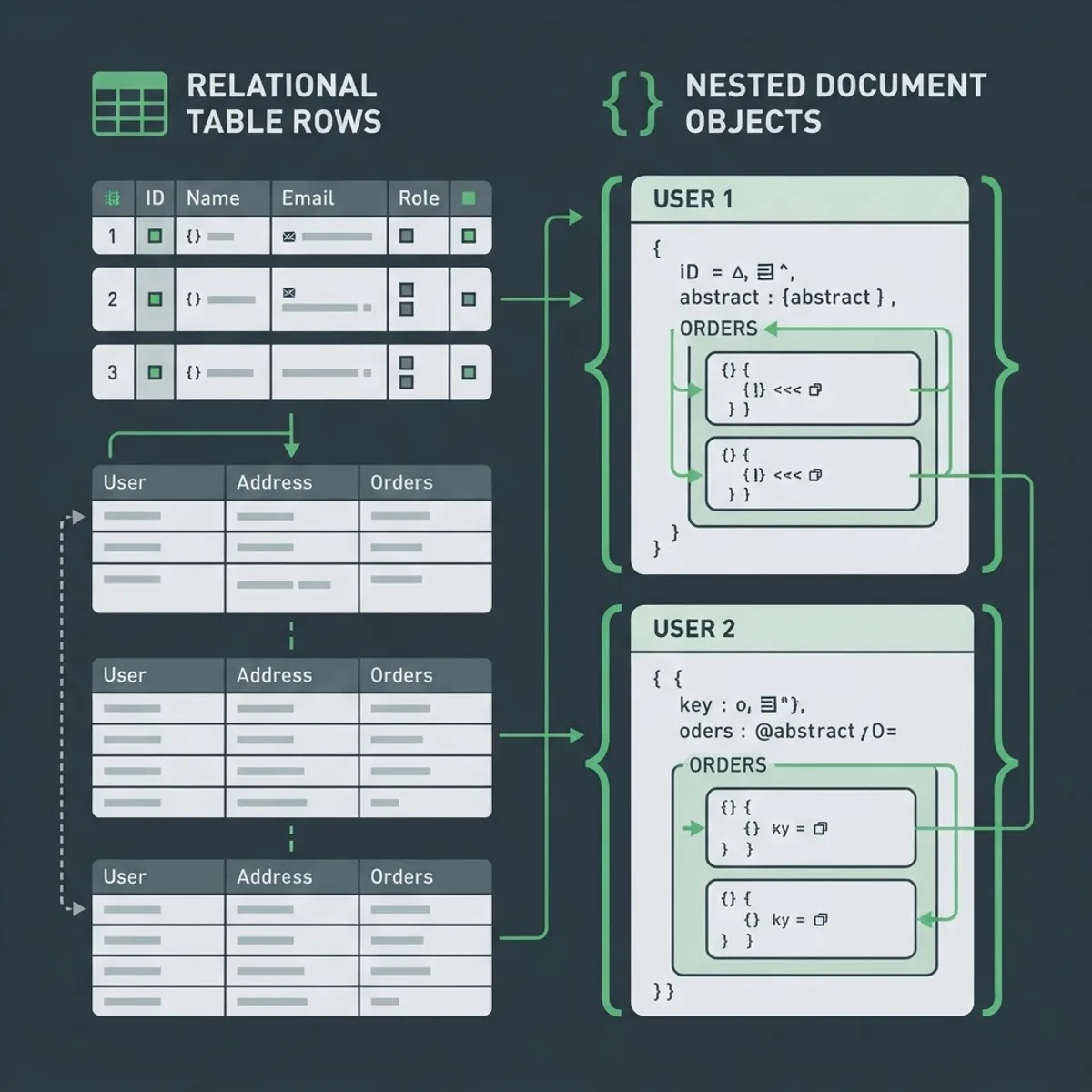
What Is MongoDB and How Does It Store Data?
MongoDB is a document-oriented NoSQL database that stores records as BSON documents, a binary-encoded superset of JSON that adds types such as Date, ObjectId, Decimal128, and binary data. Documents live in collections, and collections live in databases. Unlike a relational row, a document can contain nested objects and arrays, which lets a single read return an entire entity.
What Is BSON and Why Not Plain JSON?
BSON exists for three reasons: it is typed, it is traversable, and it is length-prefixed. Type support means a date is a real date rather than a string. Length prefixes let the storage engine skip fields it does not need instead of parsing sequentially. The practical ceiling to remember is 16 MB per document, which is the single most quoted number in MongoDB interviews.
What Is an ObjectId Made Of?
An ObjectId is 12 bytes: a 4-byte Unix timestamp in seconds, a 5-byte random value unique to the machine and process, and a 3-byte incrementing counter. Because the timestamp leads, ObjectIds sort roughly by creation time, which is why sorting by _id descending is a cheap approximation of newest-first ordering.
How Do Collections Differ From Tables?
Collections do not enforce a fixed schema by default, though JSON Schema validation can be applied per collection. That flexibility is a feature during rapid iteration and a hazard in long-lived systems, which is why mature teams add validators once the shape stabilizes rather than on day one.
Indexing Interview Questions That Separate Candidates
Indexing is where most MongoDB interviews are won or lost. Interviewers want to hear that you reason about selectivity, cardinality, and field order rather than adding indexes reactively.

How Does the ESR Rule Guide Compound Indexes?
ESR stands for Equality, Sort, Range, and it defines the correct field order in a compound index. Put fields matched by exact equality first, fields used for sorting second, and fields used in range comparisons last. Reversing sort and range forces an in-memory sort that fails once the result set exceeds the 100 MB sort memory limit unless disk use is allowed.
What Is a Covered Query?
A covered query is satisfied entirely from an index, with no document fetch. It requires that every field in the filter and projection exists in the index and that _id is excluded from the projection unless indexed. Covered queries are the single most reliable latency win available, because they eliminate random disk reads completely.
How Do You Diagnose a Slow Query?
- Run
explain("executionStats")on the query. - Compare
totalDocsExaminedagainstnReturned. A healthy ratio approaches 1:1. - Check the winning plan stage.
COLLSCANmeans no usable index;IXSCANmeans an index was used;SORTmeans an in-memory sort. - Confirm
totalKeysExaminedis not wildly higher thannReturned, which indicates poor index selectivity. - Add or reorder the index, then re-run and measure again.
When Should You Not Add an Index?
Every index adds write amplification and consumes RAM in the working set. On write-heavy collections with low-selectivity fields, such as a boolean flag where 90 percent of documents share one value, an index costs more than it returns. Interviewers reward candidates who volunteer this constraint unprompted.
Aggregation Framework Interview Questions
Aggregation questions test whether you can transform data server-side instead of pulling everything into application memory.

What Is the Aggregation Pipeline?
The aggregation pipeline processes documents through ordered stages, where each stage transforms the stream and passes it forward. Common stages include $match for filtering, $group for accumulation, $project for reshaping, $lookup for joins, $unwind for flattening arrays, and $facet for parallel sub-pipelines.
Why Should $match Come First?
Placing $match and $sort as early as possible lets the query planner use indexes before documents enter the pipeline. Once a stage such as $group or $unwind reshapes the stream, index eligibility is lost and all downstream work happens in memory. Each pipeline stage has a 100 MB memory cap unless allowDiskUse is enabled.
How Does $lookup Compare to a SQL Join?
$lookup performs a left outer join against another collection in the same database. It is genuinely useful for reporting and infrequent enrichment, but it is not free: the foreign field should be indexed, and high-volume request paths generally perform better with a deliberate denormalization. Teams building these read paths at scale, such as the engineers behind production grade web apps, often duplicate two or three fields into the parent document rather than joining on every request.
Replication, Sharding, and Consistency Questions
Senior interviews pivot here, because these questions reveal whether you have operated MongoDB in production or only developed against it.
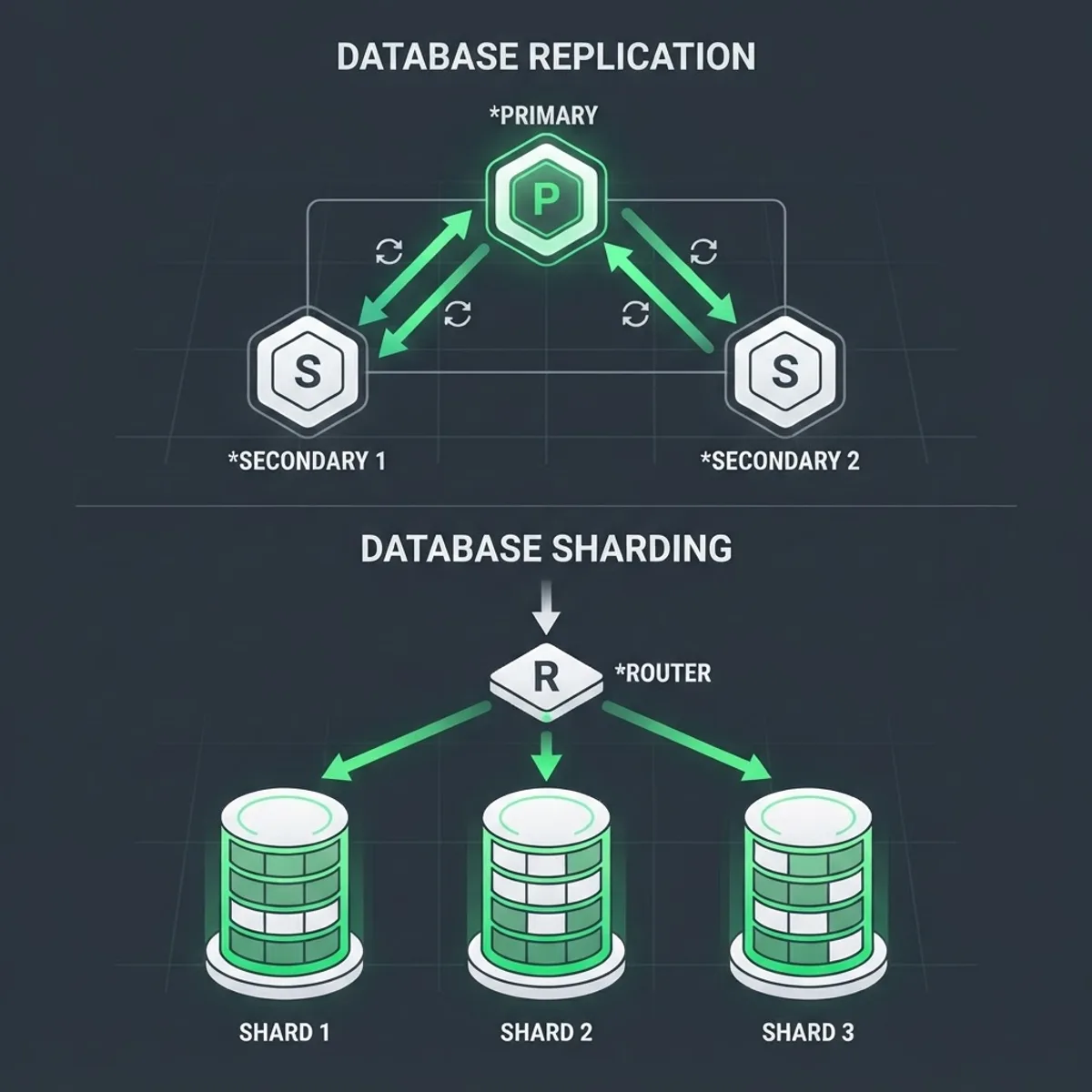
What Is a Replica Set and How Does Failover Work?
A replica set is a group of mongod processes maintaining the same data. One node is primary and accepts all writes; secondaries replicate the primary oplog. If the primary becomes unreachable, remaining members hold an election and a secondary is promoted, typically within 12 seconds under default settings. Odd member counts avoid split votes.
What Do Write Concern and Read Preference Control?
Write concern defines how many members must acknowledge a write. w: 1 acknowledges from the primary alone; w: "majority" guarantees durability across a majority and is the default in modern versions. Read preference controls which members serve reads. primary gives strong consistency; secondaryPreferred improves read throughput but exposes replication lag.
What Makes a Good Shard Key?
A good shard key has high cardinality, low frequency, and non-monotonic growth. High cardinality gives the balancer enough distinct values to split chunks. Low frequency prevents a single value from dominating one shard. Non-monotonic values avoid the hotspot created by inserting sequential keys such as timestamps into the same chunk. Hashed sharding solves monotonicity but eliminates efficient range queries.
Does MongoDB Support ACID Transactions?
Yes. Single-document operations have always been atomic, and multi-document ACID transactions across collections have been supported since version 4.0, extended to sharded clusters in 4.2. The interview-worthy caveat is that transactions add locking and coordination cost, so a well-modeled document that keeps related data together usually outperforms a transaction.
Schema Design Questions and How to Answer Them
Schema design is the highest-signal section of any MongoDB interview because there is no single correct answer, only defensible reasoning.
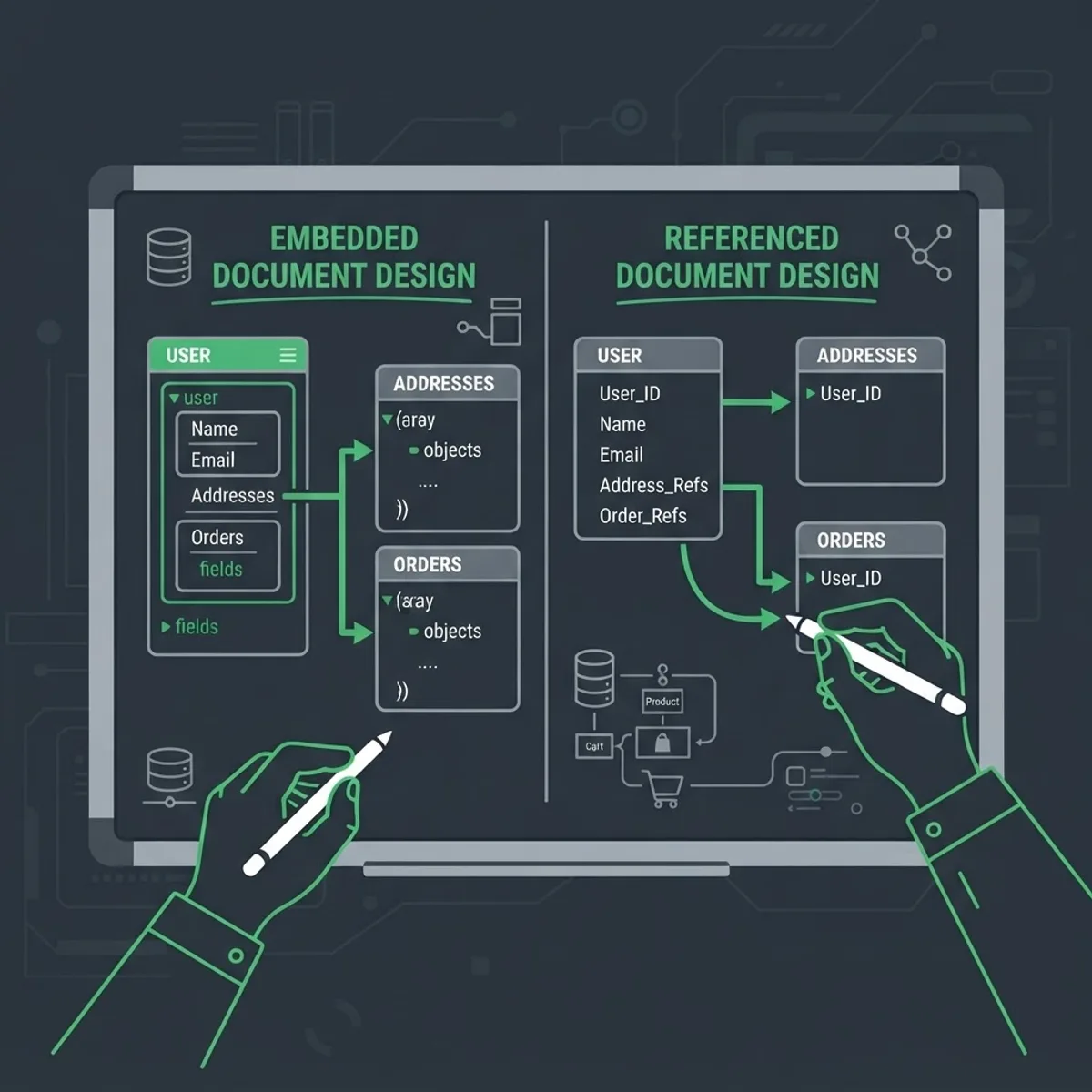
Embedding vs Referencing
| Factor | Embed | Reference |
|---|---|---|
| Read pattern | Data always read together | Data read independently |
| Cardinality | One-to-few | One-to-many or many-to-many |
| Growth | Bounded array size | Unbounded growth |
| Update frequency | Child rarely updated alone | Child updated on its own |
| Document size risk | Must stay well under 16 MB | No size pressure |
Which Schema Anti-Patterns Should You Name?
Four anti-patterns come up repeatedly and naming them proactively demonstrates real experience:
- Unbounded arrays. Comments embedded in a post document grow forever and eventually breach the 16 MB limit.
- Massive numbers of collections. Creating one collection per tenant multiplies index memory and complicates operations.
- Case-insensitive queries without collation. Regex workarounds cannot use indexes efficiently.
- Bloated documents. Storing rarely read fields inline forces the working set to load data no query needs.
How Do You Model Time-Series Data?
Use purpose-built time-series collections introduced in version 5.0, or apply the bucket pattern manually by grouping a fixed interval of readings into one document. Bucketing reduces document count and index size dramatically, often cutting storage overhead by a large margin compared to one document per reading.
How to Prepare in a Structured Way
Preparation should be hands-on. Reading answers produces recognition, not recall.

- Load real data. Import a public dataset of at least a million documents so query plans behave realistically.
- Break things deliberately. Write a query with no index, read the explain output, then add an index and compare
totalDocsExamined. - Practice out loud. Explain the ESR rule and shard key selection verbally in under 90 seconds each.
- Prepare one war story. Have a specific incident ready: what broke, what you measured, what you changed, what the result was.
- Review the release notes. Knowing what changed in the last two major versions signals you follow the ecosystem.
Candidates who pair MongoDB fluency with a full-stack understanding of how the database sits behind an API tend to interview strongest, which is why teams at full stack development shops weigh data modeling as heavily as framework knowledge.
Key Takeaways
- MongoDB stores BSON documents with a hard 16 MB per-document limit; ObjectIds are 12 bytes and sort approximately by creation time.
- Compound indexes should follow the ESR rule: Equality, then Sort, then Range.
- A healthy query has
totalDocsExaminedclose tonReturned; aCOLLSCANstage in explain output signals a missing index. - Aggregation stages cap at 100 MB of memory unless
allowDiskUseis enabled, so$matchand$sortbelong first. - Replica set failover typically completes within roughly 12 seconds, and
w: "majority"is the modern default write concern. - Good shard keys have high cardinality, low frequency, and non-monotonic growth.
- Multi-document ACID transactions exist since 4.0 but strong document modeling usually outperforms them.
Frequently Asked Questions (FAQ)
What are the most common MongoDB interview questions for freshers?
Freshers are usually asked to define MongoDB, explain documents and collections, describe BSON, write basic find and update queries, and explain what an index does. Interviewers expect correct terminology plus one practical reason behind each answer rather than deep performance analysis or production operations experience.
How much MongoDB should I know for a backend developer role?
For a mid-level backend role you need CRUD fluency, index design using the ESR rule, aggregation pipeline basics, and comfort reading explain output. You should also understand replica sets, write concern, and when to embed versus reference data. Sharding depth is generally expected only at senior level.
Is MongoDB still in demand in 2026?
Yes. MongoDB continues to rank among the top five most-used databases in Stack Overflow developer surveys and sits in the top five of the DB-Engines index across all database categories. Demand is strongest in Node.js, real-time application, content platform, and event-data engineering roles.
What is the difference between MongoDB and MySQL in interviews?
MySQL stores fixed-schema rows across normalized tables joined at query time. MongoDB stores flexible documents that keep related data together, trading join flexibility for single-read performance. Interviewers want you to choose based on access patterns and schema volatility, not to declare one database universally better.
How do I answer a MongoDB schema design question well?
Start by asking about read and write patterns, expected data volume, and growth over time. Then propose a structure, state the trade-off you accepted, and name the failure mode you avoided. Explicitly mentioning the 16 MB document limit and unbounded array risk signals genuine production experience.
Do MongoDB interviews include live coding?
Often yes. Expect to write queries or an aggregation pipeline in a shared editor, or to debug a slow query from explain output. Practice typing pipelines without autocomplete, and narrate your reasoning as you work, since interviewers score your thought process alongside the final answer.
Final Thoughts
The strongest MongoDB interview answers sound like decisions, not definitions. When you explain why a shard key avoids hotspots, or why you reordered a compound index and what the measured improvement was, you demonstrate the operational judgment that hiring teams pay for. Build a small dataset, break it, measure it, and fix it. That loop teaches more than any list of questions can.