
A practical, experience-based guide to outsourcing website development: real costs, engagement models, vetting criteria, contract terms, and the workflows that keep quality high.
Outsource Website Development
Outsourcing website development is no longer a cost-cutting compromise. It is how most funded startups ship their first product, how mid-market companies absorb redesign spikes without permanent headcount, and how enterprises staff specialised work their internal teams have never done. The decision is rarely about whether outsourcing works. It is about whether you structure the engagement well enough for it to work for you.
This guide is written from the pattern we see repeatedly across delivery projects: the companies that succeed with outsourced development are not the ones who found a cheaper vendor. They are the ones who defined scope precisely, owned their own codebase and infrastructure, and treated the external team as an extension of their process rather than a black box they threw a brief into.

Quick Answer: Outsourcing website development means hiring an external agency, freelancer, or dedicated team to build your site instead of using in-house staff. It works best when you write a detailed scope, own the code repository and hosting accounts, pay in milestones tied to working deliverables, and hold weekly demos throughout the build.
What Outsourcing Website Development Actually Means
Outsourced website development is a contractual arrangement where an external provider performs design, front-end, back-end, integration, and deployment work that your organisation would otherwise perform internally. The distinction that matters legally and practically is between three arrangements:
- Project outsourcing — a fixed deliverable with a defined scope and price. You buy an outcome.
- Staff augmentation — you rent named engineers by the month and manage them directly inside your own process.
- Managed dedicated team — the vendor supplies engineers plus a lead and delivery process, and reports on velocity rather than tasks.
Most disputes we see trace back to a client who bought project outsourcing but behaved as though they had staff augmentation, changing requirements weekly while expecting the original fixed price to hold. Naming the model in writing before kickoff prevents this specific failure more effectively than any other single step.
Why Companies Outsource: The Honest Reasons
Cost is the reason people cite, but it is rarely the strongest one. According to Deloitte's Global Outsourcing Survey, cost reduction remains the leading driver for roughly 70 percent of organisations, while access to capability and speed to market rank close behind and are frequently the deciding factors for digital projects specifically.
The genuinely defensible reasons to outsource a website build are:
- Capability you will not need permanently. A headless commerce migration or a WebGL product configurator needs deep specialism for four months, not forever.
- Calendar pressure. Hiring a senior full-stack engineer takes weeks of sourcing plus a notice period. A vetted team can start in days.
- Absorbing a spike. A rebrand launch or seasonal campaign creates a temporary workload your product roadmap cannot swallow.
- Reducing risk on unfamiliar ground. A team that has shipped forty similar builds has already hit the edge cases yours will hit.
Outsourcing is a poor fit when the website is the product and the domain logic is your competitive advantage. In that case, hire, and use outsourcing only for the surrounding surfaces — marketing site, documentation portal, internal dashboards.

What Outsourced Website Development Costs in Practice
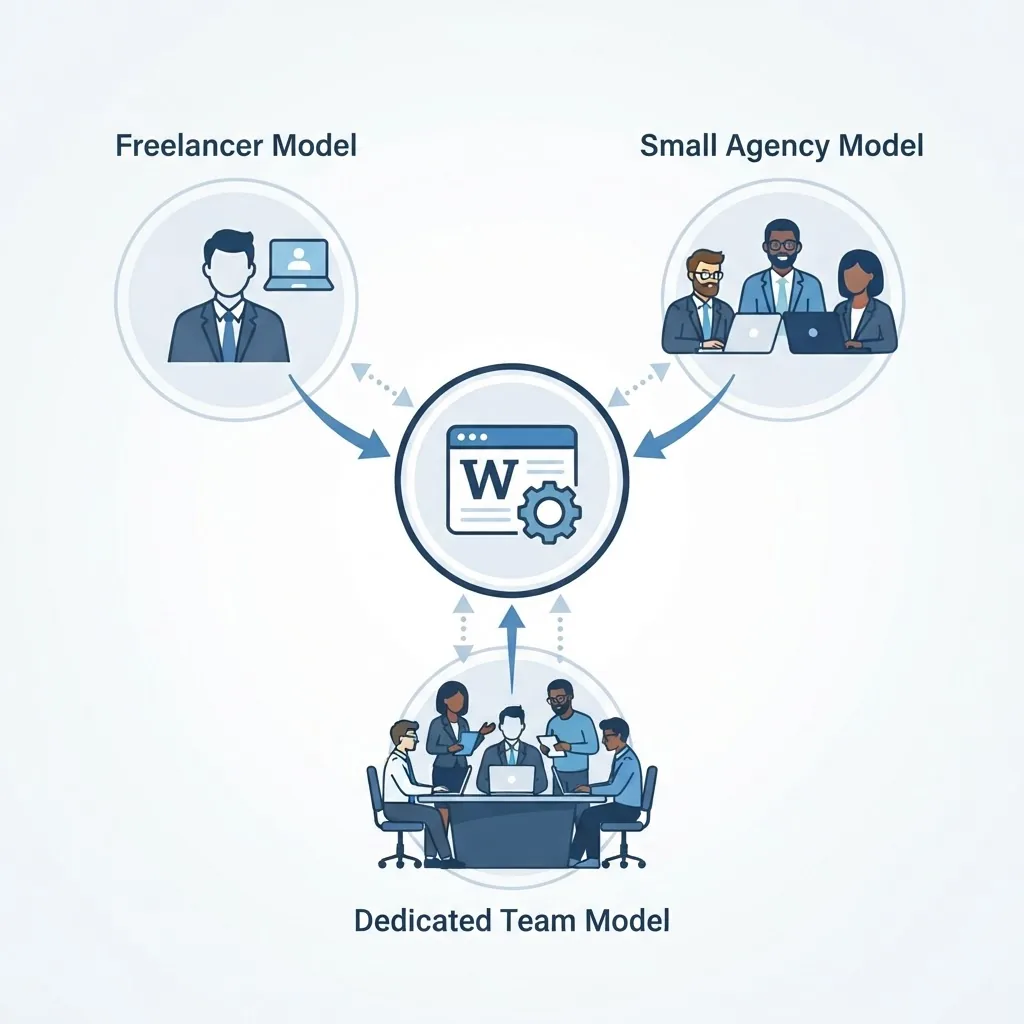
Rates vary by region and seniority more than by quality, which is why blended pricing exists. Below is a realistic comparison of the three common arrangements based on typical market ranges for professional providers.
| Factor | Freelancer | Boutique Agency | Dedicated Team |
|---|---|---|---|
| Typical hourly rate | 25 to 70 USD | 45 to 120 USD | 35 to 90 USD |
| Best project size | Under 15k USD | 15k to 120k USD | Ongoing roadmap |
| Design plus dev under one roof | Rarely | Yes | Usually |
| Bus factor risk | High | Low | Low |
| Speed to start | Days | 1 to 3 weeks | 1 to 2 weeks |
| Post-launch support | Uncertain | Contracted | Contracted |
| Best for | Small scoped tasks | Defined launch projects | Continuous product work |
Two cost realities are consistently underestimated. First, quality assurance, accessibility remediation, and performance work typically account for 15 to 25 percent of a serious build, and briefs that omit them produce quotes that look cheap and invoices that do not. Second, third-party costs — CMS licences, search, email, CDN, monitoring — are yours, not the vendor's, and should be listed separately in the proposal so you can forecast them.

How to Vet an Outsourcing Partner
Portfolios are marketing. Vetting is verification. Use this sequence, in order, and stop as soon as a step fails.
1. Verify Live Work, Not Screenshots
Ask for three live URLs the team built, then run each through Google PageSpeed Insights and a keyboard-only navigation test. Google's own research found that as page load time goes from one second to three seconds, the probability of bounce increases by 32 percent — so a portfolio of slow sites is a direct signal about engineering standards, not an aesthetic preference.
2. Interview the Engineers Who Will Do the Work
Sales engineers close deals; delivery engineers write your code. Insist on a technical call with the named lead. Ask them to walk through a decision they got wrong on a past project and what they changed. Vague answers here correlate strongly with vague delivery later.
3. Buy a Paid Trial Before the Full Contract
Commission one contained piece of work — a single template, one integration, one migration script — as a paid two-week trial. This reveals communication cadence, code quality, and estimate accuracy at a fraction of the cost of discovering them in month three.
4. Check Process Artefacts
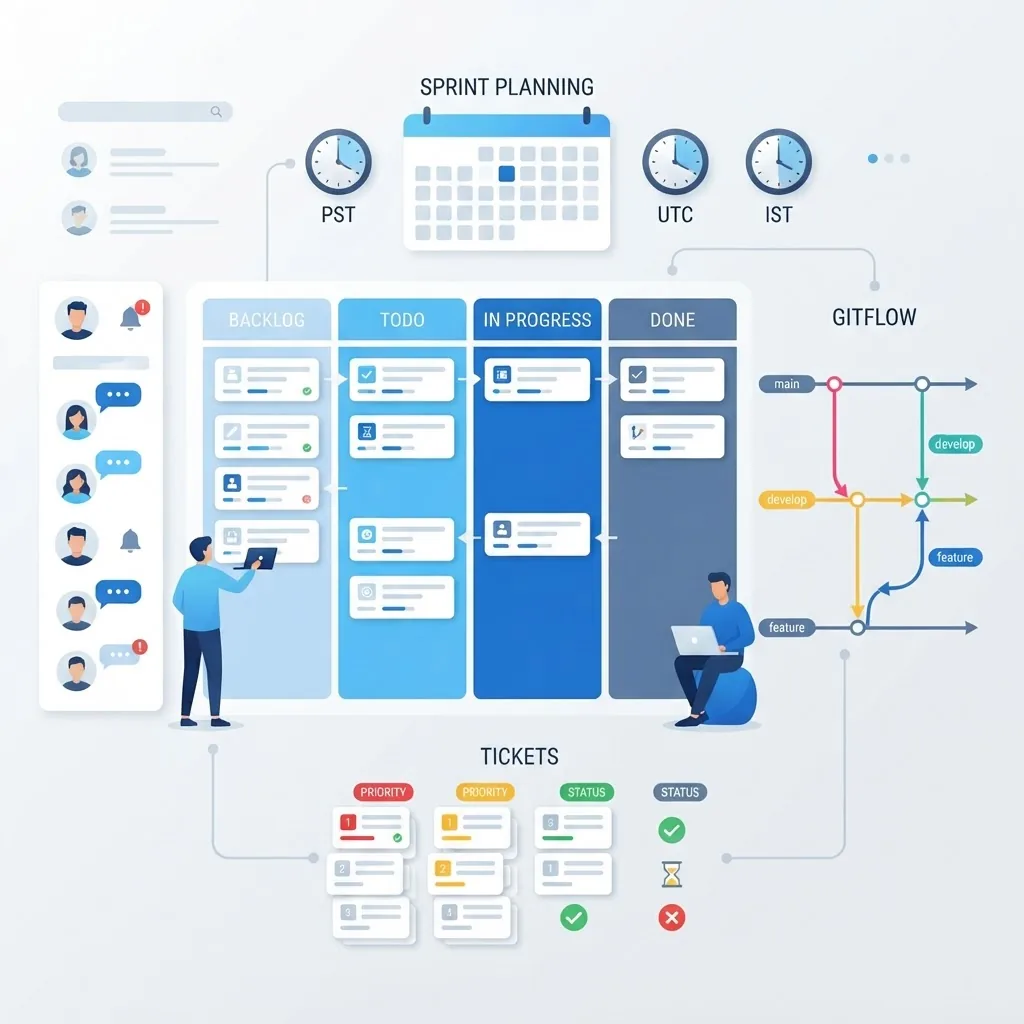
Ask to see a sanitised sprint board, a pull request with review comments, and a QA checklist from a real project. Teams with mature process produce these instantly. Teams without it produce excuses.
If you would rather compare vetted delivery teams than run this from scratch, both ZoneTechify and WebPeak publish their engagement models and stacks openly, which is the transparency baseline worth expecting from any shortlist. Teams evaluating a full scoped build can review typical deliverables under web development services before writing a brief.

Writing a Scope That Prevents Disputes
A scope document is a risk-transfer instrument. The more precisely it describes observable outcomes, the less room there is for honest disagreement. Include these seven elements:
- Page and template inventory — every unique template, not every page. Twelve pages using three templates is a three-template project.
- Content ownership — who writes copy, who sources images, and the date content is due. Late content is the most common cause of missed launch dates.
- Integration list with credentials owner — CRM, payments, analytics, email, each with the API version.
- Acceptance criteria — measurable thresholds such as a Lighthouse performance score, WCAG 2.2 AA conformance, and supported browser versions.
- Definition of done — code merged, reviewed, deployed to staging, documented.
- Change control — how a new request is estimated and approved before work starts.
- Handover package — repository access, environment variables documentation, deployment runbook, and admin training session.
Tie payment to milestones that produce inspectable artefacts. Paying 30 percent at kickoff, 40 percent at a working staging build, and 30 percent at accepted handover keeps incentives aligned without starving the vendor's cash flow.
Managing the Engagement Once Work Starts
Outsourcing fails at the communication layer far more often than the technical layer. Four practices carry most of the weight:
- Weekly demo on staging, no slides. Working software or nothing. This catches misinterpretation within days instead of months.
- One accountable owner on your side. Committees produce contradictory feedback and the vendor optimises for whoever shouts loudest.
- Written decisions in a shared channel. Decisions made in calls evaporate. A short written summary after each call is the cheapest insurance available.
- Four hours of overlap minimum. Distributed teams work when there is a reliable synchronous window for unblocking. Fully asynchronous handoffs double resolution time on ambiguous issues.
Quality, Security, and the Handover You Must Insist On
Acceptance is where leverage lives, because it is the last moment you hold unpaid money. Run acceptance against the criteria in your scope, not against your mood on launch day.
At minimum, verify: responsive behaviour at 360px, 768px, and 1440px; keyboard-only navigation through every interactive element; form validation and error states; 404 and 500 pages; HTTPS with correct security headers; no secrets committed to the repository; and automated backups configured.
The non-negotiable ownership rule: the repository, hosting account, domain registrar, and analytics properties must be in your organisation's name from day one, with the vendor added as a collaborator. Vendors who resist this are protecting leverage, not your project. Intellectual property assignment must be explicit in the contract and effective on payment, covering custom code, design files, and any AI-assisted output.

The Real Risks and How to Neutralise Them
| Risk | Warning sign | Mitigation |
|---|---|---|
| Scope creep | Verbal requests outside the brief | Written change control with re-estimation |
| Key person dependency | One engineer holds all context | Require documentation and code review |
| Lock-in | Vendor holds domain or repo | Own all accounts from day one |
| Quality drift | Demos replaced by status updates | Weekly staging demo, no exceptions |
| Abandonment after launch | No support terms in contract | Contract 30 to 90 days of warranty support |

Key Takeaways
- Outsourcing website development succeeds or fails on scope precision and ownership, not on vendor location or hourly rate.
- Deloitte's Global Outsourcing Survey identifies cost reduction as the leading driver for around 70 percent of organisations, with capability access and speed close behind.
- Google's research shows bounce probability rises 32 percent when load time moves from one to three seconds, making performance a legitimate vetting criterion.
- Freelancers suit projects under roughly 15,000 USD; agencies fit defined launches; dedicated teams fit continuous roadmap work.
- Always own the repository, domain, hosting, and analytics accounts in your organisation's name from day one.
- Run a paid two-week trial before signing a large contract — it surfaces communication and quality issues cheaply.
- Budget 15 to 25 percent of the build for QA, accessibility, and performance work, and contract 30 to 90 days of post-launch warranty support.

Frequently Asked Questions (FAQ)
Is outsourcing website development cheaper than hiring in-house?
For a one-time build, almost always yes, because you avoid recruitment costs, benefits, equipment, and idle capacity after launch. For continuous product development over two or more years, in-house usually wins on total cost and retained knowledge. Compare total cost of ownership, not hourly rates.
How long does an outsourced website project take?
A marketing site on an existing CMS typically takes four to eight weeks. A custom design with several integrations runs ten to sixteen weeks. Complex commerce or platform migrations take four to six months. Content readiness, not engineering speed, is the most common cause of delay.
Who owns the code when I outsource website development?
You should, but only if the contract says so explicitly. Insist on an intellectual property assignment clause effective on payment, covering custom code, design source files, and documentation. Keep the repository and hosting in your own accounts from day one and add the vendor as a collaborator.
How do I avoid getting scammed when outsourcing web development?
Pay in milestones tied to inspectable deliverables, never fully upfront. Start with a small paid trial task. Verify three live sites the team built. Require access to the repository during development so you can see commits. Avoid vendors who refuse a technical call with the actual engineers.
Should I outsource to a freelancer or an agency?
Choose a freelancer for contained, well-specified tasks under roughly 15,000 USD where you can manage the work yourself. Choose an agency or dedicated team when the project needs design, front-end, back-end, and QA coordinated together, or when continuity and post-launch support genuinely matter.
What should I prepare before contacting an outsourcing partner?
Prepare a template inventory, a list of required integrations, your content plan with owners and dates, examples of sites you admire and why, your measurable success criteria, and your budget range. Providers quote far more accurately against this, and you avoid paying for discovery you could have written yourself.