A practical, expert guide to Qu Enterprise Intelligence: what it is, how it works, its benefits, and how to implement AI-driven intelligence across your organization.
Qu Enterprise Intelligence
Enterprise intelligence has quietly become the deciding factor between companies that grow predictably and those that lurch from one guess to the next. After working with data-driven teams across finance, retail, and SaaS, one pattern is clear: the organizations that win are not the ones with the most data, but the ones that turn data into decisions fastest. Qu Enterprise Intelligence is the discipline and technology stack that makes that speed possible, connecting scattered systems, applying AI, and delivering answers that leaders can act on in minutes rather than weeks.
This guide breaks down exactly what enterprise intelligence is, how it differs from traditional reporting, and how to roll it out without drowning your team in dashboards nobody reads. Whether you run a lean startup or a multi-department enterprise, the principles here are field-tested and vendor-neutral.

Quick Answer: Qu Enterprise Intelligence is the practice of unifying an organization's data, applying AI and analytics, and delivering real-time, actionable insights across every department. It turns raw information into faster, smarter decisions, replacing gut-feel management with evidence, and improving forecasting, efficiency, and profitability at scale.
What Is Enterprise Intelligence?
Enterprise intelligence is the coordinated use of data integration, analytics, and artificial intelligence to give an entire organization a single, trustworthy view of its performance. Unlike a standalone dashboard or a single report, it spans finance, operations, marketing, sales, and customer service, so every team works from the same numbers.
A Clear Definition
Enterprise intelligence is a company-wide capability that collects data from all internal and external sources, cleans and unifies it, and uses analytics and machine learning to produce insights that guide strategic and operational decisions. The goal is not more charts; it is better, faster, and more confident action at every level of the business.
The difference matters. Many companies believe they already have intelligence because they own a reporting tool. In reality, they have fragments: a marketing dashboard here, a spreadsheet there, and a finance system that nobody outside accounting can read. True enterprise intelligence removes those silos so a question like why did revenue dip last quarter can be answered with one coherent story instead of five conflicting ones.
How Qu Enterprise Intelligence Works
Qu Enterprise Intelligence works by layering four capabilities on top of your existing systems: data collection, unification, analysis, and delivery. Each layer solves a specific failure point that stops most companies from becoming truly data-driven.

First, data is collected from every relevant source, including CRMs, ERPs, marketing platforms, support tools, and third-party APIs. Second, that data is unified into a consistent model so a customer in one system matches the same customer in another. Third, analytics and machine learning models surface trends, anomalies, and forecasts. Finally, insights are delivered where decisions actually happen, through dashboards, alerts, and increasingly through natural-language interfaces that let anyone ask a question in plain English.
The modern shift is the AI layer. Instead of a human analyst manually building every report, machine learning models continuously scan for patterns, flag risks, and even recommend next steps. This is where partnering with specialists in artificial intelligence services accelerates results, because model selection and data governance are where most in-house projects stall.
The Architecture Behind It
A reliable enterprise intelligence system follows a layered architecture. Understanding the layers helps you avoid buying tools that solve only one slice of the problem.
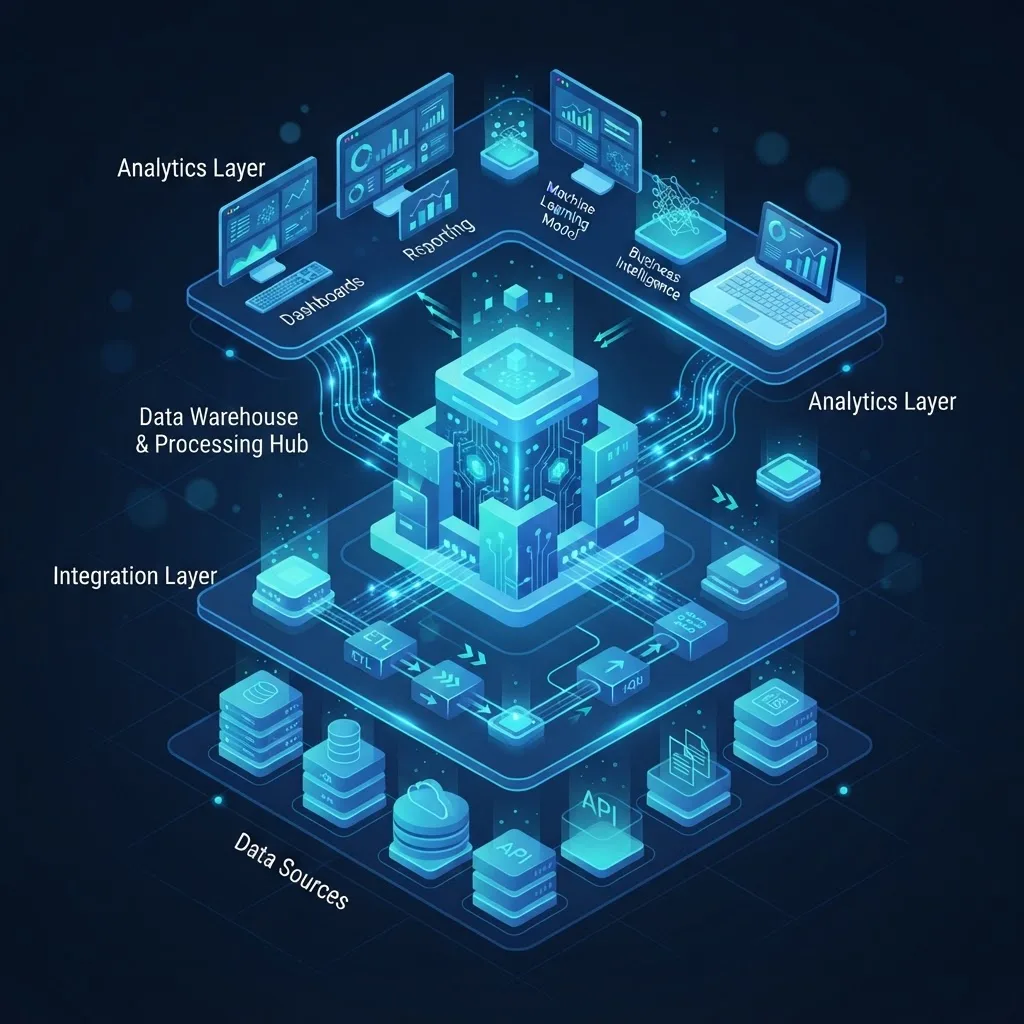
- Source layer: Databases, applications, IoT devices, and external feeds where raw data originates.
- Integration layer: Pipelines that extract, transform, and load data into a central warehouse or lakehouse.
- Storage layer: A cloud data warehouse that stores clean, query-ready data at scale.
- Intelligence layer: Analytics engines and machine learning models that generate insights and predictions.
- Experience layer: Dashboards, alerts, and conversational tools that put insights in front of decision-makers.
When one layer is weak, the whole system suffers. A brilliant AI model fed dirty, disconnected data will produce confident but wrong answers, which is worse than no answer at all.
Enterprise Intelligence vs Business Intelligence
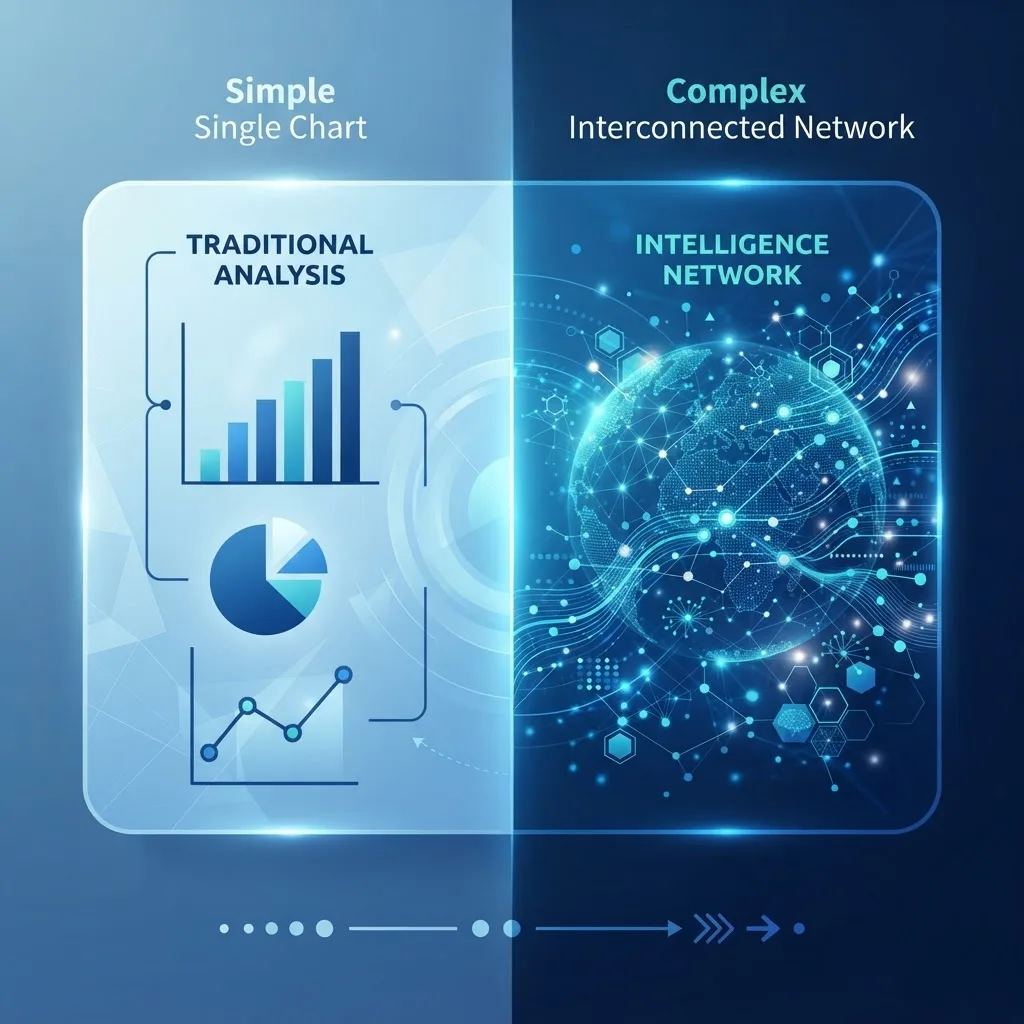
People often use enterprise intelligence and business intelligence interchangeably, but they are not the same. Business intelligence (BI) focuses mostly on reporting what already happened. Enterprise intelligence extends that into prediction, automation, and organization-wide scale.
| Factor | Traditional Business Intelligence | Qu Enterprise Intelligence |
|---|---|---|
| Primary focus | Historical reporting | Prediction and real-time action |
| Data scope | Department-level | Organization-wide |
| Intelligence type | Descriptive dashboards | Descriptive, predictive, prescriptive |
| AI and automation | Limited or none | Core capability |
| Speed of insight | Days to weeks | Minutes to real time |
| Primary user | Analysts | Every team and role |
The practical takeaway: BI tells you sales dropped last month, while enterprise intelligence tells you sales are likely to drop next month and recommends what to do about it. That forward-looking difference is why enterprise intelligence delivers a stronger return on investment.
Real-World Benefits and the Data Behind Them
Enterprise intelligence delivers measurable value, and the numbers support it. According to McKinsey research, data-driven organizations are 23 times more likely to acquire customers and 19 times more likely to be profitable than their less data-mature peers. That gap is not luck; it is the compounding advantage of making better decisions more often.

A second widely cited figure comes from Forrester, which has reported that between 60 and 73 percent of enterprise data goes unused for analytics. Enterprise intelligence directly attacks that waste by unifying and activating dormant data. Every unused dataset is a decision made blind, so recovering even a fraction of it changes outcomes.
The concrete benefits show up across the business:
- Faster decisions: Teams stop waiting on manual reports and act on live data.
- Reduced risk: Anomaly detection catches fraud, churn signals, and supply issues early.
- Higher efficiency: Automation removes repetitive reporting work from skilled staff.
- Better forecasting: Predictive models sharpen inventory, staffing, and budget planning.
- Alignment: One shared source of truth ends the endless my numbers versus your numbers debates.
How to Unify Your Enterprise Data
Data integration is the foundation, and it is where most projects either succeed or quietly fail. Unifying your data means making every system speak the same language so insights are trustworthy.

Follow these steps to build a solid foundation:
- Audit your sources. List every system that holds business data and rank it by importance.
- Define a common data model. Decide how core entities like customer, order, and product are structured everywhere.
- Build reliable pipelines. Automate extraction and transformation so data stays fresh without manual exports.
- Centralize storage. Use a cloud data warehouse as the single source of truth.
- Enforce governance. Set clear rules for data quality, access, and privacy from day one.
- Validate continuously. Add automated checks so broken data is caught before it reaches decision-makers.
Skipping governance is the most common and expensive mistake. Clean data is not a one-time cleanup; it is an ongoing discipline that protects every downstream insight.
Measuring ROI and Proving Value
Enterprise intelligence must earn its budget, and the smartest teams measure ROI from the first phase. Tie every initiative to a specific business metric such as reduced churn, faster close times, or higher marketing efficiency.

Start with a single high-value use case rather than a company-wide rollout. Prove that predictive churn scoring saved a measurable amount of revenue, then expand. This build-measure-scale approach keeps stakeholders confident and funding secure. Teams that want to accelerate this often bring in outside expertise; for example, WebPeak AI services help organizations design and deploy models that connect directly to revenue outcomes instead of vanity metrics.
The most durable programs report value in the language of the business, not the language of the data team. Executives care about margin, growth, and risk, so translate every technical win into one of those terms.
Common Mistakes to Avoid
Even well-funded enterprise intelligence projects stumble for predictable reasons. Learning them in advance saves months of wasted effort.
- Buying tools before strategy. Software cannot fix an unclear question. Define the decisions you want to improve first.
- Ignoring data quality. AI amplifies whatever you feed it, including errors.
- Building for analysts only. If frontline teams cannot use the insights, adoption dies.
- Chasing every metric. Focus on the handful of numbers that actually drive outcomes.
- Treating it as a one-off project. Enterprise intelligence is a living capability that needs ongoing ownership.
Avoiding these traps is often more valuable than any single feature. Brands like ZoneTechify and WebPeak emphasize strategy-first implementation precisely because tooling is the easy part; disciplined execution is what separates results from shelfware.
Key Takeaways
- Enterprise intelligence unifies all organizational data and applies AI to deliver real-time, actionable insights across every department.
- It goes beyond traditional business intelligence by adding prediction, prescription, and automation at organization-wide scale.
- Data-driven companies are 23 times more likely to acquire customers, according to McKinsey research.
- Forrester has found that 60 to 73 percent of enterprise data goes unused, representing a major recoverable opportunity.
- Success depends on clean, unified data, strong governance, and starting with one high-value use case before scaling.
Frequently Asked Questions (FAQ)
What is enterprise intelligence in simple terms?
Enterprise intelligence is a company-wide system that gathers data from every department, unifies it, and uses AI and analytics to turn it into clear, actionable insights. In simple terms, it helps an entire organization make faster, smarter decisions based on evidence instead of guesswork.
How is enterprise intelligence different from business intelligence?
Business intelligence mainly reports what already happened using historical dashboards. Enterprise intelligence goes further by adding prediction, prescription, and automation across the whole organization. It tells you what is likely to happen next and recommends actions, operating in real time rather than days after the fact.
Do small businesses need enterprise intelligence?
Yes, smaller companies benefit too, often more per dollar spent. Modern cloud tools make enterprise intelligence affordable at any size. Even a single unified dashboard with basic predictive alerts can sharpen forecasting, reduce waste, and help a lean team compete with much larger, data-rich rivals.
How long does it take to implement enterprise intelligence?
A focused first use case can deliver value within a few weeks, while full organization-wide maturity takes longer. The smart approach is to start small, prove measurable ROI on one high-value problem, then expand gradually so adoption and data quality keep pace with ambition.
What role does AI play in enterprise intelligence?
AI is the engine that turns raw data into foresight. Machine learning models continuously scan for patterns, detect anomalies, forecast outcomes, and recommend actions automatically. Without AI, teams rely on slow manual reporting; with it, insights and warnings surface in real time across the business.
Final Thoughts
Qu Enterprise Intelligence is less about buying another dashboard and more about building an organizational habit of deciding with evidence. The companies pulling ahead are unifying their data, layering AI on top, and putting insights directly into the hands of the people who act on them. Start with one meaningful decision you want to improve, unify the data behind it, measure the result, and scale from there. Done right, enterprise intelligence stops being a cost center and becomes the quiet engine behind steady, confident growth.