
Accurate records in practice management software protect revenue, reduce compliance risk, and speed up daily operations. Learn what accuracy really means and how to build it into your workflow.
Why Is Keeping Accurate Records in Practice Management Software Important
Every practice — medical, dental, legal, therapy, veterinary, or accounting — runs on the same fuel: records. Appointment histories, treatment notes, insurance details, invoices, consent forms, and communication logs. Practice management software promises to hold all of it in one place. But software only amplifies what you feed it. Feed it clean, accurate records and it becomes a decision engine. Feed it half-finished notes, duplicate patient files, and outdated insurance data, and it becomes an expensive filing cabinet that quietly leaks money.
In our work building operational systems and dashboards for service businesses at ZoneTechify, one pattern shows up again and again: the practices that struggle rarely have a software problem. They have a data accuracy problem wearing a software costume. This article explains exactly why record accuracy matters, what it costs when it slips, and how to fix it with a workflow you can start this week.

Quick Answer: Keeping accurate records in practice management software is important because accuracy directly controls three things: whether you get paid, whether you pass an audit, and whether clinical or client decisions are safe. Inaccurate data causes claim denials, duplicate charts, legal exposure, wasted staff hours, and reporting you cannot trust.
What "Accurate Records" Actually Means in Practice Management Software
Accuracy is not just "no typos." In a practice management system, a record is accurate only when it satisfies five conditions at once.
- Complete — every required field is filled, not skipped for later.
- Current — insurance, address, phone, and medication or matter status reflect today, not last year.
- Consistent — one person equals one record, spelled and formatted the same way everywhere.
- Timely — entered at or near the point of service, not reconstructed from memory days later.
- Attributable — timestamped and tied to the staff member who entered or edited it.
Definition: Record accuracy in practice management software is the degree to which stored data matches verifiable reality at the moment it is used for a clinical, financial, or legal decision.
That last phrase matters. A record is not accurate in the abstract — it is accurate for a purpose. A phone number that is correct but stored in a free-text note instead of the contact field is accurate data in an inaccurate place, and your automated reminder system will still fail.
Reason 1: Inaccurate Records Are the Number One Cause of Lost Revenue
Revenue leakage in a practice almost never comes from one dramatic event. It comes from small data defects repeated hundreds of times.
According to the American Medical Association's long-running work on claims administration, a meaningful share of denied claims trace back to eligibility and demographic errors rather than clinical disputes — wrong policy number, stale coverage, mismatched date of birth, missing referral. Industry claim-denial reporting consistently places administrative and registration errors among the top denial categories, and the frustrating part is that most of those denials are preventable at the front desk in under sixty seconds.

The compounding math is what hurts:
- A denied claim must be reworked, and rework costs staff time you already paid for once.
- A percentage of denials are never resubmitted at all, becoming permanent write-offs.
- Delayed payment stretches your days-in-accounts-receivable, which distorts cash flow planning.
One unverified insurance field creates a denial, a rework cycle, a delayed payment, and a distorted forecast. That is four problems from one blank box.
The Duplicate Record Tax
Duplicate patient or client records are the most underrated accuracy failure. When "Robert Chen" and "Bob Chen" exist as separate charts, the practice pays a hidden tax: split billing histories, missed balances, duplicated intake work, and two versions of the truth during a clinical or legal decision. Duplicates also break every downstream automation — recall campaigns, outstanding balance reports, and no-show tracking all undercount reality.
Reason 2: Accurate Records Are Your Only Real Defense in an Audit or Dispute
When a payer audits you, a regulator asks questions, or a client disputes a charge, your records are the argument. Not your memory, not your intent — your timestamped documentation.

Accurate records give you three defensive assets:
- An audit trail. Who created the entry, who modified it, and when. Practice management systems log this automatically — but only if staff work inside the system instead of on paper and sticky notes they transcribe later.
- Contemporaneous documentation. Notes written at the time of service carry far more weight than notes reconstructed weeks later. Late-entered documentation is legally weaker even when it is factually true.
- Demonstrable consistency. Auditors look for patterns. Records that are uniformly complete signal a controlled process; records that are complete only when convenient signal the opposite.
The practical rule we give clients: if it is not in the system, it did not happen. Verbal confirmations, hallway instructions, and remembered consents do not survive scrutiny.
Reason 3: Bad Data Makes Every Report and Decision Unreliable
Practice management software sells you dashboards. Those dashboards are only as honest as the records behind them.

If appointment types are chosen inconsistently, your utilization report is fiction. If cancellations are sometimes deleted instead of marked cancelled, your no-show rate looks artificially healthy and you will never fix the real problem. If procedures are coded loosely, your "most profitable service" analysis will point you toward the wrong growth investment.
This is where accuracy stops being an admin chore and becomes strategy. Decisions we routinely see made on unreliable practice data include:
- Hiring an additional provider based on inflated demand figures.
- Extending hours based on a misread appointment pattern.
- Cutting a service line that was actually profitable under correct coding.
- Setting marketing budgets against a patient acquisition number polluted by duplicates.
A report built on inaccurate records does not just fail to help — it actively misleads with the full confidence of a chart.
Reason 4: Accuracy Protects Care Quality and Client Safety
In clinical settings the stakes escalate past money. An out-of-date allergy list, a missing medication entry, or a treatment note attached to the wrong chart can cause direct harm. Even in non-clinical practices, a missed deadline in a legal matter record or a wrong figure in an accounting file can damage a client irreversibly.
Accurate records reduce risk through continuity. When a covering provider, a new associate, or a locum opens a chart, the record is the only handover they get. Complete documentation means the next person makes the same informed decision you would have made.
Reason 5: Clean Records Are What Make Automation and AI Work
Automated reminders, recall campaigns, waitlist filling, online booking, and AI-assisted documentation all depend on structured, correct fields. Automation does not tolerate ambiguity — it either finds a valid mobile number in the mobile field or the reminder never sends.

This is the most common disappointment we hear about modern practice software: a practice invests in automation, sees weak results, and blames the tool. In nearly every case the automation was firing correctly against incomplete data. If you are planning to layer intelligent workflows or a custom operational platform on top of your practice data, the accuracy work has to come first — that is a core part of how we scope web application development projects for service businesses, and the performance and data-quality reviews the team at WebPeak runs follow the same principle.
Accurate Records vs Inaccurate Records: The Operational Difference
| Area | Accurate Records | Inaccurate Records |
|---|---|---|
| Claim acceptance | High first-pass acceptance | Frequent denials and rework |
| Staff time | Minutes per patient | Hours per week chasing corrections |
| Audit readiness | Evidence ready on demand | Reconstruction and exposure |
| Reporting | Trustworthy for decisions | Misleading with false confidence |
| Automation | Reminders and recalls fire correctly | Silent failures, missed patients |
| Patient or client trust | Smooth, no repeated questions | Repeated intake, billing surprises |
| Handover between staff | Complete continuity | Guesswork and clinical risk |
| Cash flow | Predictable, shorter AR cycle | Volatile, extended AR cycle |
How to Build Record Accuracy Into Daily Practice: A Practical Framework
Accuracy is a process outcome, not a personality trait. Build the process and accuracy follows.
1. Make Critical Fields Mandatory in the System
Do not rely on training to enforce completeness. Configure required fields so a record cannot be saved without insurance verification status, date of birth, contact number, and consent flags. Software-enforced rules beat human diligence every time.
2. Verify at Every Visit, Not Just at Registration
Insurance coverage, addresses, and phone numbers decay continuously. Add a fifteen-second verification step to check-in: "Has anything changed with your coverage or contact details?" This single habit prevents a large share of eligibility denials.
3. Document at the Point of Service
Set a hard rule that notes are completed before the end of the session or the end of the day — never the end of the week. Contemporaneous entries are more accurate and legally stronger.
4. Run a Monthly Duplicate and Exception Report
Most practice management platforms include duplicate detection and incomplete-record reports. Schedule a recurring monthly review, merge duplicates, and close out incomplete charts. Thirty minutes a month prevents a year of compounding mess.
5. Write a One-Page Documentation Standard
Define exactly how appointment types are selected, how cancellations are recorded, and how notes are formatted. Ambiguity is the root of inconsistency. One page, agreed by the whole team, beats a fifty-page manual nobody reads.

6. Assign Ownership
Name one person accountable for data quality. Shared responsibility becomes nobody's responsibility. This person owns the monthly report, the standard document, and onboarding for new staff.
7. Restrict, Log, and Back Up Access
Accuracy and security are the same discipline. Role-based permissions limit who can edit sensitive fields, audit logs make changes traceable, and tested backups ensure accurate records survive hardware failure or ransomware.

The Real Cost of "We'll Clean It Up Later"
Data debt behaves like technical debt: interest accrues silently. A thousand records with a 5% error rate is fifty problems. Ten thousand records at the same rate is five hundred — and by then remediation requires a project, a budget, and downtime instead of a habit.
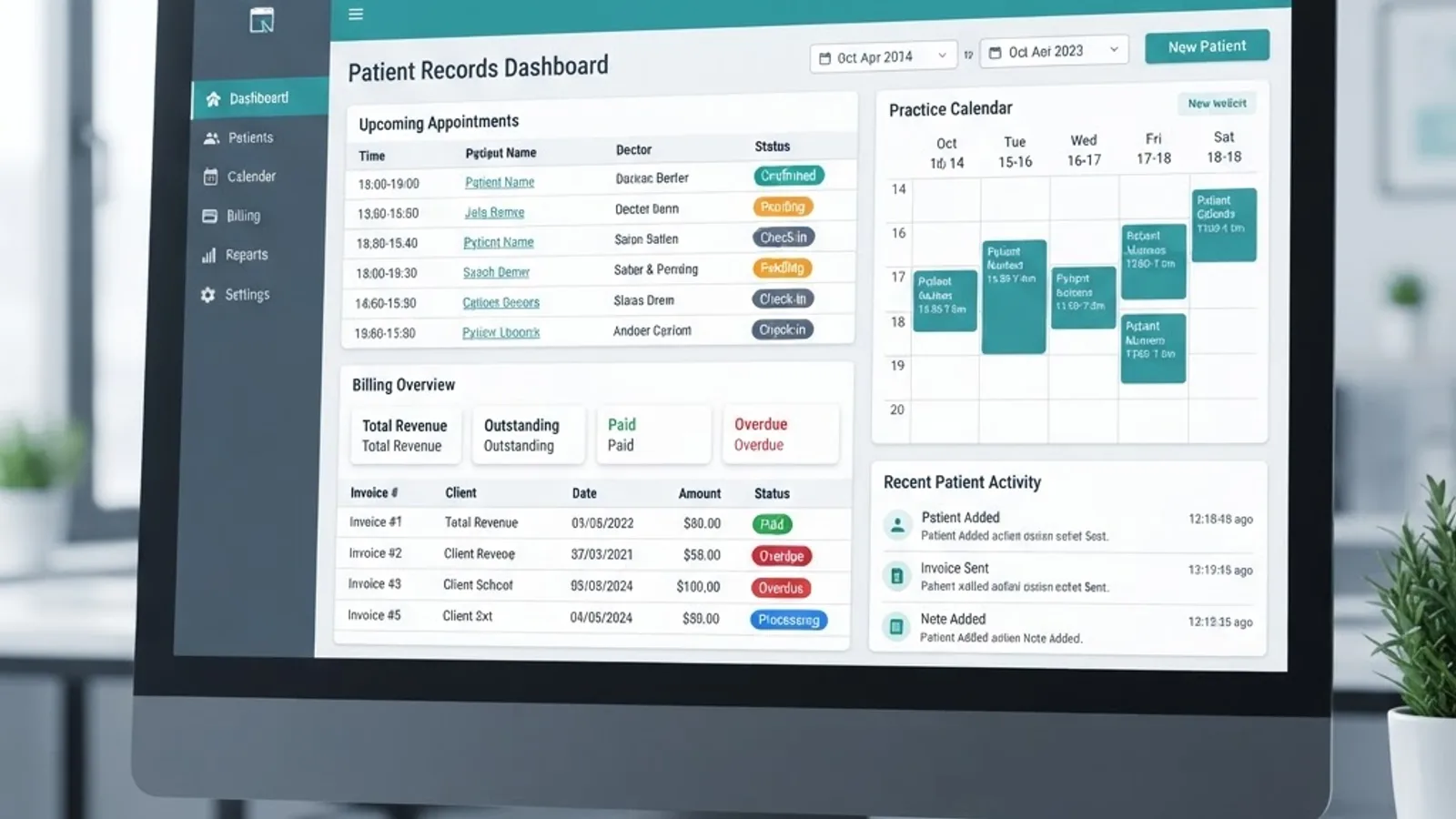
The practices that stay clean share one trait: they treat the record as the deliverable, not as paperwork that follows the deliverable. The visit is not finished when the patient leaves. It is finished when the record is accurate.
Key Takeaways
- Record accuracy requires five properties: complete, current, consistent, timely, and attributable.
- Administrative and eligibility errors — not clinical disagreements — are among the leading causes of claim denials, and most are preventable at check-in.
- Duplicate records split billing history, break automation, and undercount your real patient volume.
- Contemporaneous documentation carries far more legal and audit weight than notes reconstructed later.
- Dashboards inherit the quality of their inputs; bad records produce confidently wrong reports.
- Automation and AI features fail silently on incomplete data — clean the data before buying the tooling.
- System-enforced mandatory fields outperform training and reminders for sustained accuracy.
- Data debt compounds; a thirty-minute monthly review prevents a multi-month cleanup project.
Frequently Asked Questions (FAQ)
Why is accurate record keeping so important in practice management software?
Because accuracy controls whether you get paid, whether you can defend yourself in an audit, and whether decisions made from the record are safe. Practice management software automates billing, reminders, and reporting directly from stored fields, so any inaccuracy is silently multiplied across every connected workflow.
What are the most common record keeping mistakes practices make?
The most frequent mistakes are unverified insurance details, duplicate patient records from name variations, notes written days after the visit, inconsistent appointment or procedure coding, and important information typed into free-text fields instead of the structured fields that automation and reporting actually read.
How do inaccurate records cause insurance claim denials?
Claims are validated against payer data before clinical review. A mismatched date of birth, an expired policy number, a misspelled name, or a missing referral triggers an automatic rejection. The care was appropriate, but the record failed verification, so payment stops until someone corrects and resubmits it.
How often should we audit our practice management records?
Run a duplicate and incomplete-record report monthly, and verify each patient's contact and insurance details at every visit rather than only at registration. A deeper quarterly review of coding consistency and appointment classification keeps your reporting reliable enough to base staffing and budget decisions on.
Can practice management software fix inaccurate data on its own?
No. Software can enforce required fields, flag duplicates, validate formats, and log every change, but it cannot know whether the information entered is true. Accuracy still depends on verification at the point of service, a written documentation standard, and one named person accountable for data quality.
Does record accuracy actually affect patient experience?
Yes, and patients notice immediately. Accurate records mean no repeated intake forms, reminders that reach the right phone, billing without surprise corrections, and providers who already know the history. Inaccurate records force patients to repeat themselves, which reads as disorganisation and erodes trust quickly.
Final Thought
Practice management software does not create order — it reflects it. The accuracy of your records is the single highest-leverage operational habit in a practice, because it sits upstream of revenue, compliance, safety, reporting, and automation simultaneously. Fix the record and you fix everything downstream of it.