A complete, expert guide to using an AP Computer Science Principles practice exam effectively — covering exam format, question types, scoring, study schedules, and the mistakes that cost students points.
AP Computer Science Principles Practice Exam
Most students who struggle with AP Computer Science Principles (AP CSP) do not fail because they lack coding ability. They lose points because they never practiced the exam in the exact format the College Board uses. An AP Computer Science Principles practice exam is the single highest-leverage study tool available, because the test rewards reading comprehension, pseudocode fluency, and data reasoning far more than memorization.
This guide explains exactly how the exam is structured, what a genuinely useful practice exam looks like, how to score yourself accurately, and how to convert your mistakes into points. Everything below reflects the current College Board exam design — the 70-question multiple-choice test plus the Create Performance Task.
Quick Answer: An AP Computer Science Principles practice exam is a full-length 70-question, 120-minute multiple-choice simulation that mirrors the real End-of-Course exam. Taking at least three timed practice exams, then reviewing every missed question by topic, is the fastest proven way to raise your AP CSP score.
What Is an AP Computer Science Principles Practice Exam?
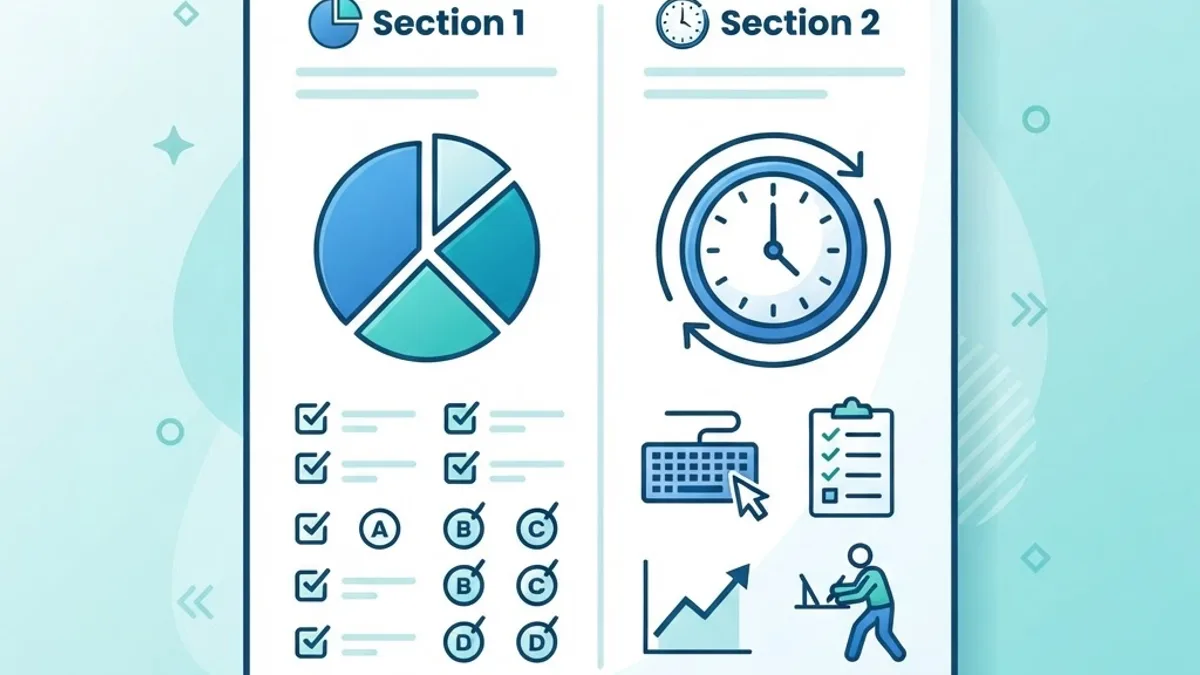
An AP CSP practice exam is a timed replica of the End-of-Course (EOC) multiple-choice section: 70 questions in 120 minutes, weighted at 70 percent of your final AP score. The remaining 30 percent comes from the Create Performance Task, which you submit before the exam date.
A practice exam is only useful if it replicates four specific conditions:
- Question count and timing — 70 questions, 120 minutes, which averages 1 minute 43 seconds per question.
- Question format — single-select and multi-select (choose two answers) questions.
- Pseudocode style — the College Board AP CSP Exam Reference Sheet pseudocode, not Python, Java, or JavaScript.
- Topic distribution — proportional coverage of all five Big Ideas.
Any practice test written in real programming language syntax is training you for the wrong exam. That single mismatch is the most common reason students report feeling "surprised" on test day.
Exam Format: What You Are Actually Being Tested On
The AP CSP exam is organized around five Big Ideas, and the multiple-choice section samples them in fixed proportions. Knowing these weights tells you where to spend your review hours.
| Big Idea | Topic Focus | Approximate MCQ Weight | Practice Priority |
|---|---|---|---|
| Creative Development | Collaboration, program design, debugging | 10-13% | Medium |
| Data | Binary, compression, metadata, data analysis | 17-22% | High |
| Algorithms and Programming | Pseudocode, loops, lists, procedures, simulation | 30-35% | Highest |
| Computing Systems and Networks | Internet, protocols, fault tolerance, parallel computing | 11-15% | Medium |
| Impact of Computing | Bias, digital divide, privacy, crowdsourcing, legal issues | 21-26% | High |
Notice the split: roughly 35 percent of the exam is programming logic, but nearly 25 percent is the Impact of Computing — a reading-and-reasoning section with no code at all. Students who over-index on coding and skip Impact of Computing typically lose 8 to 12 easy points.
The Two Question Types You Must Practice Separately
Single-select questions make up the large majority. Multi-select questions ask you to select two correct answers, and partial credit does not exist — both must be right. Practice these deliberately, because the wrong strategy (picking the two that "sound best") is far less reliable than evaluating each option independently as true or false.
How to Take a Practice Exam the Right Way
A practice exam taken casually is barely better than reading notes. Follow this protocol:
- Sit for the full 120 minutes in one block. Fatigue in questions 50-70 is real, and only a full-length attempt exposes it.
- Keep the AP CSP Exam Reference Sheet open. You get it on the real exam, so practicing without it builds a habit you cannot use.
- Flag, do not stall. If a question exceeds 2 minutes, flag it and move on. There is no penalty for guessing, so never leave a blank.
- Log your reasoning, not just your answer. Write a one-line "why" beside each answer. When you review, you will discover whether you knew it or guessed correctly.
- Score it the same day. Delayed review loses the memory of your reasoning, which is where the actual learning lives.
The Review Method That Actually Moves Scores
After scoring, sort every missed question into one of four buckets:
- Content gap — you did not know the concept. Action: relearn the topic.
- Misread — you knew it but misread the question or answer. Action: slow down on the last clause of each stem.
- Trace error — your pseudocode tracing broke. Action: rewrite the loop by hand with a variable table.
- Guess — pure chance. Action: treat correct guesses as wrong and study them anyway.
Students who categorize errors this way improve faster than students who simply re-read explanations, because the fix is specific to the failure type.
Scoring: Translating Practice Results Into an AP Score
According to College Board score distribution data, roughly 6 to 7 out of 10 AP Computer Science Principles students earn a passing score of 3 or higher each year, and around 1 in 8 to 1 in 10 earn a 5 — making it one of the more accessible AP exams, but not an easy 5.
Use this practical conversion for a 70-question practice test, assuming a solid Performance Task submission:
| Raw MCQ Correct (of 70) | Approximate Percentage | Likely AP Score | What It Means |
|---|---|---|---|
| 60-70 | 86-100% | 5 | Strong across all Big Ideas |
| 50-59 | 71-84% | 4 | One or two weak Big Ideas |
| 40-49 | 57-70% | 3 | Passing, but algorithms need work |
| 30-39 | 43-56% | 2 | Systematic content gaps |
| Below 30 | Under 43% | 1 | Restart with Big Ideas 3 and 5 |
These are estimates, not official cut scores — the College Board adjusts curves annually. Treat them as a directional signal, and always pair them with your per-topic accuracy rather than the headline number.
Track Accuracy by Big Idea, Not Overall
A 75 percent overall score can hide a 40 percent score in Algorithms and Programming. Build a simple table after each practice exam: Big Idea, questions attempted, questions correct, accuracy. Your lowest-accuracy Big Idea is your study plan for the next week. That is the whole system.
The Create Performance Task Is 30 Percent — Practice It Too
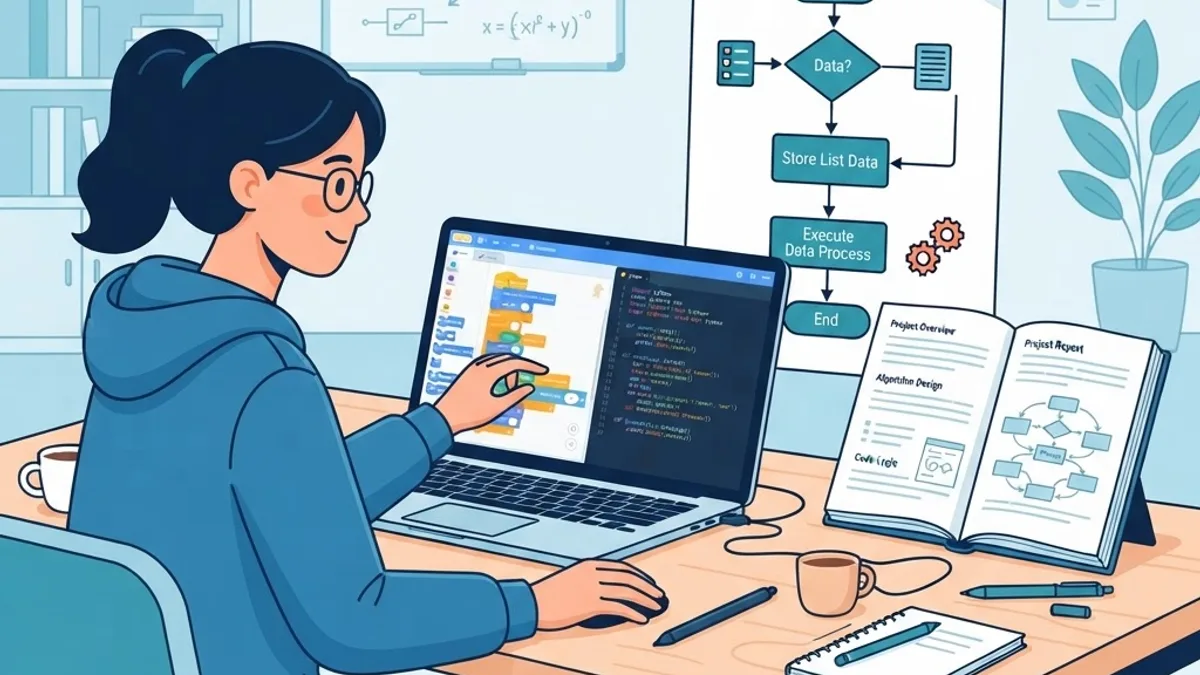
The Create Performance Task requires a working program plus written responses and a video of your program running. It is worth 30 percent of your score, and it is the only part you control completely, with no time pressure.
Your program must clearly demonstrate:
- A list (or other collection type) that manages complexity — meaning the program would be meaningfully harder to write without it.
- A student-developed procedure with at least one parameter that affects functionality.
- Sequencing, selection, and iteration inside that procedure.
- A call to the procedure.
The most common point loss here is not code quality — it is written responses that describe what the code does instead of explaining how the list manages complexity. Write the explanation as if the reader cannot see your code.
Seven Mistakes That Cost Students the Most Points
From reviewing how students approach digital assessments and technical problem-solving, these patterns repeat constantly:
- Practicing in Python or Java syntax instead of AP pseudocode.
- Skipping Impact of Computing because it feels like "not real computer science" — it is a quarter of the exam.
- Leaving multi-select questions half-answered. Both selections must be correct; commit to two.
- Not tracing loops on paper. Mental tracing fails around nested iteration and list indexing.
- Confusing lossy and lossless compression. Know that lossless is fully reversible; lossy discards data permanently.
- Mixing up bandwidth and latency. Bandwidth is data volume per unit time; latency is delay before transfer begins.
- Taking only one practice exam. One test measures; three tests improve.
A Realistic Four-Week Practice Exam Schedule
- Week 1: Full diagnostic practice exam. Score by Big Idea. Do not study first — you need an honest baseline.
- Week 2: Attack your two weakest Big Ideas. Do 20-question topic drills daily. Finalize your Create Performance Task program.
- Week 3: Second full practice exam. Compare per-topic accuracy against Week 1. Polish Performance Task written responses.
- Week 4: Third practice exam, then a focused review of every question you missed twice. Reread the Exam Reference Sheet until pseudocode feels automatic.
This cadence works because it alternates measurement and repair. Back-to-back practice exams without targeted repair in between produce flat scores.
Why Computing Fundamentals Matter Beyond the Exam
The concepts AP CSP tests — abstraction, data representation, iteration, algorithmic efficiency, and the societal impact of computing — are the same fundamentals that underpin professional software and digital product work. Teams that build production systems at agencies like ZoneTechify and WebPeak rely on the exact reasoning this exam measures: choosing the right data structure, decomposing a problem into procedures, and evaluating who a system might unintentionally exclude.
That is a useful reframe for motivation. You are not memorizing trivia for a May test. You are learning the reasoning layer that sits beneath every application, and it transfers directly into practical web development work.
Key Takeaways
- The AP CSP multiple-choice exam is 70 questions in 120 minutes, worth 70 percent of your score; the Create Performance Task is worth 30 percent.
- Algorithms and Programming (30-35%) and Impact of Computing (21-26%) together account for over half the multiple-choice section.
- Roughly 6-7 in 10 students score a 3 or higher, so passing is realistic with structured practice.
- Practice exams must use College Board pseudocode, not real programming language syntax.
- Multi-select questions award no partial credit — both answers must be correct.
- Track accuracy by Big Idea, not overall, to find what to study next.
- Three full-length timed practice exams with targeted repair between them is the proven minimum.
- There is no penalty for wrong answers, so never leave a question blank.
Frequently Asked Questions (FAQ)
How many questions are on the AP Computer Science Principles exam?
The AP CSP End-of-Course exam has 70 multiple-choice questions to be completed in 120 minutes, which is about 1 minute and 43 seconds per question. This section is worth 70 percent of your final score. The Create Performance Task, submitted separately, accounts for the remaining 30 percent.
Is the AP Computer Science Principles exam hard?
AP CSP is considered one of the more approachable AP exams, with roughly 6 to 7 out of 10 students scoring a 3 or higher. The difficulty is not coding depth but careful reading, pseudocode tracing, and conceptual precision on topics like compression, networks, and computing impact.
How many practice exams should I take before the AP CSP exam?
Take at least three full-length timed practice exams: one diagnostic four weeks out, one at the midpoint, and one final check. The number matters less than what happens between them — targeted repair of your weakest Big Idea is what actually raises your score.
Do I need to know how to code to pass AP CSP?
You need to read and trace code more than write it. The multiple-choice section uses College Board pseudocode, testing loops, conditionals, lists, and procedures. Real coding ability matters mainly for the Create Performance Task, where you build one working program with a list and a custom procedure.
What is the difference between lossy and lossless compression on the exam?
Lossless compression reduces file size with no information loss, so the original file is perfectly recoverable — for example, PNG or ZIP. Lossy compression permanently discards data to achieve smaller sizes, as in JPEG or MP3. Expect at least one question distinguishing these on every exam.
Can I use Python or Java on the AP CSP exam?
No. The multiple-choice section uses the AP CSP Exam Reference Sheet pseudocode, which is language-neutral. You may write your Create Performance Task program in any language your class uses, including Python, JavaScript, or block-based tools, but practice your multiple-choice work in pseudocode only.