
A practical engineering guide to creating a private blockchain, covering platform selection, node topology, consensus configuration, identity management, smart contracts, and production governance.
How to Create a Private Blockchain
A private blockchain is a distributed ledger where every participating node must be explicitly authorized before it can read, write, or validate transactions. Unlike Bitcoin or Ethereum mainnet, where anyone can spin up a node anonymously, a private network is governed by a known membership list. That single design decision changes everything downstream: consensus becomes cheaper, throughput rises dramatically, and privacy becomes configurable rather than aspirational.
This guide walks through the actual sequence engineers follow when standing up a private chain for a real organization, including the decisions that quietly determine whether the network survives its second year.
Quick Answer: To create a private blockchain, define your participants and use case, choose a permissioned platform such as Hyperledger Fabric or a private Ethereum network, generate identity certificates for each member, deploy at least four validator nodes, configure a crash or Byzantine fault tolerant consensus protocol, then deploy and version your smart contracts under a written governance policy.
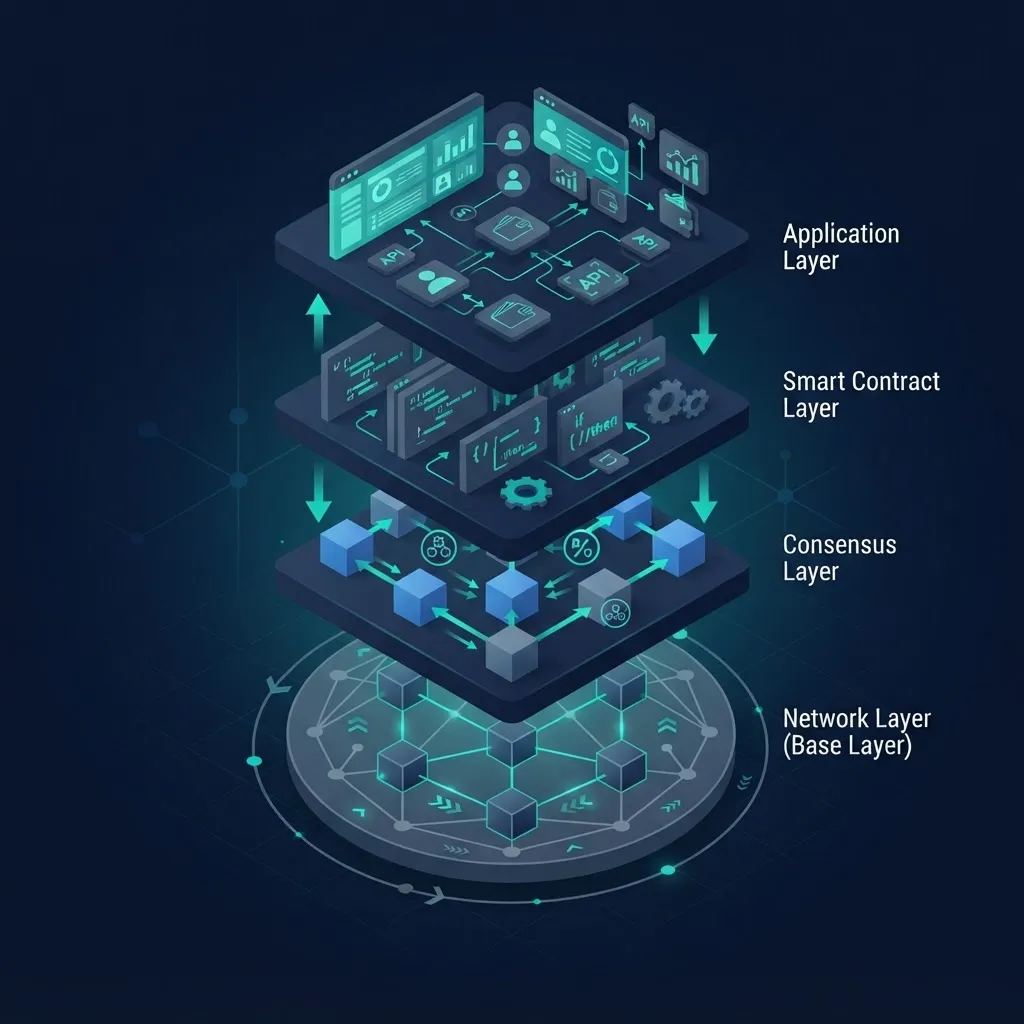
What Exactly Is a Private Blockchain?
A private blockchain is a permissioned ledger controlled by one organization or a defined consortium. Three properties define it:
- Gated membership. Nodes join only after receiving a cryptographic identity from a certificate authority or membership service.
- Known validators. Because validator identities are known, the network does not need economically expensive mining to deter attackers.
- Configurable visibility. Data can be scoped to subsets of members through channels, private data collections, or separate state databases.
Two terms are often confused. A private blockchain is typically operated by a single entity. A consortium blockchain distributes control across several independent organizations. Most enterprise deployments are technically consortium networks, and that distinction determines your governance model more than your technology choice does.
Step 1: Prove You Actually Need a Ledger
Start here, because most failed blockchain projects fail at this step rather than in code. A private blockchain is justified when all four conditions hold:
- Multiple parties write to the same dataset.
- Those parties do not fully trust one another with unilateral edits.
- A neutral intermediary is absent, expensive, or slow.
- An immutable, independently verifiable audit trail has real business value.
If a single organization owns all the data, a replicated PostgreSQL cluster with append-only audit logging will be faster, cheaper, and easier to hire for. Gartner has repeatedly noted that a majority of enterprise blockchain pilots never reach production, and the dominant reason is not technical failure but the absence of a genuine multi-party trust problem. Being honest at this stage saves quarters of engineering time.
A Concrete Test
Write down the exact dispute your ledger resolves. If you can name it in one sentence, such as "three logistics partners disagree on when custody of a container transferred," you have a valid use case. If you cannot, you have a database requirement wearing a blockchain costume.

Step 2: Choose the Right Platform
Platform choice locks in your consensus options, privacy model, and developer hiring pool. Four options dominate real deployments.
| Platform | Consensus | Smart Contract Language | Best Fit | Typical Throughput |
|---|---|---|---|---|
| Hyperledger Fabric | Raft (CFT), pluggable | Go, JavaScript, Java | Multi-party consortiums needing data partitioning | 1,000 to 3,000 TPS |
| Hyperledger Besu (private mode) | QBFT, IBFT 2.0 | Solidity | Teams reusing Ethereum tooling and skills | 400 to 1,000 TPS |
| Quorum (GoQuorum) | QBFT, Raft | Solidity | Financial settlement with private transactions | 400 to 1,500 TPS |
| Corda | Notary based validation | Kotlin, Java | Bilateral legal agreements, regulated finance | Varies by notary design |
Fabric leads when different members must not see one another's data, because channels and private data collections partition state at the protocol level. Besu wins when your team already knows Solidity, MetaMask, Hardhat, and Foundry, since that entire toolchain transfers unchanged. Corda is unusual in that it avoids global broadcast entirely, sharing transactions only with parties that need them, which suits contract-heavy financial workflows.
Organizations that need help mapping these tradeoffs onto existing systems often bring in an outside engineering partner such as full stack development specialists rather than learning consensus tuning on a production deadline.
Step 3: Design the Node Topology
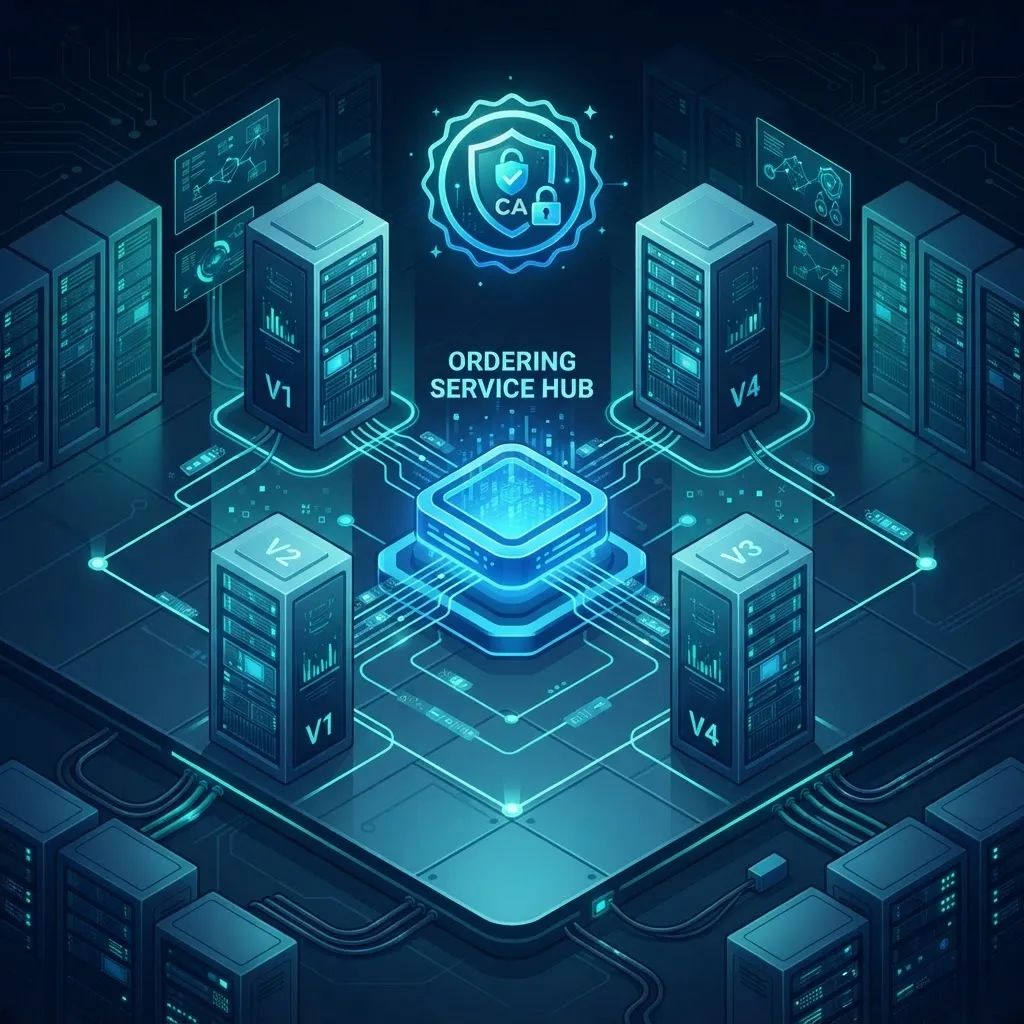
Node layout determines fault tolerance, so calculate it before provisioning infrastructure.
For crash fault tolerant protocols such as Raft, a cluster of N nodes tolerates the loss of a minority, so five nodes survive two failures. For Byzantine fault tolerant protocols such as QBFT or IBFT 2.0, the rule is stricter: with N validators you tolerate at most F faulty nodes where N is at least 3F plus 1. That is the arithmetic behind the standard four-validator minimum, which tolerates exactly one malicious or arbitrarily failing node.
Practical topology guidance:
- Never place all validators in one availability zone. Spread them across zones, and across organizations in a consortium, or you have created a single point of control.
- Separate roles. In Fabric, keep peers, ordering service nodes, and certificate authorities on distinct hosts so a compromised application peer cannot rewrite ordering.
- Add read-only nodes for analytics. Query traffic should never compete with consensus traffic for CPU.
- Budget storage growth. Ledgers only grow. Measure average transaction size, multiply by projected daily volume, and provision three years ahead.
Step 4: Establish Identity and Membership
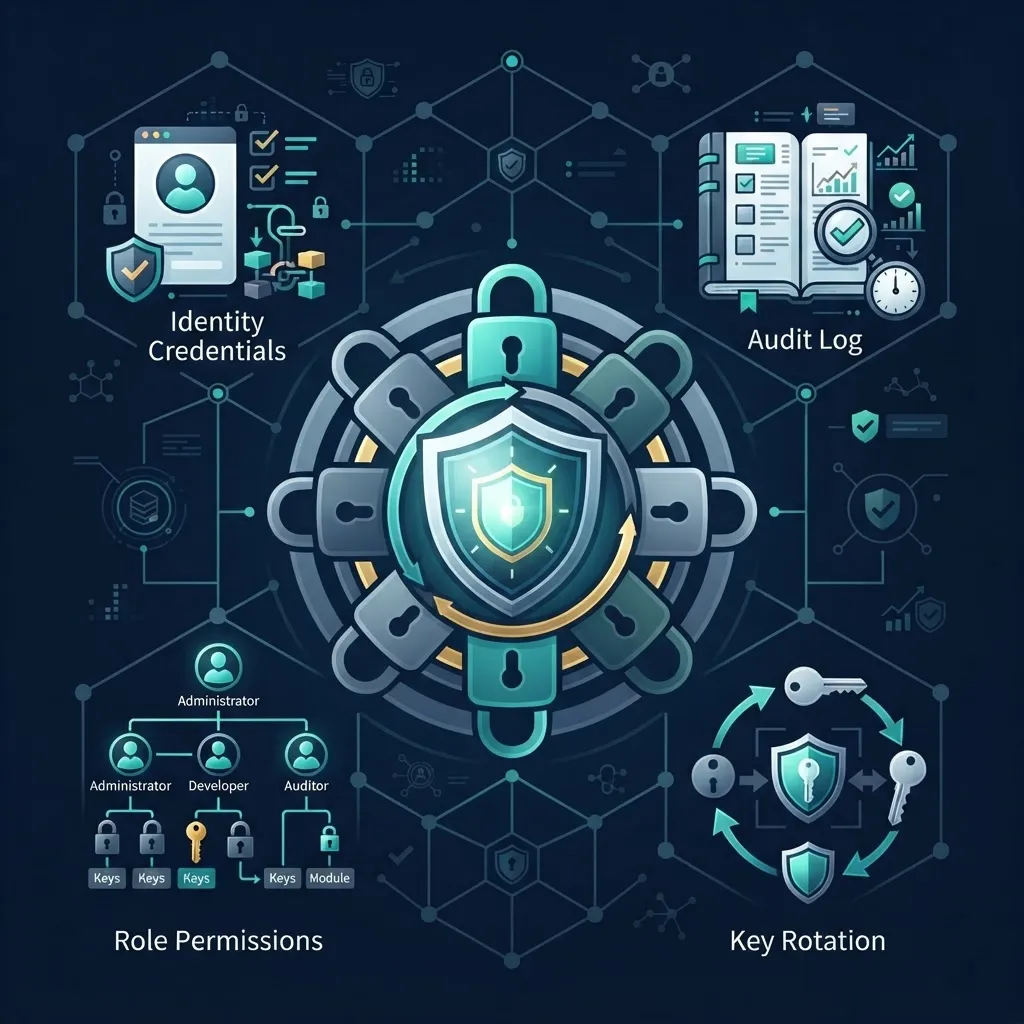
Identity is the defining feature of a private chain, and it is where teams cut corners most often. Every node and every user needs an X.509 certificate issued by a certificate authority you control.
Work through this checklist:
- Stand up a root certificate authority offline and keep it offline permanently.
- Issue intermediate certificate authorities per organization so revoking one member does not disturb others.
- Enroll each node and application identity against its organization's intermediate authority.
- Define a certificate revocation list process and test it before launch, not after an incident.
- Store private keys in a hardware security module or a managed key service, never in a container image or environment file.
- Set explicit certificate lifetimes and automate rotation, because expiring certificates are the single most common cause of unplanned private network downtime.

Step 5: Configure Consensus Deliberately
Consensus in a private network answers one question: what happens when a known validator misbehaves or disappears?
- Raft (crash fault tolerant) assumes validators may crash but never lie. It is fast, simple to operate, and appropriate when one organization runs all validators.
- QBFT and IBFT 2.0 (Byzantine fault tolerant) assume validators may actively lie. They provide immediate finality with no forks and are the correct default for multi-organization consortiums.
Avoid proof of work entirely on a private chain. Its security comes from open competition among anonymous miners, which does not exist here. Running it privately means burning electricity for a guarantee your membership list already provides.
Tune block parameters against measured load rather than defaults. Shorter block intervals reduce latency but increase overhead and ledger size. A two-second interval with a batch size matched to observed peak transactions per second is a reasonable starting point for most enterprise workloads.

Step 6: Write and Deploy Smart Contracts
Smart contracts, called chaincode in Fabric, encode the rules all members agreed to. Because a ledger is append-only, contract bugs are permanent in a way that application bugs are not.
Engineering standards worth enforcing from day one:
- Keep contracts deterministic. No timestamps from the local clock, no random values, no outbound network calls. Non-determinism breaks endorsement across peers.
- Store hashes, not documents. Put files in object storage and commit only the cryptographic digest on chain.
- Version every deployment. Treat contract upgrades as schema migrations with an explicit rollback plan.
- Test against a real multi-node network. Single-node testing hides endorsement policy failures completely.
- Require an independent review. Have someone who did not write the contract read it line by line before deployment.
Define endorsement policies before you write business logic. A policy requiring signatures from two of three organizations produces very different code from one requiring only the submitter, and retrofitting it later is painful.
Step 7: Operate, Monitor, and Govern
Launch is the beginning of the work. A private blockchain is production infrastructure and needs the same discipline as any distributed database.
Monitor these signals continuously:
- Block height divergence across nodes, which reveals a lagging or stalled peer.
- Certificate expiry windows, alerting at least thirty days ahead.
- Transaction latency at the ninety-fifth percentile, not the average.
- Endorsement failure rate, which usually signals a contract or policy mismatch.
- Ledger disk growth against provisioned capacity.
Governance must be written down and signed. Document who can admit a new member, who approves contract upgrades, what quorum amends the configuration, how disputes are settled, and what happens if a member exits. Consortium networks rarely collapse from cryptographic failure; they collapse because nobody agreed in advance who decides. Agencies that publish their delivery methodology openly, such as WebPeak Digital, tend to formalize this kind of operational ownership before the first line of code ships.
Key Takeaways
- A private blockchain restricts participation to authorized, identified nodes, which removes the need for proof of work.
- Byzantine fault tolerant consensus requires at least 3F plus 1 validators to tolerate F faulty nodes, making four the practical minimum.
- Hyperledger Fabric suits consortiums needing data partitioning; Hyperledger Besu suits teams reusing Ethereum and Solidity tooling.
- Private networks commonly achieve hundreds to a few thousand transactions per second, orders of magnitude above public mainnet throughput.
- Expired certificates and unwritten governance rules cause more private blockchain outages and project failures than protocol vulnerabilities.
- If a single organization controls all the data, an append-only database is the better engineering choice.
Frequently Asked Questions (FAQ)
How long does it take to create a private blockchain?
A functional development network runs in a few days using Hyperledger Fabric or Besu sample configurations. A production consortium network typically takes three to six months, because identity management, governance agreements, integration with existing systems, and security review consume far more time than deploying nodes.
How much does it cost to run a private blockchain?
Costs are mostly infrastructure and staffing rather than transaction fees. Four to seven cloud nodes with managed key storage and monitoring commonly land in the low thousands of dollars monthly. The larger expense is engineering time for operations, certificate rotation, and contract upgrades over the network lifetime.
Can I create a private blockchain on Ethereum?
Yes. Hyperledger Besu and GoQuorum run private Ethereum-compatible networks with permissioned membership and QBFT consensus. You keep Solidity, Hardhat, Foundry, and MetaMask compatibility while replacing public mining with a known validator set, which makes it the fastest path for existing Ethereum developers.
How many nodes do I need for a private blockchain?
Use four validators minimum for Byzantine fault tolerant consensus, which tolerates one faulty node. Three nodes work for crash fault tolerant Raft in single-organization setups. Add nodes in the pattern of 3F plus 1 as your tolerance requirement grows, and separate read-only query nodes from validators.
Is a private blockchain more secure than a public one?
It is differently secure. A private chain resists external attackers better through gated access, but it lacks the decentralization that makes public chain history practically unalterable. If a majority of validators collude, records can be rewritten, so governance and validator distribution carry the security burden.
Do private blockchains need a cryptocurrency?
No. Native tokens exist on public chains to pay miners and prevent spam. Private networks already control who can submit transactions, so most run with zero gas cost or a nominal internal accounting unit. Tokens are added only when the business case genuinely requires transferable value.