Learn how to write artificial intelligence birthday wishes that sound human, with prompt templates, tone comparisons, examples and privacy safe practices.
Artificial Intelligence Birthday Wishes
Birthday messages are one of the few pieces of writing almost everyone sends, and one of the few where a generic line is instantly noticeable. Artificial intelligence tools now draft those messages in seconds, which raises a fair question: does a machine written greeting still feel personal? The answer depends far less on the model you use and far more on the details you feed it. This guide explains how AI birthday wishes actually work, how to prompt them so they sound like you, when to avoid them entirely, and how to keep private details out of a chatbot.
Quick Answer: Artificial intelligence birthday wishes are greetings drafted by a language model from a prompt you supply. They sound personal only when the prompt includes the relationship, a specific shared memory, the desired tone, and a length limit. Always edit the output before sending it.
Table of Contents
- What AI birthday wishes actually are
- Why generated greetings often sound generic
- How to write a prompt that produces a usable wish
- Tone comparison for different relationships
- Worked examples you can adapt
- Privacy limits worth respecting
- Where AI writing genuinely helps at scale
- Key takeaways and FAQ
What Are Artificial Intelligence Birthday Wishes?
An artificial intelligence birthday wish is a greeting produced by a large language model, which is a system trained to predict the next word in a sequence based on patterns in enormous amounts of text. The model does not know the person having the birthday. It reconstructs the statistical shape of a birthday message and fills it with whatever specifics your instruction provides.
That mechanism explains both the strength and the weakness. Language models are excellent at structure, rhythm, and tone shifting. They are incapable of supplying genuine detail unless you give it to them. A prompt that says write a birthday wish for my friend will return something structurally correct and emotionally hollow, because the only input was the word friend.

Generator Tools Versus General Chat Assistants
Two product categories dominate. Dedicated greeting generators offer dropdown menus for relationship and tone, then produce several short options at once. General assistants such as chat based models accept free text and follow detailed instructions much more closely.
Dedicated generators are faster for a single quick message. General assistants are stronger when you want a specific memory woven in, a particular length, or a voice that matches how you normally text. If you care about the message sounding like you, the general assistant with a detailed prompt is the better tool.
Why Do AI Birthday Wishes Sound Generic?
Generated greetings feel flat for three identifiable reasons, and each one is fixable.
First, models default to the statistical average. Trained on countless greeting cards, the most probable next words are the most common ones: another year, wonderful, blessed, amazing. Averages are by definition unremarkable.
Second, prompts are usually underspecified. A single sentence of instruction cannot carry the relationship history a real message implies. The model fills the gap with cliches.
Third, output is often sent unedited. The final ten percent of editing, cutting one line, swapping one word for how you actually speak, is what converts a draft into something a person recognises as yours.
How Do You Prompt AI for a Personal Birthday Wish?
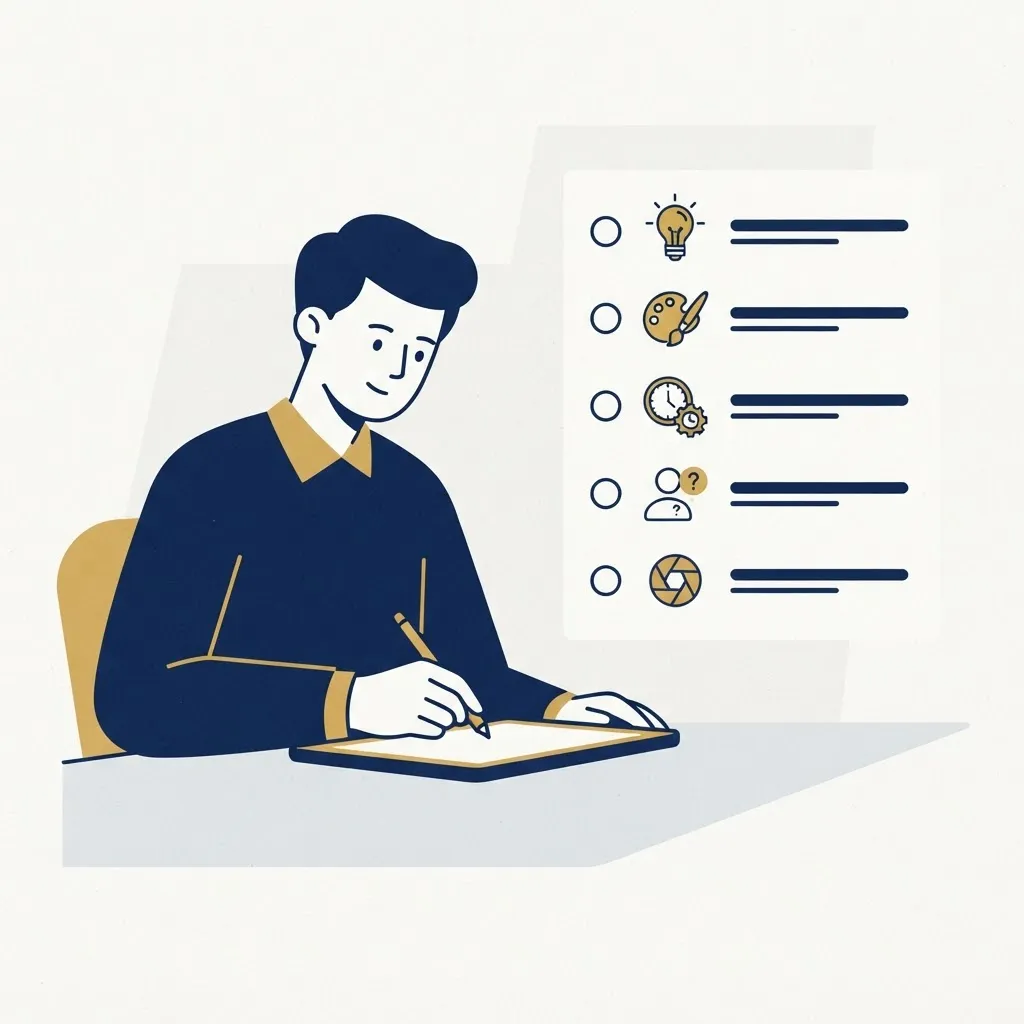
A reliable prompt contains five components. Missing any one of them measurably degrades the result.
- Relationship. State it precisely. Younger sister, manager of two years, and college roommate produce different registers.
- One concrete memory or detail. A shared trip, a running joke, a habit. This single element does most of the personalisation work.
- Tone. Choose one: warm, funny, formal, sentimental, understated. Asking for funny and heartfelt at once usually yields neither.
- Length limit. Specify a word or sentence count. Without a limit, models overwrite.
- Voice instruction. Add a line such as write it the way I text, short sentences, no exclamation marks.
A workable prompt looks like this: Write a 35 word birthday message for my older brother. Mention that we still argue about who actually won our last chess game. Tone should be dry and affectionate. Short sentences, no exclamation marks.
Iterate Rather Than Regenerate Blindly
If the first output is close but wrong, do not press regenerate repeatedly. Give a correction instead: too formal, cut the second sentence, or use the chess detail as the closing line. Targeted revision converges far faster than random resampling, because each instruction narrows the model to your intent.
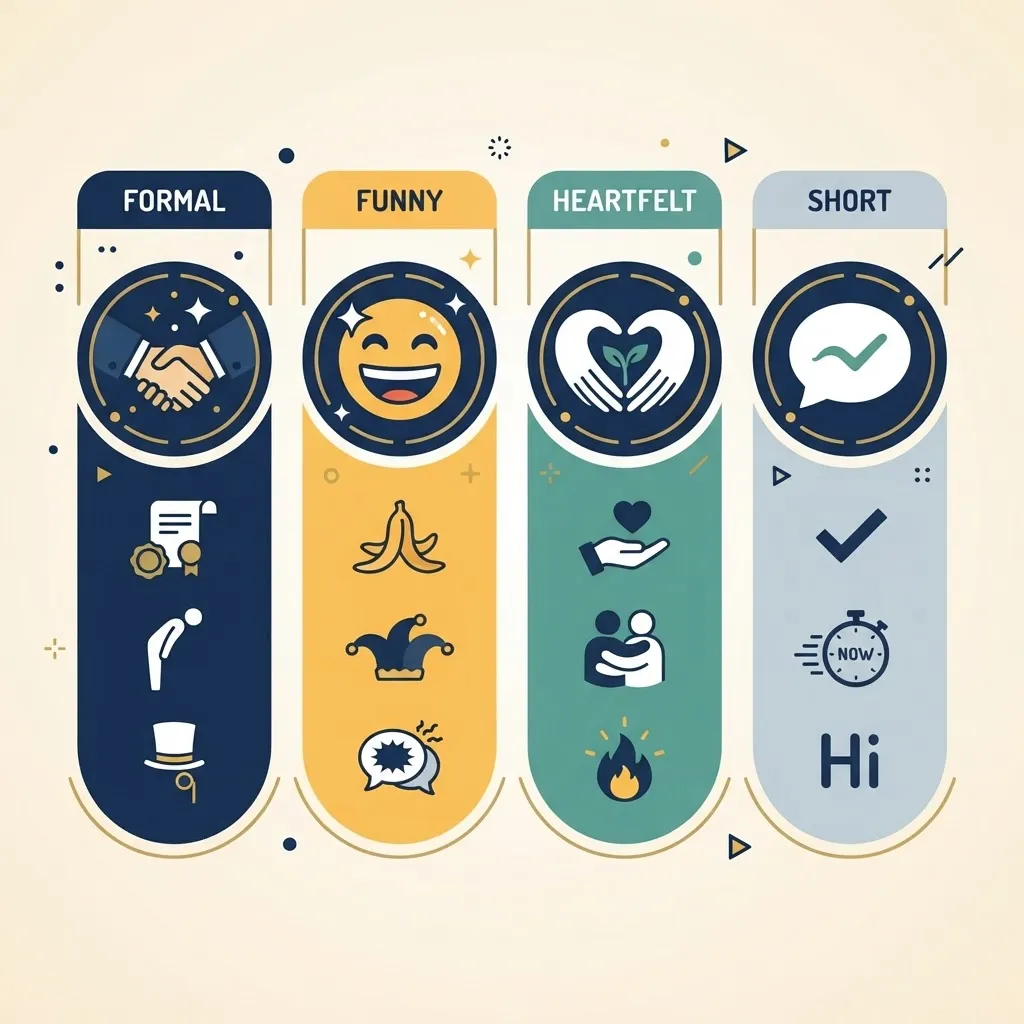
Which Tone Fits Which Relationship?
Tone is the most common mismatch in generated greetings. A message that works for a close friend can read as inappropriate to a client. The table below sets practical defaults.
| Relationship | Recommended tone | Ideal length | Use AI for | Main risk |
|---|---|---|---|---|
| Close friend | Funny, informal | 20 to 40 words | Joke angles, wording ideas | Sounds too polished |
| Parent or grandparent | Sentimental, sincere | 40 to 70 words | Structure and phrasing | Emotional cliches |
| Partner | Deeply personal | Any | Rough draft only | Feels outsourced |
| Colleague | Warm but neutral | 15 to 30 words | Full draft, light edit | Over familiarity |
| Client or manager | Professional, brief | 15 to 25 words | Full draft, light edit | Sounds like a template |
| Group or team message | Inclusive, upbeat | 25 to 50 words | Full draft | Naming some, missing others |
The pattern is consistent: the closer the relationship, the smaller the role AI should play. For a partner or a parent, use the model to break a blank page, then rewrite in your own words. For a colleague or client, a lightly edited draft is genuinely appropriate, because professional greetings follow conventions rather than intimacy.
Examples You Can Adapt Today
These are patterns rather than copy ready lines. Replace the bracketed specifics with real detail, since the specific is the entire point.
For a close friend, dry humour: Another year and you still cannot parallel park. Genuinely glad you exist. Happy birthday.
For a sibling, warm and short: You have been my default person for [number] years. Hope this one treats you properly. Happy birthday.
For a parent, sincere: Thank you for [specific ordinary thing they did repeatedly]. I understood the effort behind it much later. Happy birthday, and I hope this year is slower and kinder.
For a colleague, professional: Happy birthday. Working alongside you on [project] has been a real pleasure. Enjoy the day away from your inbox.
For a client, brief and neutral: Wishing you a very happy birthday and a strong year ahead. Thank you for your continued trust in our work.
Each example follows the same architecture: one specific observation, one genuine wish, one clean close. That three part shape is what you should instruct the model to produce.

What Should You Never Put Into an AI Tool?
This is the practical constraint most articles skip. Many free AI services state in their terms that submitted inputs may be reviewed by humans or used to improve their systems unless you disable that setting. Under the European Union General Data Protection Regulation, which took effect in May 2018, personal information about another identifiable person is protected data, and a birthday message can easily contain it.
Apply three rules. Do not paste full names combined with dates of birth, since that pairing is a common identity verification field. Do not include private health, financial, or relationship information about someone who has not consented. Do not upload a private message thread wholesale to give the model context.
A safer approach is to abstract the detail. Instead of naming a person and their condition, write mention that they had a difficult year health wise without specifics. The model produces an equally warm message with far less exposure.
When Does AI Writing Genuinely Earn Its Place?
AI birthday wishes are most defensible at scale, where the alternative is not a heartfelt handwritten note but no message at all. Human resources teams sending greetings across hundreds of employees, and small businesses running birthday campaigns, face a volume problem that generation solves well.
Email marketing benchmarks published by providers such as Mailchimp and Omnisend have repeatedly found that automated lifecycle emails, including birthday messages, outperform standard promotional broadcasts on open and click rates, because they arrive with relevant timing and personalised context. The mechanism is timing and relevance, not clever copy, which is exactly why generated text performs acceptably in that setting.
The honest limit is this: automation improves consistency, not sincerity. If a message is meant to carry real feeling, generated text is a starting point rather than a finished product. Teams building this kind of personalisation into products often work with an AI digital agency to connect data sources, templates, and delivery timing, and the technical side is usually handled through AI automation services rather than a single tool.

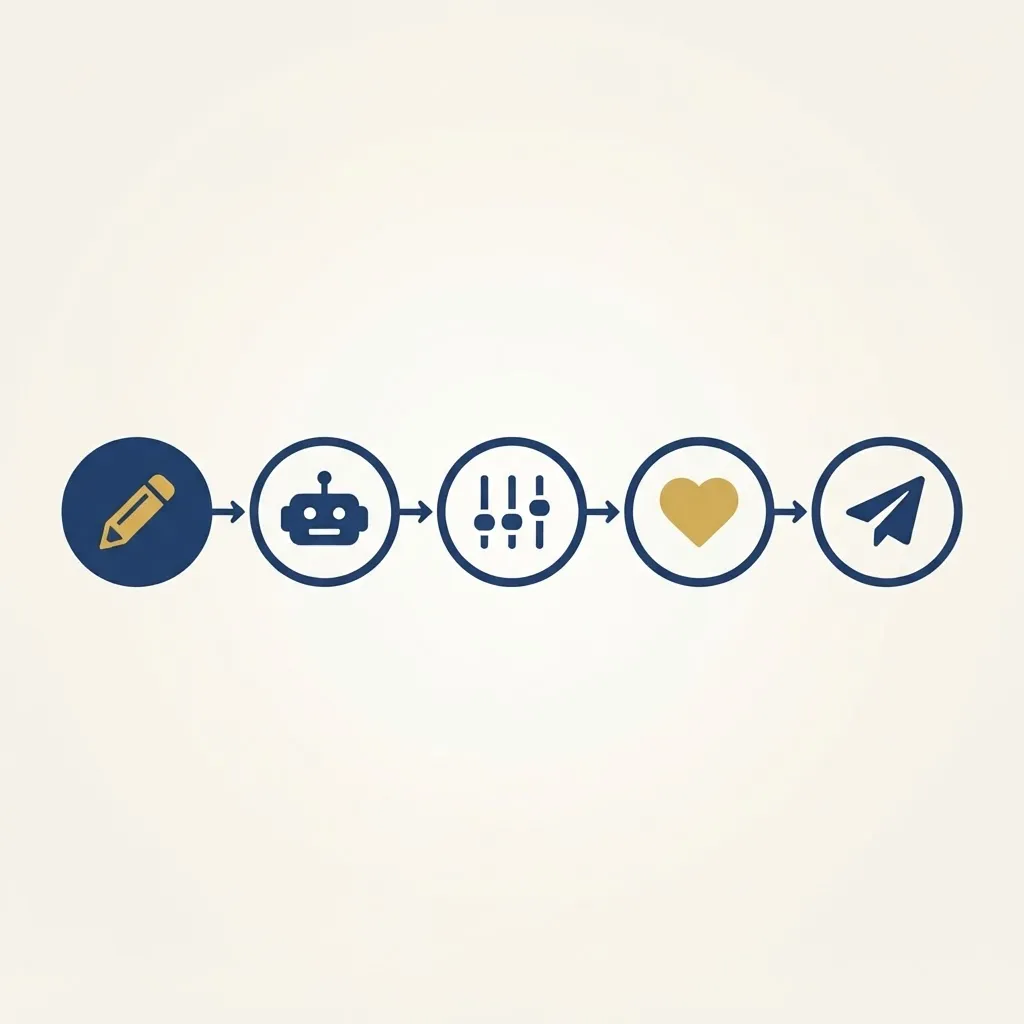
A Five Step Workflow That Works
- Collect one real detail before opening any tool. Check a photo, an old chat, a shared calendar.
- Write the five part prompt covering relationship, detail, tone, length, and voice.
- Generate three variants and pick the strongest opening line rather than the strongest whole message.
- Edit for voice. Remove any word you would not say aloud. Cut the weakest sentence entirely.
- Read it once as the recipient. If it could be sent to anyone, it is not finished.
Step five is the quality gate. Interchangeability is the single clearest signal of machine authorship, and it is also the easiest flaw to correct.
Key Takeaways
- Artificial intelligence birthday wishes are model generated greetings that depend entirely on prompt specificity for personalisation.
- A complete prompt includes five elements: relationship, one concrete detail, a single tone, a length limit, and a voice instruction.
- The closer the relationship, the smaller the role AI should play. Use it for a draft with partners and parents, and for near final text with colleagues and clients.
- Never submit another person's full name with their date of birth, or their private health, financial, or relationship details, to a general AI tool.
- Automated birthday emails generally outperform standard promotional broadcasts on engagement because of timing and relevance, not wording.
- Editing is mandatory. A message that could be sent to anyone signals machine authorship more than any specific phrase does.
Frequently Asked Questions (FAQ)
Can people tell if a birthday message was written by AI?
Often yes, though not from any single word. Readers notice interchangeability, over polished phrasing, and the absence of specific shared detail. A generated message containing one real memory and edited into your normal speaking style is very difficult to distinguish from a message written entirely by hand.
Which AI tool writes the best birthday wishes?
No single tool is definitively better. General chat assistants follow detailed instructions more closely, making them stronger when you want specific memories included. Dedicated greeting generators are faster for quick, conventional messages. Prompt quality and your own editing affect the result far more than the model choice does.
Is it rude to send an AI generated birthday message?
It depends on the relationship. For colleagues, clients, and large team lists, an edited generated message is a reasonable and widely accepted practice. For a partner, parent, or closest friend, unedited generated text can read as outsourced effort, which is usually worse than sending a short handwritten line.
How do I make an AI birthday wish sound more personal?
Add exactly one concrete detail no algorithm could invent, such as a running joke, a shared trip, or a specific habit. Then specify tone and length, and instruct the model to match your normal texting style. Finally, delete the weakest sentence and replace any word you would not say aloud.
Is it safe to give AI personal details about the birthday person?
Be cautious. Several free AI services may review or train on submitted inputs unless you disable that option in settings. Avoid combining full names with dates of birth, and never share another person's health, financial, or relationship details. Abstract sensitive context instead of stating it explicitly.
Can AI write birthday wishes in other languages?
Yes, and modern models handle major languages competently. Accuracy declines with less widely represented languages and with regional idiom or dialect. For an important message, ask for a literal back translation into your own language, or have a fluent speaker review it, before sending.