Discover how Sanskrit and artificial intelligence intersect, from Panini's grammar to modern NLP, and why this ancient language is shaping the future of AI.
Sanskrit Artificial Intelligence
Sanskrit artificial intelligence sits at a fascinating crossroads where one of the world's oldest languages meets the most advanced technology of our era. For decades, researchers have wondered whether Sanskrit, with its famously precise grammar, could become a natural ally for computers. Today, that curiosity has matured into real research projects, language models, and digitization efforts. In this guide, we explore what Sanskrit AI really means, why the language is uniquely suited to machine processing, and how teams like the experts at ZoneTechify and WebPeak think about building intelligent systems around complex linguistic data.
What Is Sanskrit Artificial Intelligence?
Sanskrit artificial intelligence refers to the use of machine learning, natural language processing (NLP), and computational linguistics to read, understand, translate, and generate Sanskrit text. This includes everything from optical character recognition (OCR) of ancient palm-leaf manuscripts to building chatbots that can answer questions about classical texts.
The goal is twofold. First, researchers want to preserve and unlock the enormous body of knowledge stored in Sanskrit literature, covering philosophy, mathematics, medicine, astronomy, and grammar. Second, computer scientists are genuinely interested in Sanskrit because its structure may teach us something about how to design clearer, more logical systems for representing meaning.
Unlike many natural languages that evolved organically with countless exceptions, Sanskrit was carefully formalized thousands of years ago. That formalization is exactly what makes it appealing to engineers building modern AI.
Why Sanskrit Fascinates AI Researchers
The interest in Sanskrit is not just romantic nostalgia for an ancient tongue. There are concrete technical reasons why this language keeps appearing in AI conversations.
Panini and the First Formal Grammar
More than 2,500 years ago, the scholar Panini wrote the Ashtadhyayi, a set of roughly 4,000 rules that describe Sanskrit grammar with astonishing precision. Many computer scientists describe this work as one of the earliest examples of a generative, rule-based system, conceptually similar to the formal grammars used to define programming languages today.

Panini's approach uses ordered rules, abbreviations, and meta-rules that resemble the logic of a compiler. Because the grammar is so systematic, parts of it can be modeled directly in software. This is why a famous 1985 paper even argued that Sanskrit's structure shares qualities with artificial languages designed for unambiguous communication.
Precision and Reduced Ambiguity
Natural language is full of ambiguity, which is one of the hardest problems in NLP. Sanskrit's strict grammar, rich case system, and consistent word formation rules reduce some of that ambiguity. When meaning is encoded clearly in word endings and structure rather than relying heavily on word order, certain parsing tasks become more tractable for machines.
This does not mean Sanskrit is a programming language, that idea is a popular myth. But its regularity does make it a valuable test case for computational linguistics.
Core Technologies Behind Sanskrit AI
Building intelligent Sanskrit systems requires several layers of technology working together. Each layer solves a different part of the puzzle.
Natural Language Processing
NLP is the foundation. For Sanskrit, this includes tokenization, which is unusually hard because words often join together through a process called sandhi. Splitting these combined words correctly is a major research area. Other NLP tasks include part-of-speech tagging, morphological analysis, and dependency parsing.
Machine Learning Models
Modern Sanskrit AI increasingly relies on machine learning and deep learning. Neural networks, including transformer-based models similar to those powering mainstream language tools, are trained on digitized Sanskrit corpora to handle translation, summarization, and text generation.
Training these models is challenging because high-quality, labeled Sanskrit data is far scarcer than English data. Researchers often combine rule-based methods, which encode Panini-style grammar, with statistical learning to get the best of both worlds. This hybrid strategy is a recurring theme in specialized AI work, and it is exactly the kind of problem that dedicated artificial intelligence services are designed to tackle.
Digitization and OCR
Before any model can learn, the text must exist in machine-readable form. A huge amount of Sanskrit knowledge still sits in physical manuscripts. OCR systems tuned for Devanagari and other scripts convert these documents into digital text, building the datasets that everything else depends on.
Real-World Applications of Sanskrit AI
Sanskrit artificial intelligence is no longer purely academic. Practical tools are emerging that serve scholars, students, and curious learners around the world.
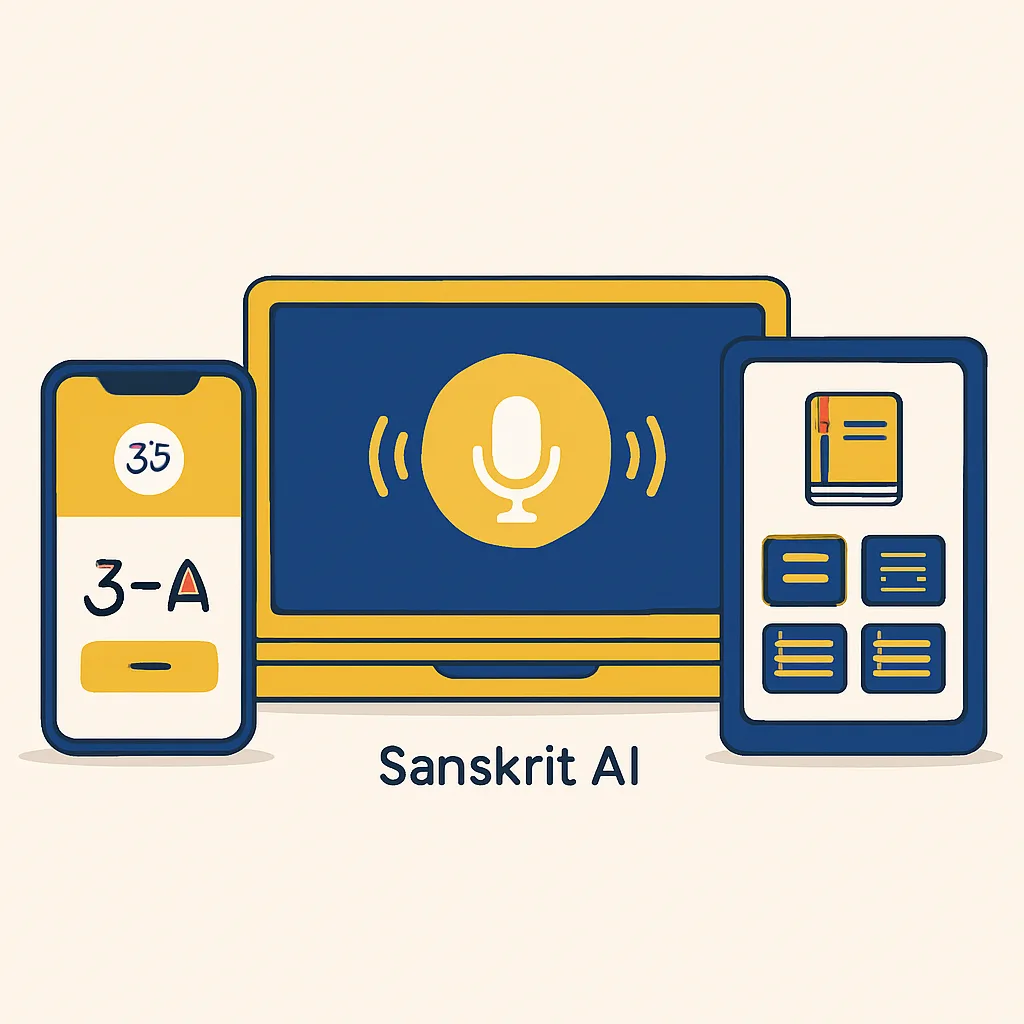
Some of the most promising applications include:
- Machine translation between Sanskrit and modern languages such as English and Hindi, opening ancient texts to global readers.
- Digital libraries that make thousands of manuscripts searchable, so a researcher can find a single verse in seconds instead of weeks.
- Educational tools that help students learn Sanskrit grammar interactively, with instant feedback on declensions and conjugations.
- Voice and speech systems that can recite or recognize Sanskrit, supporting accessibility and pronunciation practice.
- Knowledge extraction from texts on Ayurveda, mathematics, and philosophy, helping scholars connect ideas across vast collections.
These applications show that the value of Sanskrit AI is both cultural and practical. It preserves heritage while creating tools people can actually use.
A Quick Comparison: Rule-Based vs. Machine Learning Approaches
Teams building Sanskrit systems usually choose between, or blend, two broad strategies. The table below summarizes the trade-offs.
| Aspect | Rule-Based (Panini Style) | Machine Learning |
|---|---|---|
| Data needed | Low | High |
| Handles exceptions | Limited | Better |
| Transparency | Very clear | Often opaque |
| Setup effort | High (manual rules) | High (data prep) |
| Best for | Grammar, parsing | Translation, generation |
In practice, the strongest results come from combining both. Rules provide structure and reliability, while learning handles the messy, real-world variation found in actual texts.
Challenges Facing Sanskrit AI
Despite the excitement, building robust Sanskrit AI is genuinely difficult. Honesty about these challenges helps set realistic expectations.

The biggest hurdles include:
-
Limited datasets. Compared to English or Mandarin, the volume of clean, annotated Sanskrit data available for training is small. Models perform best when fed enormous amounts of text, and that scale simply does not yet exist for Sanskrit.
-
Sandhi and compound words. The way Sanskrit fuses sounds and words together makes accurate splitting one of the field's hardest problems. A single error early in processing can cascade through an entire sentence.
-
Script and encoding issues. Sanskrit appears in multiple scripts and transliteration schemes. Standardizing them for consistent processing takes careful engineering.
-
Scarcity of experts. Building these systems requires people fluent in both classical linguistics and modern AI, a rare combination.
-
Evaluation difficulty. Measuring whether a translation or interpretation is correct often requires expert human judgment, which is slow and expensive.
None of these challenges are insurmountable, but they explain why progress, while real, is gradual. Organizations that approach these problems with patience and the right engineering discipline tend to produce the most reliable results.
How Businesses and Researchers Can Get Started
If you are interested in exploring Sanskrit AI, whether for cultural preservation, education, or product development, a thoughtful roadmap helps. Start by clearly defining your goal, such as translation, search, or text analysis, because the goal dictates the technology.
Next, focus on data. Gather or digitize a clean corpus, and invest time in quality because models are only as good as the text they learn from. Then decide on your architecture, often a hybrid of rule-based grammar and machine learning. Finally, plan for ongoing evaluation with experts who can validate the output.
Many teams partner with specialists rather than building everything in-house. Working with an experienced studio such as WebPeak's AI specialists can shorten the path from idea to working prototype, especially when dealing with niche linguistic data that mainstream tools handle poorly.
The Future of Sanskrit Artificial Intelligence
Looking ahead, the trajectory is encouraging. As large language models become more capable and as digitization efforts expand the available data, Sanskrit AI will steadily improve. We can expect more accurate translation, smarter manuscript search, and richer educational experiences.
There is also a deeper, two-way exchange happening. AI helps us understand Sanskrit at scale, while Sanskrit's logical structure offers lessons in how to design clear, unambiguous systems for representing knowledge. This dialogue between the ancient and the cutting-edge is one of the most intellectually rewarding areas in computational linguistics.
Ultimately, Sanskrit artificial intelligence is about more than technology. It is about connecting thousands of years of human thought with tools that can carry that wisdom forward. By preserving texts, making them searchable, and translating them for new audiences, AI ensures that this knowledge remains alive rather than locked away.
Conclusion
Sanskrit artificial intelligence blends an extraordinary linguistic heritage with modern machine intelligence. From Panini's rule-based grammar to today's neural networks, the journey shows how an ancient language can inform and inspire the future of technology. The challenges are real, datasets are limited and the grammar is complex, but the progress is steady and the potential is immense.
Whether you are a researcher, an educator, or a business exploring specialized AI, the field offers meaningful opportunities to build something lasting. If you want expert guidance on turning these ideas into working products, the teams at ZoneTechify and WebPeak are ready to help you bridge tradition and innovation.