
A practical guide to how search engine optimization agencies work, what they charge, and how to choose one that actually grows organic revenue instead of vanity rankings.
Search Engine Optimization Agencies
Hiring an SEO partner is one of the few marketing decisions that compounds. Paid ads stop the day the budget stops; organic rankings earned this quarter can still deliver traffic three years from now. That asymmetry is exactly why the search engine optimization agency market is crowded, noisy, and full of promises that cannot be kept. This guide explains how these agencies actually operate, what separates a competent one from an expensive one, and the specific questions that expose weak providers within a single sales call.

Quick Answer: Search engine optimization agencies are specialist firms that improve a website's organic visibility through technical fixes, keyword research, content, and link acquisition. Good agencies report on qualified traffic and revenue, work on 6 to 12 month horizons, explain their methods openly, and never guarantee a specific Google ranking position.
What Is a Search Engine Optimization Agency?
A search engine optimization agency is a service business that increases the number of qualified visitors a website earns from unpaid search results. Unlike a general marketing agency, an SEO agency owns three technical disciplines at once: crawlability and site health, search intent research, and authority building through content and links.
The practical difference shows in staffing. A real SEO agency has separate people for technical audits, content strategy, and outreach, because those skills rarely live in one person. When a single generalist handles all three, something gets neglected, and it is almost always technical SEO, the part clients cannot see.
Why Organic Search Still Deserves the Budget
According to BrightEdge research, organic search drives roughly 53% of all trackable website traffic, more than paid search, social, and referral traffic combined. Google's own studies on mobile experience found that 53% of mobile visits are abandoned when a page takes longer than three seconds to load, which is why credible agencies begin with performance and technical work rather than blog volume.
Those two numbers frame the entire engagement. Search delivers the majority of your addressable demand, and speed determines how much of it you keep. An agency that cannot speak fluently about both is selling content, not SEO.
How SEO Agencies Actually Work
Most competent agencies follow a predictable sequence. Knowing it helps you judge whether a proposal is a real plan or a template.
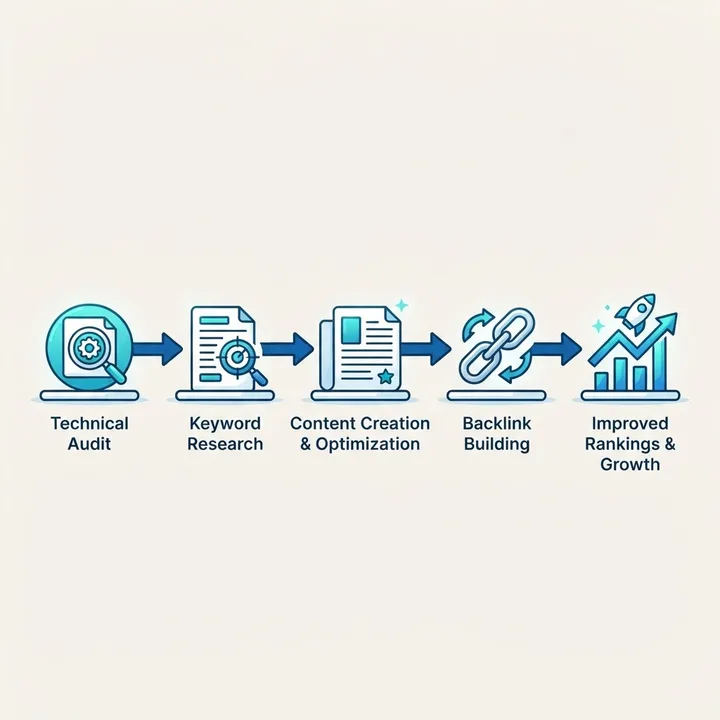
- Discovery and technical audit. Crawl the site, identify indexation waste, broken internal links, duplicate templates, slow pages, and Core Web Vitals failures. This typically takes two to three weeks.
- Keyword and intent mapping. Group keywords by intent stage, then map each cluster to an existing page or a page that must be created. Overlapping pages are consolidated, not multiplied.
- On-page and structural fixes. Titles, headings, internal linking, schema markup, and site architecture. This phase usually produces the first measurable lift, often within 60 to 90 days.
- Content production. Publishing against the mapped clusters, prioritising pages closest to commercial intent rather than the easiest topics.
- Authority building. Earning links through original data, expert commentary, digital PR, and genuine partnerships.
- Measurement and iteration. Monthly reporting on rankings, non-branded organic traffic, assisted conversions, and revenue.
The order matters. Publishing content on a site with crawl and speed problems is like pouring water into a leaking bucket. Any agency that opens with a content calendar before an audit has skipped the diagnosis.
The Core Services You Should Expect
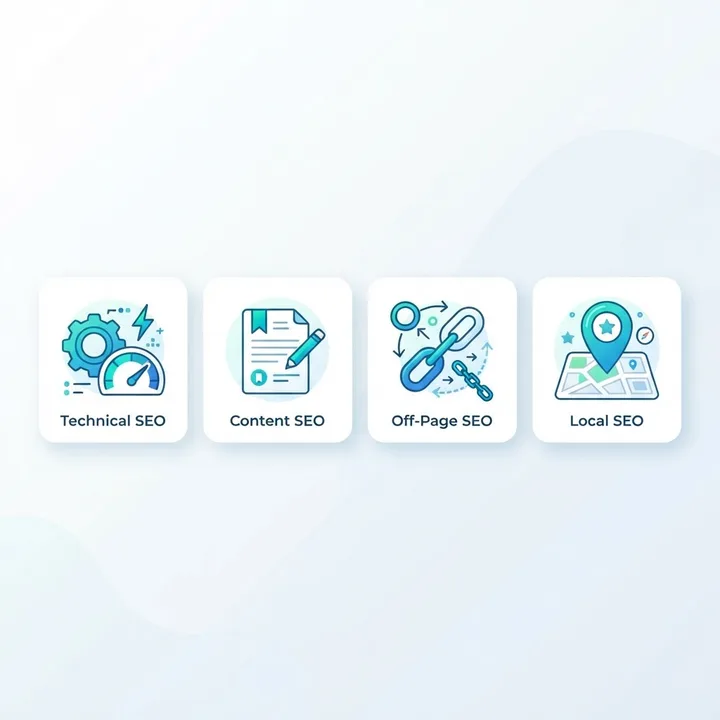
Technical SEO
This covers crawl budget, index bloat, JavaScript rendering, canonical logic, structured data, redirect hygiene, and Core Web Vitals. It is the highest-leverage work on large sites. A single misapplied noindex tag or a robots.txt rule can suppress thousands of pages, and fixing it can restore traffic in days.
Content Strategy and Production
Strong agencies build topical depth rather than isolated posts. They cluster related queries, assign one page per intent, and interlink the cluster so authority flows to the commercial page. If your agency cannot explain which page is meant to rank for your highest-value term, the strategy does not exist yet. Teams that need ongoing execution support often pair strategy with a dedicated digital marketing service to keep output consistent.
Off-Page and Digital PR
Links remain a ranking input, but the acquisition method decides whether they help or harm. Editorial links from relevant publications compound; bought links from private networks create risk that surfaces months later. Ask exactly how each link will be earned. A vague answer is the answer.
Local SEO
For businesses with physical locations or service areas, local SEO covers Google Business Profile optimisation, citation consistency, review velocity, and location landing pages. It is a distinct discipline with its own ranking factors, primarily proximity, prominence, and relevance.
Answer and AI Visibility
Since AI assistants and AI Overviews began summarising results, visibility now includes being cited inside generated answers. Agencies worth hiring in 2026 optimise for extractable structure: direct answers under clear headings, definitions, comparison tables, and FAQ blocks. Teams at ZoneTechify and WebPeak treat answer-engine formatting as a standard deliverable rather than an upsell.
Agency, Freelancer, or In-House Hire?

| Factor | SEO Agency | Freelancer | In-House Specialist |
|---|---|---|---|
| Skill coverage | Broad, multiple specialists | Narrow, one strength | Moderate, depends on hire |
| Typical monthly cost | 1,500 to 15,000 USD | 500 to 4,000 USD | Salary plus tools |
| Speed to start | Fast, process ready | Fast | Slow, hiring cycle |
| Business context | Learns over time | Learns over time | Deepest understanding |
| Tool access included | Yes | Sometimes | No, must be purchased |
| Continuity risk | Low, team based | High, single point | Medium |
| Best fit | Multi-channel or complex sites | Single focused problem | Mature, content-heavy brands |
The honest recommendation: hire a freelancer for a defined problem such as a technical audit or a migration. Hire an agency when you need several disciplines running in parallel. Hire in-house when organic search is your primary acquisition channel and you already know what good work looks like.
What SEO Agencies Charge and Why

Three pricing models dominate the market:
- Monthly retainer. The default for ongoing work. Small business retainers commonly sit between 1,500 and 5,000 USD per month; competitive ecommerce and SaaS programmes often exceed 10,000 USD.
- Project based. Fixed fee for a defined scope such as a technical audit, a domain migration, or an information architecture rebuild. Typically 2,500 to 25,000 USD.
- Performance based. Payment tied to rankings or traffic. Attractive on paper, risky in practice, because it incentivises short-term tactics that can trigger manual actions.
Price tracks scope and competition, not agency quality. A 2,000 USD retainer buys perhaps 15 to 20 focused hours per month. If a proposal promises technical work, eight articles, and link building for that fee, something is being outsourced cheaply or simply will not happen.
Red Flags That Predict a Bad Engagement
After reviewing hundreds of SEO proposals, the same warning signs repeat:
- Guaranteed number one rankings. Google states plainly that no one can guarantee ranking positions. This claim alone disqualifies a provider.
- Secret proprietary methods. Legitimate SEO is explainable. Secrecy usually hides link buying or spun content.
- Reports built only on ranking screenshots. Rankings without traffic, conversions, and revenue context prove nothing.
- No technical discussion at all. If nobody asks about your CMS, hosting, or rendering method, they are not planning technical work.
- Long lock-in with no exit review. Twelve-month contracts are reasonable; twelve months with no 90-day performance checkpoint is not.
- No named team members. You should know who does the work, not just who sold it.
How to Evaluate and Choose the Right Agency
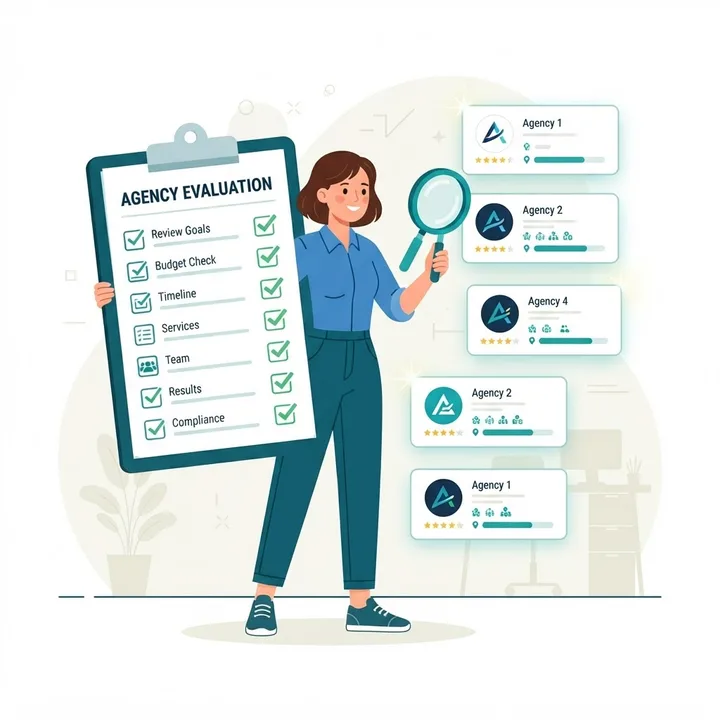
Use this sequence, in order:
- Define the commercial outcome first. Not rankings, but pipeline, bookings, or revenue from non-branded organic search.
- Request two case studies in a similar competitive context. Ask for the starting position, timeline, tactics used, and what did not work.
- Buy a paid audit before a retainer. A 1,500 to 3,000 USD audit reveals their thinking, communication quality, and technical depth at low risk.
- Interview the practitioner, not the closer. Ask the person who will run your account how they would prioritise your first 90 days.
- Agree on reporting metrics in writing. Non-branded organic sessions, indexed page count, Core Web Vitals, assisted conversions, and organic revenue.
- Set a 90-day checkpoint. Early wins should be technical and structural. Content and link results mature between months four and nine.
Measuring Whether It Is Working

Track a small set of metrics rather than a bloated dashboard. Non-branded organic clicks from Google Search Console show whether you are winning new demand instead of harvesting existing brand awareness. Indexed versus submitted page ratios reveal crawl health. Average position for your mapped commercial clusters shows strategic progress. Organic assisted conversions connect the work to money.
A realistic timeline for a mid-competition site: technical improvements visible in 30 to 60 days, ranking movement on mapped clusters in 90 to 150 days, and meaningful revenue impact between months six and twelve. Anyone compressing that timeline is either working in a very low-competition niche or misrepresenting the outcome.
Key Takeaways
- Organic search accounts for roughly 53% of trackable website traffic, making SEO a majority-share channel for most businesses.
- Google reports 53% of mobile visits are abandoned after three seconds of load time, so technical performance precedes content volume.
- No agency can guarantee a specific Google ranking; Google confirms ranking guarantees are not possible.
- Typical retainers range from 1,500 to 15,000 USD monthly, scaled to competition and scope rather than agency prestige.
- A paid audit is the lowest-risk way to test an agency before committing to a retainer.
- Expect technical results in 30 to 60 days and revenue impact between months six and twelve.
Frequently Asked Questions (FAQ)
How much does an SEO agency cost per month?
Most SEO agencies charge between 1,500 and 15,000 USD per month. Small local businesses typically pay 1,500 to 3,000 USD, while competitive ecommerce and SaaS programmes often exceed 10,000 USD. Price reflects scope, competition level, and the number of specialists assigned to your account each month.
How long before an SEO agency shows results?
Technical improvements often show within 30 to 60 days because indexation and speed fixes act quickly. Ranking movement on targeted keyword clusters usually appears between 90 and 150 days. Meaningful revenue impact typically arrives between months six and twelve, depending on competition and existing domain authority.
Can an SEO agency guarantee first page rankings?
No. Google states directly that no one can guarantee ranking positions because its algorithms weigh hundreds of signals and update constantly. Any agency offering guaranteed number one rankings is either misleading you or relying on manipulative tactics that risk penalties and long-term traffic loss.
Is it better to hire an SEO agency or a freelancer?
Hire a freelancer for one defined problem, such as a technical audit or a site migration. Choose an agency when you need technical work, content, and link building running simultaneously, since those require different specialists. Agencies also include premium tool access and provide continuity if one person leaves.
What should I ask an SEO agency before signing?
Ask who will personally run your account, how they will earn links, what their first 90-day priorities are, which metrics they report, and for two case studies in comparable competition. Also request a paid audit first so you can evaluate their thinking before committing to a retainer.
How do I know if my current SEO agency is underperforming?
Check non-branded organic clicks in Google Search Console over six months. If they are flat while reports celebrate rankings, the work is not reaching commercial queries. Other signals include no technical changes shipped, no internal linking improvements, and reports that never mention conversions or revenue.