A clear, expert breakdown of who actually owns artificial intelligence: the corporations, developers, data providers, governments, and users behind the technology.
Who Own AI
Artificial intelligence feels like it belongs to everyone and no one at the same time. You can chat with a model for free, yet the systems behind it are built by some of the most powerful companies on earth. So when people ask "who own AI," they are really asking several questions at once: Who controls the technology? Who owns the models? Who owns the content AI creates? And who owns the data that makes it all possible?
This guide answers each of those questions clearly, based on how the AI industry actually operates in 2026. At ZoneTechify and WebPeak, we work with AI tools every day, and the reality of AI ownership is more layered than most headlines suggest.
Quick Answer: No single person or company owns artificial intelligence. Ownership is split across corporations that build models (like OpenAI, Google, and Anthropic), open-source communities, the data providers whose content trains AI, and governments that regulate it. AI is a shared, contested resource.
What Does It Mean to "Own" AI?
AI ownership refers to the legal and practical control over the components that make artificial intelligence work: the trained models, the computing hardware, the training data, the software code, and the outputs the system generates. Owning AI is not one thing; it is a stack of overlapping rights.
Think of it like owning a car factory. One company may own the factory, another supplies the steel, workers build the cars, and a government licenses who can drive. AI works the same way. Understanding "who owns AI" means looking at each layer separately rather than searching for a single owner.
The Layers of AI Ownership
Artificial intelligence is built on a stack, and each layer has different owners. Breaking it down removes the confusion around who truly controls the technology.
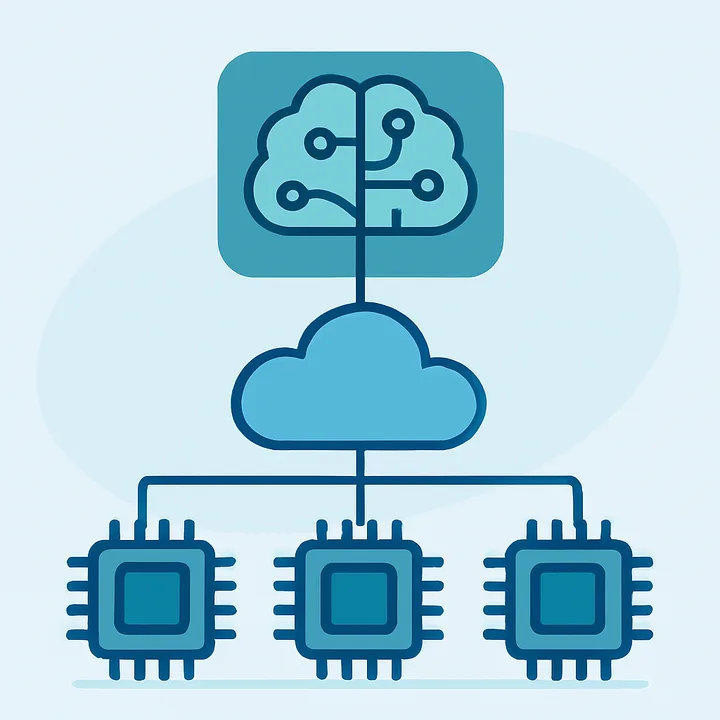
- Hardware layer: Chipmakers like Nvidia, AMD, and Google (with its TPUs) own the physical processors that train and run AI.
- Infrastructure layer: Cloud providers such as Microsoft Azure, Amazon Web Services, and Google Cloud own the data centers where models live.
- Model layer: Companies like OpenAI, Anthropic, Google DeepMind, and Meta own the trained model weights.
- Data layer: Publishers, artists, websites, and individual users own much of the raw content used to train models.
- Application layer: Businesses and developers who build products on top of AI own their specific applications.
No single entity controls all five layers, which is exactly why the question of ownership is so debated.
Big Tech and Corporate Control
In practical terms, a small group of large technology companies holds the most concentrated power over AI. These firms own the most capable models, the largest data centers, and the deepest research talent pools.
OpenAI builds the GPT family of models, with Microsoft as a major investor and infrastructure partner. Google owns Gemini and DeepMind. Anthropic builds Claude, backed heavily by Amazon and Google. Meta develops the Llama models. This concentration matters: according to Stanford's AI Index, industry produced the vast majority of notable machine learning models in recent years, far outpacing academia. The cost of training a frontier model now runs into the tens or even hundreds of millions of dollars, which naturally limits ownership to deep-pocketed organizations.
This is the core tension. The companies that own the most powerful AI are also the ones with the resources to keep owning it. For businesses wanting to use AI without building it from scratch, partnering with experienced teams through AI services is often the realistic path to ownership of an application, even if you do not own the underlying model.
Open-Source AI: Shared Ownership
Not all AI is locked behind corporate walls. Open-source AI has created a genuinely shared form of ownership, where model weights are released publicly for anyone to use, study, and modify.
Meta's Llama models, Mistral's releases, and community hubs like Hugging Face have made powerful AI freely available. Open-source AI means the model weights and often the code are published under licenses that permit reuse, sometimes with commercial restrictions. This shifts ownership from a single company toward a global community of developers, researchers, and businesses.
The practical upside is real: a startup can download a capable open model, fine-tune it on private data, and run it on its own servers. In that scenario, the business effectively owns its deployed AI system. Open-source does not mean unowned, though. Licenses still apply, and some "open" models restrict use by large competitors. Always read the license before assuming you own what you download.
Who Owns AI-Generated Content and Copyright?
One of the most pressing ownership questions is about output: if AI writes an article or designs an image, who owns it? The answer depends heavily on jurisdiction and how the tool is used.
In the United States, the Copyright Office has repeatedly stated that works generated purely by AI, without meaningful human authorship, cannot be copyrighted. Human creative input is required for protection. This means a raw, one-click AI image may not be ownable by anyone in the traditional copyright sense.
However, most commercial AI tools grant users ownership or broad usage rights to outputs through their terms of service. For example, many platforms assign the user the rights to commercialize generated content, even where formal copyright is uncertain. The practical takeaway: you usually have the right to use and sell AI output you create with a paid tool, but the strength of your legal ownership increases the more human creativity you add on top.
Who Owns the Data That Trains AI?
AI models are only as good as the data they learn from, and that data overwhelmingly comes from people and organizations who did not build the models. This is the most contested ownership battleground of all.
Most large language models were trained on vast amounts of text and images scraped from the public web, including news articles, books, code, and artwork. The creators of that content, publishers, authors, and artists, argue they own that material and were not compensated. A wave of lawsuits, including high-profile cases from major publishers and artists, is now testing whether training on copyrighted data counts as fair use or infringement.
This matters for ownership because if courts rule that training data must be licensed, the companies that own valuable datasets gain new leverage. Your data, whether it is your website content, your photos, or your customers' information, has real value in the AI economy. Protecting and controlling it is becoming a core business strategy, not an afterthought.
Governments, Regulation, and Public Ownership
Governments do not own AI models, but they increasingly control how AI can be owned and used. Regulation is a powerful form of indirect ownership over the technology's direction.

The European Union's AI Act, the most comprehensive AI law to date, sets rules on transparency, risk, and accountability that any company operating in Europe must follow. Other nations are drafting similar frameworks. Through these laws, the public gains a stake in how AI behaves, even without owning a single model weight.
There is also a growing movement for public or sovereign AI, where governments fund national models trained on local languages and values so they are not dependent on foreign corporations. This represents a genuine attempt to put a form of AI ownership in public hands rather than leaving it entirely to private companies.
Comparison: Who Controls Each Part of AI
| AI Component | Primary Owner | Can You Own It? |
|---|---|---|
| Frontier models (GPT, Gemini, Claude) | Large tech companies | No, only license access |
| Open-source models (Llama, Mistral) | Released to community | Yes, within license terms |
| AI-generated output | User (via terms of service) | Usually yes, with human input |
| Training data | Original content creators | Yes, you own your own data |
| Your custom AI application | You or your business | Yes, fully |
| Computing hardware | Chipmakers and cloud providers | Rented, rarely owned outright |
The Future of AI Ownership
The ownership of AI is shifting from a handful of giants toward a more distributed model, even if slowly. Open-source progress, data licensing deals, and public AI initiatives are all spreading control wider.
For businesses and creators, the smartest move is to own the layers you realistically can: your data, your applications, and the unique value you build on top of shared models. You may never own a frontier model, but you can absolutely own a profitable, defensible AI product. Teams like those behind WebPeak's AI services help organizations build exactly that kind of owned, custom AI capability rather than depending entirely on someone else's platform.
Expect the next few years to bring clearer copyright rulings, more data licensing markets, and stronger regulation. Ownership will not consolidate further; it will fragment in healthy ways that give more people a real stake.
Key Takeaways
- No one owns AI outright. Control is split across hardware makers, model builders, data owners, regulators, and users.
- Big Tech dominates the model layer because frontier models cost tens to hundreds of millions to train.
- Open-source AI enables genuine ownership. You can download, fine-tune, and deploy models within their license terms.
- AI output is usually yours to use, but pure AI work without human input often cannot be copyrighted in the US.
- Your data is valuable. Training-data lawsuits show that content creators hold real ownership leverage in the AI economy.
- Governments shape AI ownership through laws like the EU AI Act and sovereign AI programs.
Frequently Asked Questions (FAQ)
Who owns AI as a technology?
No single entity owns AI as a whole. It is a stack of technologies owned by different groups: chipmakers own hardware, companies like OpenAI and Google own specific models, content creators own training data, and governments regulate it. AI is best understood as a shared, layered ecosystem rather than one product.
Does OpenAI own all of AI?
No. OpenAI owns its own models, like the GPT family, and Microsoft is a major investor. But it competes with Google, Anthropic, Meta, and many open-source projects. OpenAI controls a powerful slice of AI, yet it owns only its own technology, not the entire field or the underlying mathematics behind AI.
Who owns the content that AI generates?
In most cases, the user owns the right to use AI-generated content through the tool's terms of service. However, in the US, purely AI-made work without meaningful human input generally cannot be copyrighted. Adding your own creative edits strengthens your ownership and legal protection over the final result.
Can I legally own an AI model?
Yes, you can. By using open-source models such as Llama or Mistral within their licenses, you can download, fine-tune, and deploy a model you effectively own. You can also build a custom AI application that is fully yours, even if it runs on a model licensed from another company.
Who owns the data used to train AI?
The original creators own most training data, including publishers, writers, artists, and website owners. Many AI models were trained on web content without explicit permission, which has sparked major lawsuits. This means your own content and data remain yours, and they carry real value in today's AI economy.
Will the government ever own AI?
Governments are unlikely to own private AI models, but they increasingly control AI through regulation like the EU AI Act. Some countries are also funding sovereign AI models trained on national data and languages. This creates a form of public ownership and ensures AI is not controlled solely by private corporations.