A practical guide to bespoke web application development: when custom software beats off-the-shelf SaaS, what it costs, how the process works, and how to avoid the mistakes that sink most projects.
Bespoke Web Application Development
Most companies do not need custom software. The ones that do usually discover it the same way: a spreadsheet has quietly become the most important system in the business, three SaaS tools are being held together by manual copy-paste, and someone on the operations team spends six hours a week doing work a database could do in six seconds. That is the moment bespoke web application development stops being a luxury and starts being arithmetic.
This guide is written from the perspective of teams who have shipped and maintained custom platforms — not from a sales brochure. It covers when bespoke genuinely wins, what it actually costs, how the build process should run, and the specific failure patterns that waste budgets.
Quick Answer: Bespoke web application development is the process of designing and building a web-based software product tailored to one organisation's exact workflows, data, and users, instead of adapting a generic off-the-shelf tool. It wins when your processes are a competitive advantage, your data is complex, or licence and workaround costs exceed a custom build.
What Bespoke Web Application Development Actually Means
Definition: A bespoke (custom) web application is software accessed through a browser and built specifically for one organisation's requirements, with its own data model, business logic, user roles, and interface — owned outright by the client rather than licensed per seat.
That definition matters because three different things get sold under the same label:
- A configured SaaS product — Salesforce, HubSpot, or Monday.com with heavy customisation. You are still renting someone else's data model.
- A low-code build — faster to launch, but you inherit the platform's ceiling on performance, logic complexity, and portability.
- A true bespoke application — your own codebase, your own database schema, deployable anywhere, extensible without asking permission.
Only the third gives you full control of the roadmap. It is also the one that demands genuine engineering discipline, because there is no vendor to blame when the architecture is wrong.
When Custom Is the Right Call — and When It Is Not
The honest test is not "could custom software do this?" It is "does a generic tool force us to change how we make money?"
Build bespoke when:
- Your process is your differentiator. A logistics firm with a unique routing method or a lender with proprietary risk scoring cannot outsource that logic to a template.
- Your data model does not fit a standard product. If you are constantly abusing custom fields, tags, and notes columns to store real entities, the tool is wrong.
- Integration is the actual product. When the value lies in unifying an ERP, a warehouse system, and a payment provider into one view, you are building middleware whether you admit it or not.
- Per-seat licensing is punishing growth. At 200+ users, subscription fees for several tools frequently exceed the amortised cost of one owned application.
- Compliance requires control. Data residency, audit trails, and retention rules are far easier to guarantee in software you control.
Stay with off-the-shelf when the requirement is genuinely common: email marketing, accounting, payroll, helpdesk ticketing, standard e-commerce. Rebuilding a solved problem is the single most expensive mistake in this field. A mature SaaS product represents thousands of engineering hours and years of edge-case handling you would be re-funding from zero.
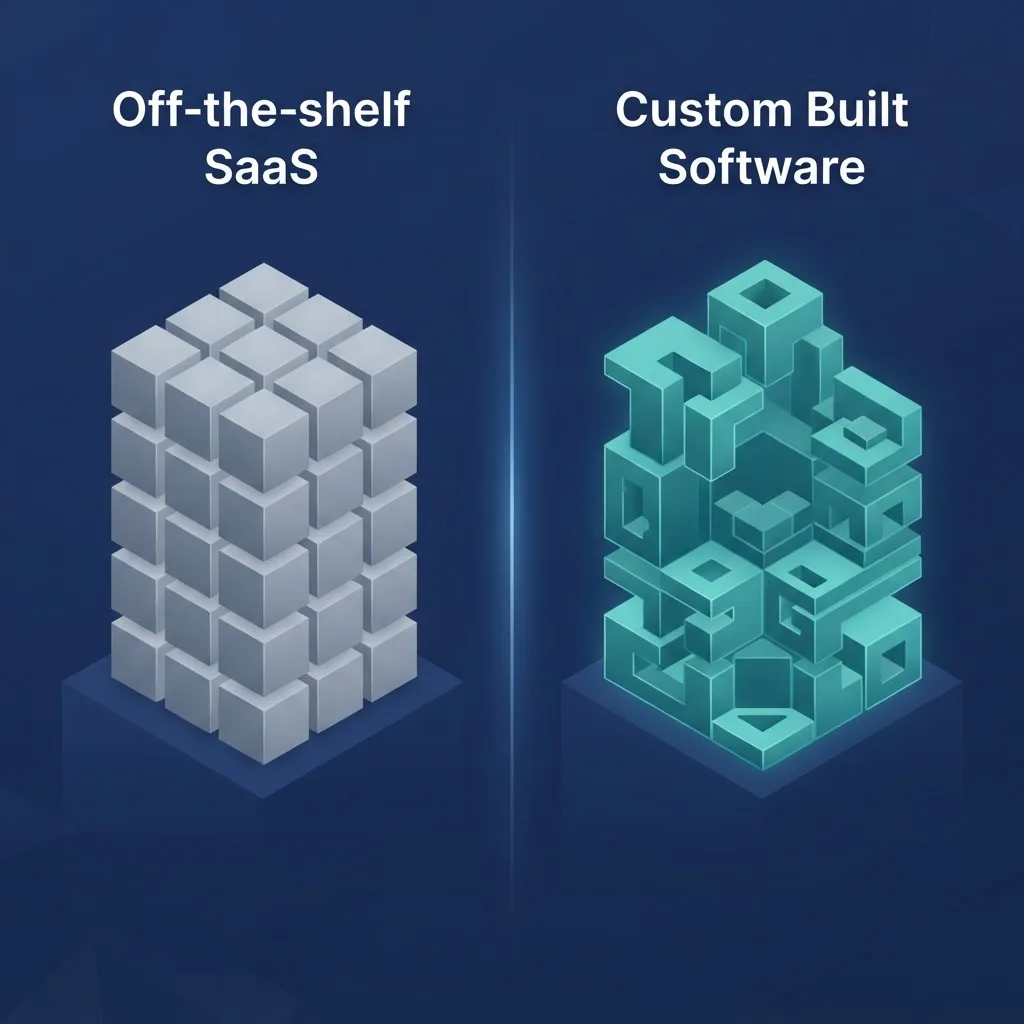
Bespoke vs Off-the-Shelf: A Direct Comparison
| Factor | Bespoke Web Application | Off-the-Shelf SaaS |
|---|---|---|
| Time to first value | Weeks to months (MVP) | Days |
| Upfront cost | High | Low or free tier |
| Cost at scale | Fixed hosting plus maintenance | Rises with every seat |
| Process fit | Exact | Approximate, needs workarounds |
| Ownership of code and data | Yes | No |
| Integration freedom | Unlimited | Limited to available APIs |
| Feature roadmap control | Yours | Vendor's |
| Ongoing maintenance burden | Yours | Vendor's |
| Competitive advantage potential | High | None — rivals use the same tool |
The row people underestimate is the last-but-one. Custom software transfers maintenance responsibility to you permanently. Budget roughly 15–20 percent of the original build cost per year for dependency updates, security patches, and small improvements. A project planned without that line item degrades within two years.
The Development Process That Actually Works
A bespoke build succeeds or fails in the first three weeks, long before any production code is deployed.
1. Discovery and Process Mapping
Sit with the people who will use the system and document what they do today, including the workarounds they are slightly embarrassed by. Those workarounds are the requirements. The output should be a written process map, a list of user roles, and a ranked list of problems — not a feature wishlist.

2. Define the Thinnest Useful Slice
Pick the one workflow that, if digitised, removes the most manual effort. Ship that alone. Teams who insist on launching every module simultaneously routinely spend twice the budget for a system nobody trusts, because no single part has been validated in real use.
3. Data Model Before Interface
Entities, relationships, and constraints first. Interfaces are cheap to change; a wrong schema propagates into every query, report, and integration you write afterwards. This is where experienced web application development teams earn their fee — recognising that "client" in your business means three different things, and modelling that correctly on day one.
4. Build in Short, Reviewable Increments
Two-week cycles with a working deployment at the end of each. If stakeholders only see the product at the end, you have a waterfall project wearing agile vocabulary.
5. Real Data Testing Before Launch
Import a genuine sample of production data during development, not clean fixtures. Legacy data is always messier than anyone claims, and discovering that after go-live is how launches slip by months.
6. Launch With a Rollback and a Support Path
Run in parallel with the old process for one cycle. Give users a named person to report problems to. Adoption dies on the small friction nobody escalated.
Architecture Decisions That Age Well
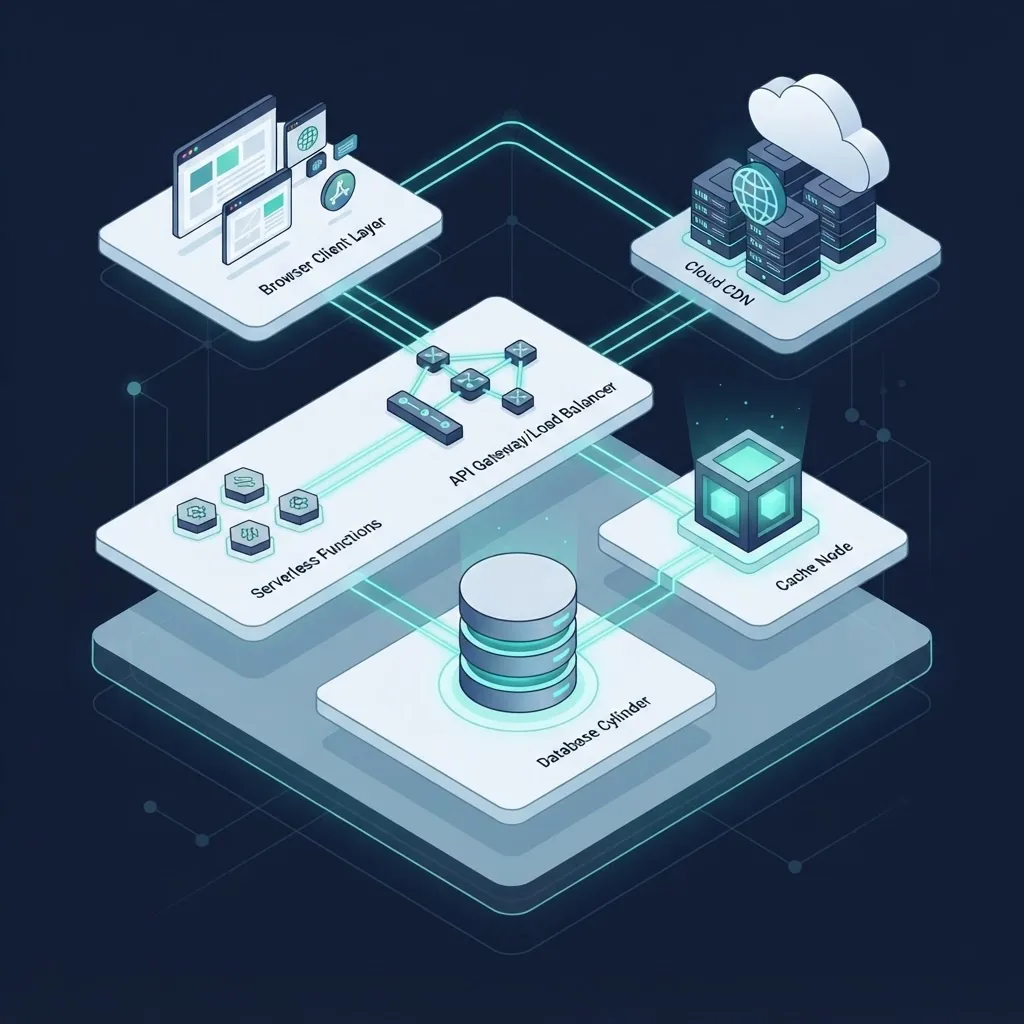
Some technical choices are reversible in a week. Others define your next five years.
- Prefer boring, widely-adopted technology. A framework with a large hiring pool and long support cycle protects you when your original developers move on.
- Separate the interface from the business logic. Expose your own API layer even if only your own front end consumes it at first. When a mobile app or partner integration arrives, the work is already done.
- Use a relational database unless you have a proven reason not to. Business applications are relational by nature — orders belong to customers, invoices to orders.
- Instrument from day one. Error tracking, structured logging, and basic analytics cost hours to add up front and save days of blind debugging later.
- Treat performance as a feature. According to Google research, mobile pages taking longer than three seconds to load lose over half of visits, and internal tools follow the same logic: slow software gets abandoned in favour of the spreadsheet it replaced.
A further data point worth citing: the Standish Group's long-running CHAOS research consistently finds that small, incrementally delivered software projects succeed at several times the rate of large monolithic ones. Scope discipline is not caution — it is the single strongest predictor of a working outcome.
What Bespoke Development Costs
Cost is driven by four variables: number of distinct user roles, complexity of business rules, number of external integrations, and compliance requirements. Screen count barely matters by comparison.
Realistic ranges for a competent team:
- Focused internal tool (one role, one workflow, no integrations) — the smallest sensible commitment, typically weeks of work.
- Operational platform (three to five roles, reporting, one or two integrations) — the most common bracket for growing companies.
- Customer-facing product (public sign-up, billing, permissions, audit trails, scale requirements) — significantly higher, and the point where architecture spending pays back.
Two cost traps recur. The first is integration optimism — assuming a legacy system has a usable API when it only exports CSV files overnight. Verify every integration before estimating. The second is undefined reporting — "and it should have dashboards" can mean two charts or a full analytics layer with an order-of-magnitude cost difference. Specify exact metrics before signing anything.

Security and Compliance Are Build-Time Decisions
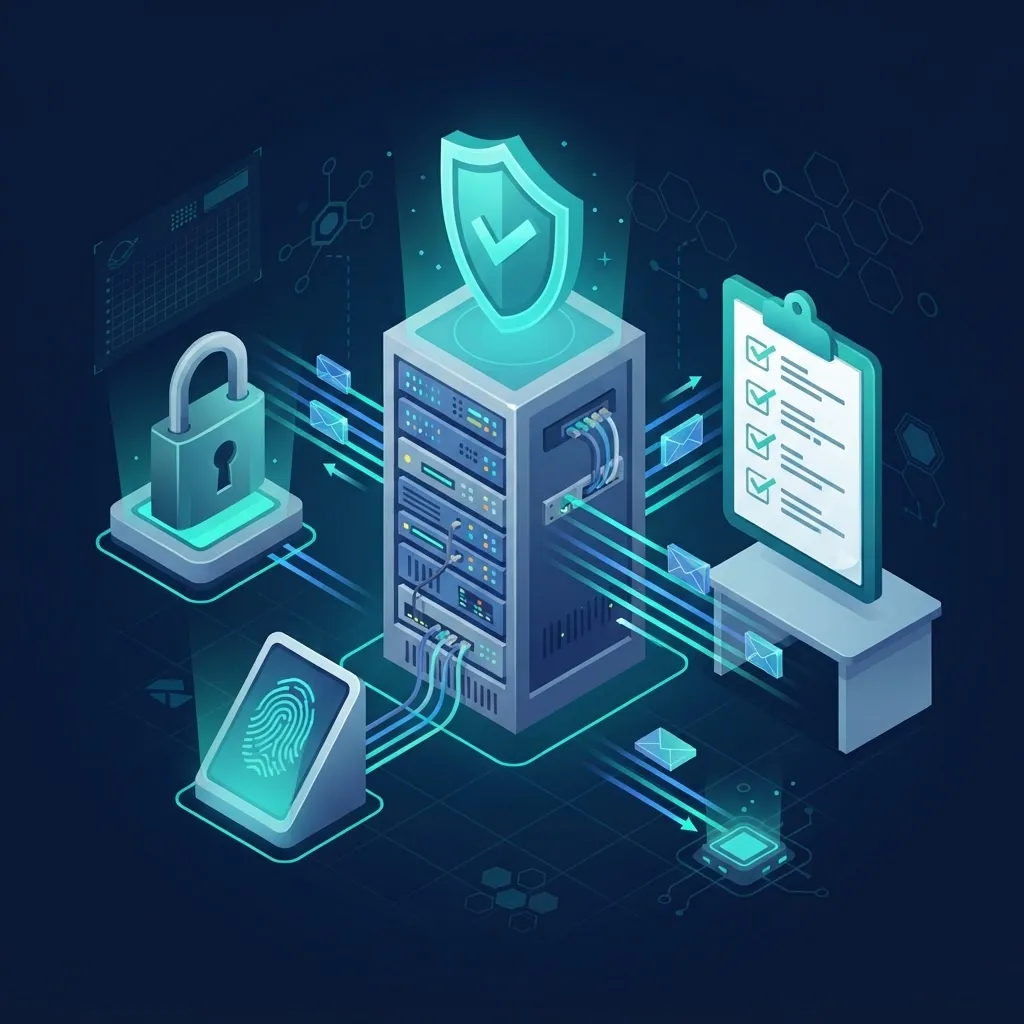
Retrofitting security is the most expensive rework in software. Establish these before the first feature ships:
- Server-side authorisation on every request. Hiding a button is not access control. Every endpoint must independently verify who is asking and what they own.
- Parameterised queries everywhere. Injection remains one of the most common serious vulnerability classes in web applications.
- Encrypted data in transit and at rest, with secrets in environment configuration rather than in the repository.
- Immutable audit logging for any action with financial or legal consequence — who did what, to which record, when.
- Least-privilege roles, defined during discovery, not improvised after a data leak.
- Automated dependency scanning, since most breaches exploit known, patched vulnerabilities in outdated libraries.
Choosing a Development Partner
Evaluate on evidence, not portfolio screenshots. Ask four questions:
- Show me a system you still maintain after two years. Anyone can launch. Longevity proves architecture quality.
- Who owns the code and infrastructure? The answer must be you, with repository access from week one.
- How do you handle a mid-project requirement change? A team without a clear answer will either resist reality or bill chaotically.
- What will you refuse to build? Partners willing to talk you out of unnecessary scope are the ones worth hiring.
Teams at ZoneTechify and WebPeak approach engagements this way — process mapping first, thin vertical slice second, and a documented handover so the client is never hostage to a single vendor.

Key Takeaways
- Bespoke web application development means owning your code, data model, and roadmap — not configuring someone else's product.
- Build custom when your process is a differentiator, your data model is genuinely complex, integration is the core value, or per-seat licensing punishes growth.
- Never rebuild a solved commodity problem such as payroll, email marketing, or helpdesk ticketing.
- Budget 15–20 percent of build cost annually for maintenance, or expect degradation within two years.
- Model the data before designing the interface; schema mistakes propagate everywhere, interface mistakes do not.
- Small, incrementally delivered projects succeed far more often than large all-at-once builds, per long-running CHAOS research.
- Google's mobile research shows over half of visits are lost past three seconds of load time — performance is adoption.
- Security, authorisation, and audit logging must be designed in at the start, never retrofitted.
Frequently Asked Questions (FAQ)
How long does it take to build a bespoke web application?
A focused internal tool covering one workflow typically takes several weeks. A multi-role operational platform with integrations and reporting usually runs a few months. Timelines expand mainly through undefined requirements and unverified integrations, so a thorough discovery phase shortens delivery rather than delaying it.
Is bespoke web application development cheaper than SaaS long term?
Sometimes, but not automatically. Custom software replaces recurring per-seat fees with a one-time build plus annual maintenance of roughly 15–20 percent. It usually wins past 100–200 users or when workarounds consume significant staff hours, and loses when a mature SaaS product already fits.
Do I own the source code of a custom web app?
You should own it outright, including the repository, database, and infrastructure accounts. Confirm this in writing before work begins. Any arrangement where the developer retains ownership or hosting control creates lock-in that is far worse than the SaaS dependency you were escaping.
What is the difference between a website and a web application?
A website mainly presents information to visitors. A web application lets users perform work — creating records, running processes, managing permissions, and generating reports. Web applications carry authentication, a real database, and business logic, which makes them substantially more complex to build and maintain.
Can a bespoke web application integrate with my existing software?
Yes, provided the existing systems expose an API, database access, or a reliable file export. Verify this before estimating, because legacy tools often only support overnight CSV exports. Integration feasibility is the most common source of budget overruns in custom development projects.
Should I use low-code instead of custom development?
Low-code suits simple internal tools with modest logic and few users. It becomes limiting once you need complex business rules, high performance, deep integrations, or portability. If the application is central to how your business operates, a genuine custom codebase remains the safer long-term choice.