
A practical guide to the AI business strategies and real-world applications taught by Emeritus, with frameworks leaders can use to drive measurable growth.
Artificial Intelligence Business Strategies and Applications From Emeritus

Artificial intelligence has moved from boardroom curiosity to operational necessity. Yet most leaders still struggle with the same question: how do you turn AI from an experiment into a strategy that delivers profit? Executive education provider Emeritus, in partnership with universities like MIT, Columbia, and Wharton, has shaped how thousands of managers answer that question. This guide distills the AI business strategies and applications taught through that lens into something you can act on today, drawing on patterns we see repeatedly when advising teams at ZoneTechify and WebPeak.
Quick Answer: Emeritus teaches AI as a business discipline, not just technology. Its strategies focus on identifying high-value use cases, building data readiness, upskilling leaders, and scaling responsibly. The goal is measurable outcomes like lower costs, faster decisions, and new revenue, rather than isolated AI experiments.
What Emeritus Teaches About AI in Business
Emeritus is a global online education platform that collaborates with top universities to deliver executive courses in AI, analytics, and digital transformation. Its core philosophy is simple: AI is a management problem before it is an engineering one. Leaders fail not because algorithms are weak, but because they deploy AI without a clear business case, clean data, or organizational buy-in.

The Emeritus approach reframes AI around three questions every executive must answer. First, which decisions in your organization are slow, costly, or inconsistent? Second, do you have the data to improve those decisions? Third, can your teams trust and adopt the output? When these questions guide adoption, AI stops being a science project and becomes a lever for measurable performance.
The Core AI Business Strategy Framework
The strategic frameworks promoted through Emeritus programs share a recognizable structure. Rather than chasing the newest model, they sequence AI adoption into deliberate layers that compound value over time.

1. Identify High-Value Use Cases
Start where AI affects money, not novelty. Prioritize use cases by business impact and feasibility. A demand-forecasting model that reduces inventory waste by 10 percent often beats a flashy chatbot that touches no revenue. Score each idea on potential value, data availability, and implementation difficulty before committing budget.
2. Build Data Readiness
AI is only as good as the data feeding it. Emeritus courses stress data governance, quality, and accessibility as prerequisites. According to a widely cited Gartner estimate, poor data quality costs organizations an average of $12.9 million per year. Before training models, fix the pipelines that feed them.
3. Upskill Leaders, Not Just Engineers
Adoption fails when executives cannot interpret AI output. The strategy emphasizes AI literacy for decision-makers so they can question, validate, and act on model recommendations. This is precisely why executive AI programs exist in the first place.
4. Scale Responsibly
Once a pilot proves value, the final layer is responsible scaling: monitoring for bias, ensuring compliance, and embedding AI into everyday workflows rather than leaving it as a side project.
Real-World AI Applications Across the Enterprise
Strategy means little without application. The Emeritus curriculum repeatedly points to functions where AI delivers the fastest, most defensible returns.
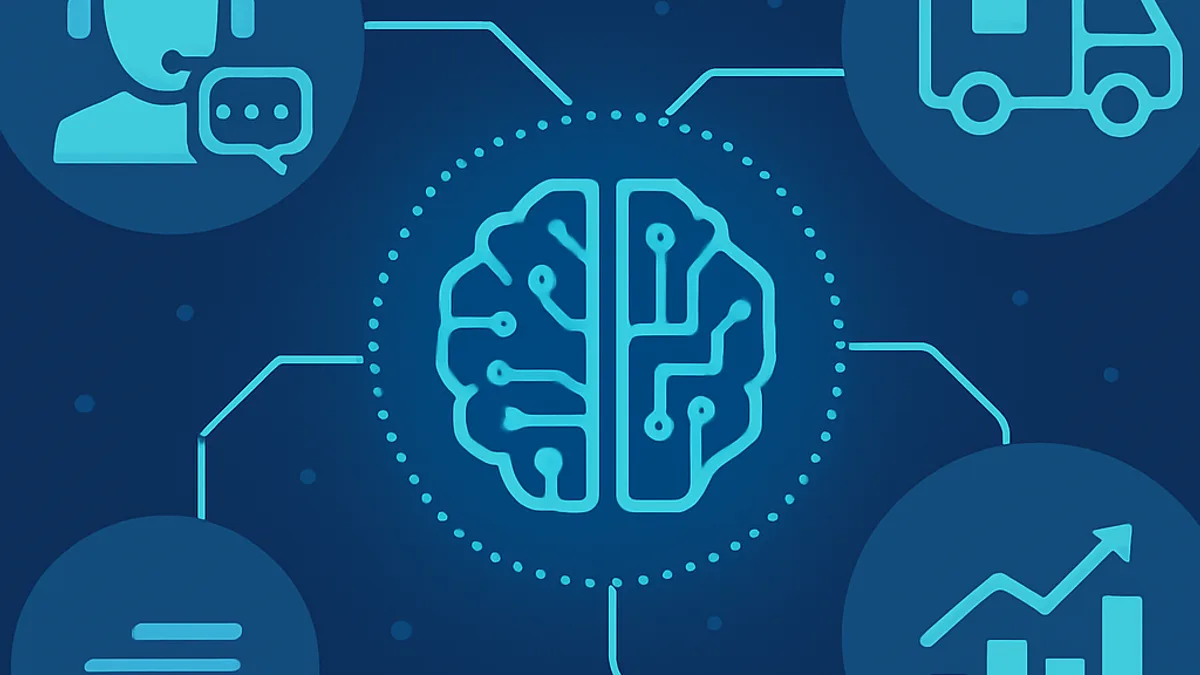
- Customer experience: AI chatbots and recommendation engines personalize service at scale. Salesforce research has reported that a majority of customers now expect companies to anticipate their needs, a gap AI helps close.
- Operations and supply chain: Predictive maintenance and demand forecasting cut downtime and overstock.
- Marketing: AI segments audiences, predicts churn, and optimizes ad spend in real time.
- Finance: Fraud detection models flag anomalies faster than manual review ever could.
- Human resources: AI screens applications, predicts attrition, and personalizes learning paths.
The common thread is decision augmentation. AI rarely replaces the whole job; it sharpens the specific decisions that drive cost and revenue. Organizations that want to operationalize these applications often pair strategy with hands-on delivery, which is where artificial intelligence services bridge the gap between a course concept and a production system.
How AI Drives Measurable Business Value
The most credible argument for AI is financial, and the data is increasingly clear. According to McKinsey's research on generative AI, the technology could add the equivalent of $2.6 trillion to $4.4 trillion annually across analyzed use cases. That value, however, concentrates among organizations that treat AI strategically rather than experimentally.

Value shows up in three measurable ways. AI reduces cost by automating repetitive tasks and lowering error rates. It increases speed by compressing analysis that once took weeks into minutes. And it creates new revenue through personalization, dynamic pricing, and products that simply were not possible before. The discipline lies in choosing one clear metric per use case and tracking it relentlessly.
Comparison: Traditional Strategy vs. AI-Driven Strategy
Understanding the shift Emeritus advocates is easier when you compare old and new operating models side by side.
| Dimension | Traditional Strategy | AI-Driven Strategy |
|---|---|---|
| Decision speed | Periodic, report-based | Real-time, continuous |
| Data use | Backward-looking | Predictive and prescriptive |
| Personalization | Broad segments | Individual-level |
| Cost structure | Labor-intensive | Automation-leveraged |
| Competitive edge | Scale and brand | Data and learning loops |
| Risk management | Reactive | Proactive monitoring |
The table makes the core insight obvious: AI does not just speed up old processes, it changes the basis of competition from physical scale to data-driven learning.
A Practical AI Adoption Roadmap
Drawing the strategy together, here is a sequence leaders can follow. It mirrors the staged thinking Emeritus promotes and avoids the common mistake of buying technology before defining purpose.

- Define the business problem. Write the use case as a decision, not a tool.
- Assess data readiness. Confirm you have relevant, clean, accessible data.
- Run a focused pilot. Pick one measurable metric and a small scope.
- Validate with stakeholders. Ensure the people who will use the output trust it.
- Integrate into workflows. Embed AI where decisions are already made.
- Monitor and govern. Track accuracy, bias, and ROI continuously.
- Scale what works. Expand proven use cases and retire the rest.
This roadmap keeps teams honest. Each stage has a gate, so resources flow only to use cases that earn the next step.
Why Leadership and Culture Decide AI Success
The most overlooked lesson from executive AI education is that culture, not code, determines outcomes. AI initiatives stall when employees fear replacement, when leaders cannot interpret results, or when incentives reward old behavior. Emeritus programs invest heavily in change management because a brilliant model nobody trusts produces zero value.
In practice, the highest-performing organizations treat AI as a shared capability. They appoint clear ownership, fund continuous learning, and celebrate decisions improved by data. Leaders who model curiosity, asking how a recommendation was generated and what it might miss, set the tone for responsible, confident adoption across every team.

Key Takeaways
- Emeritus frames AI as a management discipline first, with technology serving clearly defined business decisions.
- The core framework sequences adoption: prioritize high-value use cases, build data readiness, upskill leaders, and scale responsibly.
- Poor data quality costs organizations an average of $12.9 million annually, per Gartner, making data governance non-negotiable.
- McKinsey estimates generative AI could add $2.6 trillion to $4.4 trillion in annual value, concentrated among strategic adopters.
- AI shifts competitive advantage from physical scale to data-driven learning loops.
- Culture and leadership literacy, not algorithms alone, decide whether AI delivers measurable returns.
Frequently Asked Questions (FAQ)
What does Emeritus teach about artificial intelligence in business?
Emeritus teaches AI as a business strategy rather than pure technology. Its programs, built with universities like MIT and Wharton, focus on identifying valuable use cases, ensuring data readiness, upskilling executives, and scaling responsibly so AI produces measurable cost savings, faster decisions, and new revenue.
How do I start an AI strategy for my company?
Start by defining a specific business decision that is slow, costly, or inconsistent. Confirm you have clean, relevant data, then run a focused pilot tied to one clear metric. Validate results with the people who will use them before integrating AI into everyday workflows and scaling.
Which business functions benefit most from AI?
Customer experience, operations, marketing, finance, and human resources see the fastest returns. AI personalizes service, forecasts demand, detects fraud, optimizes ad spend, and predicts employee attrition. The strongest results come from augmenting specific high-value decisions rather than trying to automate entire departments at once.
Do leaders need technical skills to use AI effectively?
Leaders do not need to code, but they must understand AI well enough to question, validate, and act on results. AI literacy lets executives spot bias, judge reliability, and align models with business goals. This interpretive skill is exactly what executive AI education programs are designed to build.
What is the biggest reason AI projects fail?
Most AI projects fail for non-technical reasons: unclear business cases, poor data quality, and weak organizational adoption. When teams deploy AI without trusted data or stakeholder buy-in, even accurate models go unused. Treating AI as a management and culture challenge dramatically improves success rates.
Final Thoughts
The enduring lesson from the AI strategies and applications taught through Emeritus is that technology is the easy part. The hard, valuable work is choosing the right problems, preparing your data, building leadership literacy, and earning organizational trust. Master that, and AI becomes a durable competitive advantage rather than another stalled initiative. Whether you learn through an executive program or partner with specialists at ZoneTechify, the path forward starts with one well-chosen, measurable use case.